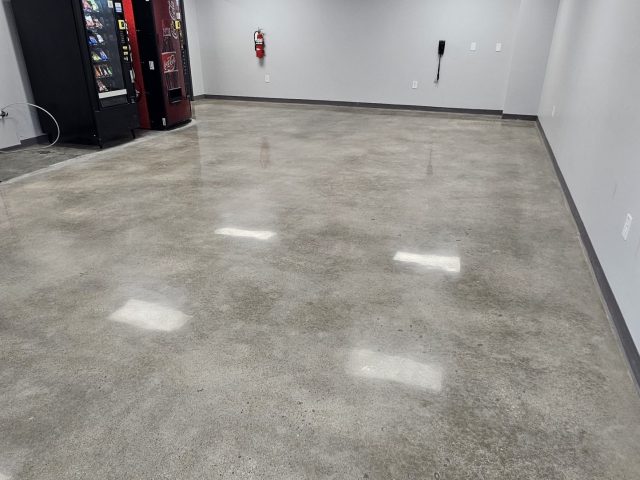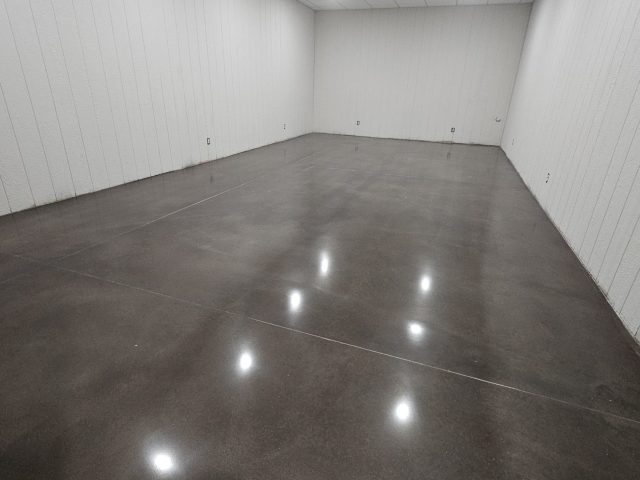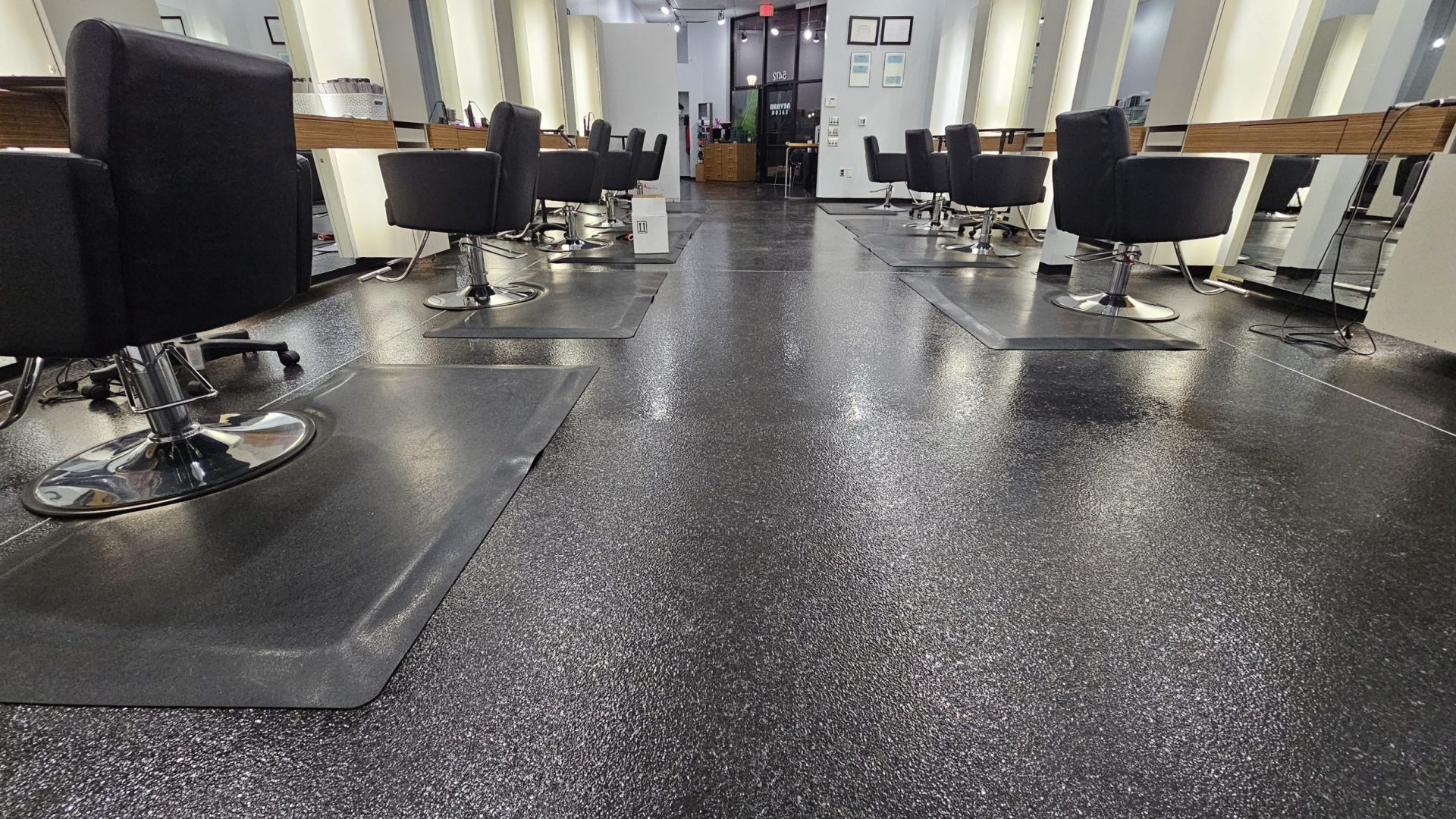
This article is written for logistics real estate developers, tenant improvement project managers, and general contractors in the Kansas City market who are specifying or overseeing polished concrete installations in distribution center and logistics facility environments. High Stakes Epoxy LLC has installed polished concrete in distribution facilities ranging from 50,000 to 500,000+ sq ft across the Kansas City metro area — from the KCI Tradeport to the Gardner and Edwardsville industrial corridors.
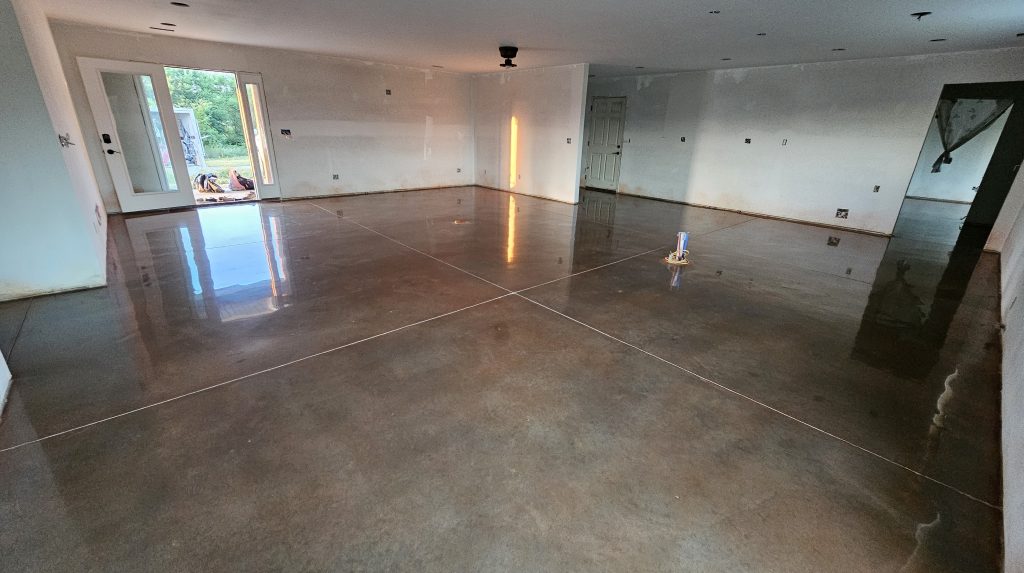
Why the Kansas City Distribution Center Market Prefers Polished Concrete
Kansas City’s central location at the intersection of I-70 and I-35 has made it one of the top 5 logistics markets in the United States. The major industrial parks — KCI Tradeport, KC Logistics Park, Lenexa Industrial Park, and the Olathe industrial corridor — are home to national and regional distribution operations for e-commerce, food and beverage, automotive aftermarket, and consumer goods. These tenants share a common flooring specification preference: polished concrete.
The reasons are well-established in the logistics real estate industry and are worth reviewing for Kansas City project teams:
- Dust-free operations: essential for e-commerce and food-grade distribution, where product contamination is a disqualifying event
- Forklift economics: harder polished surface reduces tire wear, improves battery life, reduces maintenance costs for electric forklift fleets
- Lighting efficiency: 20–30% improvement in lumen efficiency reduces operating costs over the life of the lease
- No maintenance cycle: no waxing, stripping, or topcoat reapplication — ever — reduces facility management burden
- LEED contribution: increasingly specified by institutional investors and REITs pursuing LEED certification for industrial assets
- Tenant attraction: polished concrete is now a standard amenity specification for Class A industrial leases in the Kansas City market
FF/FL Flatness Standards for Kansas City Distribution Facilities
Floor flatness (FF) and floor levelness (FL) values — as defined in ASTM E1155 — are critical for distribution facilities using high-reach, very narrow aisle (VNA), and automated material handling equipment. The following table summarizes common FF/FL requirements by facility type in the Kansas City market:
| Facility Type | Recommended FF | Recommended FL | Polishing Impact |
|---|---|---|---|
| Standard Distribution (≤40′ rack) | FF35 / FL25 | FF50 / FL35 | Grinding improves surface FF |
| High-Bay Rack (40–60′ clear) | FF50 / FL35 | FF75 / FL50 | Diamond grind + polish required |
| Very Narrow Aisle (VNA) | FF100 / FL50 | FF100 / FL50 | Super-flat slab spec required |
| Fully Automated (ASRS/AGV) | FF125+ | FF100+ | Coordinate with slab contractor |
| E-Commerce Fulfillment | FF50 / FL35 | FF75 / FL45 | Standard high-polish spec |
Polished Concrete Specification for Kansas City Distribution Centers
Phase 1: Slab Acceptance Testing
Before commencing any polishing work on a new Kansas City distribution center slab, we perform: compressive strength verification (minimum 3,500 psi for standard polish), moisture emission testing (ASTM F1869 — acceptable limits ≤ 3 lbs/1,000 sq ft/24 hrs for densifier application), flatness measurement (ASTM E1155), and visual inspection for honeycombing, cold joints, and construction contamination.
Phase 2: Coarse Metal-Bond Grinding
Metal-bond diamond tooling at 30–80 grit is used to remove surface laitance, form-release compounds, curing compounds, construction contamination, and any low spots revealed by flatness testing. High-spots are ground down to match the specified FF/FL profile. Cracks and control joints are assessed for repair.
Phase 3: Lithium Silicate Densification
After the first medium-grit pass (100–200 grit), a lithium silicate densifier/hardener is applied and allowed to penetrate the concrete. The densifier reacts with calcium hydroxide in the concrete to form additional calcium silicate hydrate — permanently hardening the surface to 6–7 Mohs hardness (comparable to granite). This step is critical for long-term dust control and abrasion resistance.
Phase 4: Progressive Resin-Bond Polishing
Resin-bond diamond pads progress from 400 through 800, 1500, and optionally 3000 grit. Each pass removes the scratch pattern of the previous pass and increases surface reflectivity. The specified final grit level is determined by the tenant’s aesthetic requirements and the project specification.
Phase 5: Concrete Guard Application
A high-performance penetrating guard (fluorochemical or silane/siloxane hybrid) is applied to the polished surface to reduce porosity, improve stain resistance, and extend the maintenance interval. This is the final step in the polished concrete process — no topcoat is applied.
Phase 6: OSHA Safety Marking
Integrated OSHA safety marking is applied using epoxy or polyurea paint compatible with the polished concrete surface. Marking systems include vehicle lane lines, pedestrian walkways, dock door staging zones, rack column protection markings, and emergency exit routes.
Polished Concrete Maintenance Protocol for Kansas City Distribution Centers
| Frequency | Activity | Product/Equipment |
|---|---|---|
| Daily | Dust mop or auto-scrub entire floor | HEPA auto-scrubber or microfiber dust mop |
| Weekly | Wet mop with neutral pH cleaner | pH 7 concrete-specific cleaner, microfiber mop |
| Monthly | Inspect for wear zones in high-traffic paths | Visual inspection + DCOF spot test if needed |
| Annually | Apply concrete guard to high-traffic areas | Compatible fluorochemical or siliconate guard |
| Every 5–10 yrs | Professional maintenance polish (burnish) | High-speed burnisher or professional re-polish |
Lifecycle Cost Analysis: Polished Concrete vs. VCT in Kansas City Distribution
| Cost Item | VCT (100,000 sq ft) | Polished Concrete (100,000 sq ft) |
|---|---|---|
| Installation | $200,000–$400,000 | $350,000–$650,000 |
| Annual Maintenance (Year 1–15) | $75,000–$150,000/yr | $5,000–$15,000/yr |
| Replacement at Year 15 | $200,000–$400,000 | $0 |
| 15-Year Total | $1,525,000–$2,950,000 | $425,000–$875,000 |
| Estimated 15-Year Savings | — | $1,100,000–$2,075,000 |
| 📋 Get Expert Distribution Center Flooring Spec Support — Contact High Stakes Epoxy LLC in Kansas City Today! |
|---|
FAQ — Polished Concrete for Distribution Centers Kansas City
Q: What polished concrete spec is standard for Class A industrial in the Kansas City market?
A: The current Class A industrial standard in the Kansas City market is a 1000–1500 grit polished concrete with lithium silicate densifier and a fluorochemical guard treatment, installed on a minimum 3,500 psi slab with FF50/FL35 flatness values. OSHA aisle marking is included in the standard specification.
Q: How long does it take to polish 100,000 sq ft of distribution center floor in Kansas City?
A: A well-equipped crew can polish 8,000–12,000 sq ft per day per machine with a full polishing sequence (4–6 passes). A 100,000 sq ft project typically takes 9–13 working days. For tight tenant move-in timelines, we mobilize multiple machines and crews to accelerate the schedule.
Q: Can polished concrete be repaired if damaged by forklift incidents in a Kansas City distribution center?
A: Yes. Polished concrete can be locally repaired by re-polishing the damaged area and blending the new polish into the surrounding floor. For significant impact damage, concrete repair mortar is used to fill the damaged area before re-polishing. The result is seamless and virtually undetectable.
See more of our work on the High Stakes Epoxy website.