Car wash and auto detailing facilities in Kansas City present a uniquely demanding flooring environment: constant water exposure, hot tire contact, acidic and alkaline cleaning chemicals, sodium hypochlorite brighteners, silicone-based protectants, high-pressure spray, and vehicle traffic — all in a space where slip resistance is a matter of customer and employee safety. High Stakes Epoxy LLC has installed flooring in car wash tunnels, express detail facilities, full-service auto spa operations, and fleet wash facilities throughout Kansas City, KS, Overland Park, Lenexa, and the greater metro area.
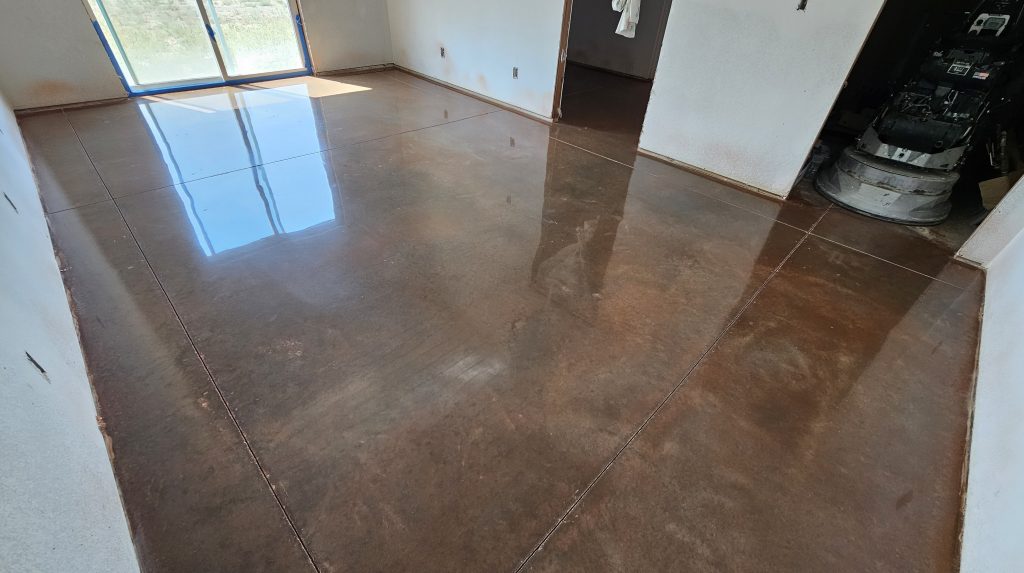
Car Wash Flooring Zones & Requirements
| Zone | Key Challenge | Recommended System | Cost/Sq Ft |
|---|---|---|---|
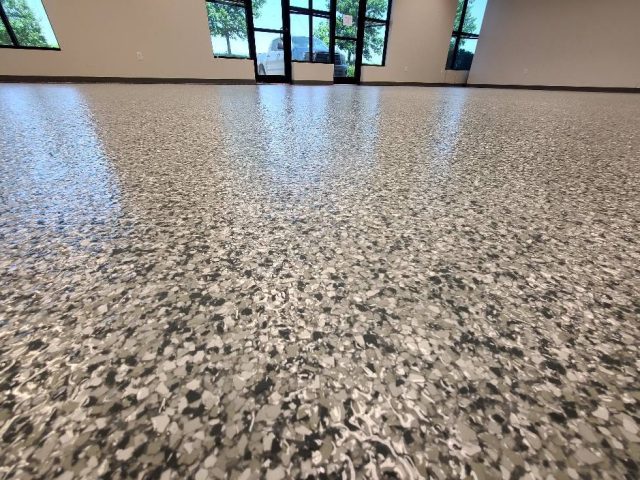
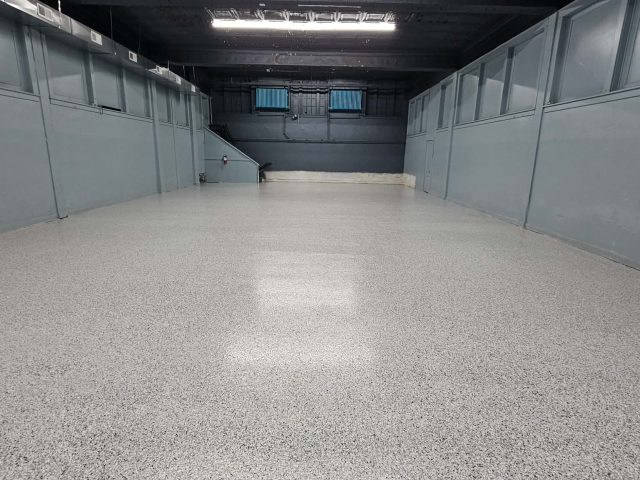
| Tunnel Floor | Constant water, chemicals, vehicle traffic | Quartz Broadcast Epoxy | $7–$12 |
| Detail Bay | Chemical spills, hot water, vehicle tires | Quartz Broadcast or Polished Concrete | $6–$10 |
| Vacuum Area | Light traffic, aesthetics | Polished Concrete or Flake Epoxy | $4–$8 |
| Customer Lobby | Aesthetics, slip resistance | Polished Concrete or Metallic Epoxy | $5–$10 |
| Equipment Room | Chemical storage, mechanical | Epoxy Mortar or Quartz Epoxy | $7–$12 |
| Office/Retail Area | Durable, attractive | Polished Concrete | $5–$8 |
Critical Performance Requirements for Car Wash Floors
Chemical Resistance Profile
Car wash chemicals include: tire and wheel cleaners (high pH caustic), triple foam soap, carnauba wax emulsions, tire shine silicones, sodium hypochlorite (bleach brightener), acid wheel cleaner (low pH), and pressure washing detergent. A properly specified quartz broadcast epoxy system handles this full chemical profile. Standard coatings and inadequate systems will show chemical attack degradation within months.
Sustained Wet Slip Resistance
Car wash floors are wet virtually 100% of the operating day. OSHA requires a minimum DCOF of 0.42 on wet surfaces. For car wash tunnels and detail bays, we specify quartz broadcast epoxy systems that achieve DCOF of 0.60–0.80 wet — significantly above the minimum, providing genuine protection against slip-and-fall incidents.
Drainage Design
Effective drainage design is essential for car wash facility floors. We install epoxy systems on sloped concrete (minimum 1/8 to 1/4 inch per foot) toward trench drains or floor drains throughout the wash and detail areas. Drain surrounds receive additional chemical-resistant topcoat for the highest chemical concentration zones.
Epoxy vs. Tile for Car Wash Facilities in Kansas City
| Factor | Epoxy System | Quarry Tile |
|---|---|---|
| Installed Cost | $7–$12/sq ft | $12–$20/sq ft |
| Grout Lines | None — seamless | Yes — require regular cleaning |
| Slip Resistance | Excellent (DCOF 0.60–0.80 wet) | Good (depends on tile spec) |
| Chemical Resistance | Excellent | Good (grout is the weak point) |
| Repair | Spot re-coat | Re-tile individual units |
| Lifespan | 10–20 years | 20–30 years (tile only; grout shorter) |
| Maintenance | Low — hose clean | Moderate — grout requires treatment |
| Best For | New construction, value-conscious | Premium full-service car spas |
Project Showcase: Car Wash Flooring in Kansas City
Lenexa Express Car Wash — Full Tunnel + Vacuum Canopy Epoxy
A new express car wash in Lenexa required complete flooring for their 120-foot tunnel, vacuum island, and equipment room. We installed a broadcast quartz epoxy system throughout the tunnel with a DCOF of 0.72 wet, polished concrete under the covered vacuum canopy, and an epoxy mortar system in the equipment room housing the chemical injection systems. The tunnel floor has operated through its first three years of high-volume wash operations without a single slip incident report.
| 🚗 High-Performance Car Wash Flooring in Kansas City — Contact High Stakes Epoxy LLC for a FREE Facility Assessment! |
|---|
FAQ — Car Wash Flooring Kansas City
Q: How long does car wash epoxy flooring last in Kansas City?
A: A properly specified and installed quartz broadcast epoxy system in a Kansas City car wash typically lasts 10–15 years before topcoat renewal is needed. The primary wear factors are chemical concentration, wash volume (cars per day), and cleaning protocol. We provide maintenance guidance to maximize service life.
Q: Can epoxy flooring handle the chemical environment of a full-service car wash in Kansas City?
A: Yes — with the right specification. We use epoxy formulations with documented resistance to the full range of car wash chemicals including sodium hypochlorite, acid wheel cleaners, high-pH caustic cleaners, and silicone-based protectants. We provide chemical resistance documentation for all car wash flooring installations.
Q: Is car wash flooring installation disruptive to operations in Kansas City?
A: For new construction, installation is straightforward. For renovation of operating facilities, we schedule phased installation by zone — maintaining operation of unaffected areas. Polyaspartic topcoat systems allow vehicle traffic return in 24 hours for fast-turnaround renovation projects.
See more of our work on the High Stakes Epoxy website.