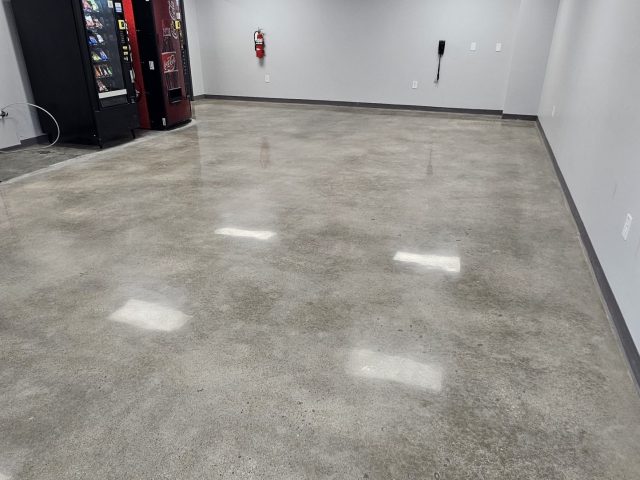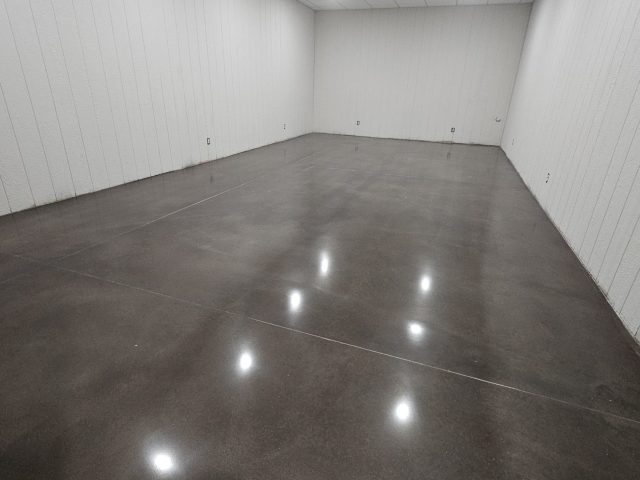
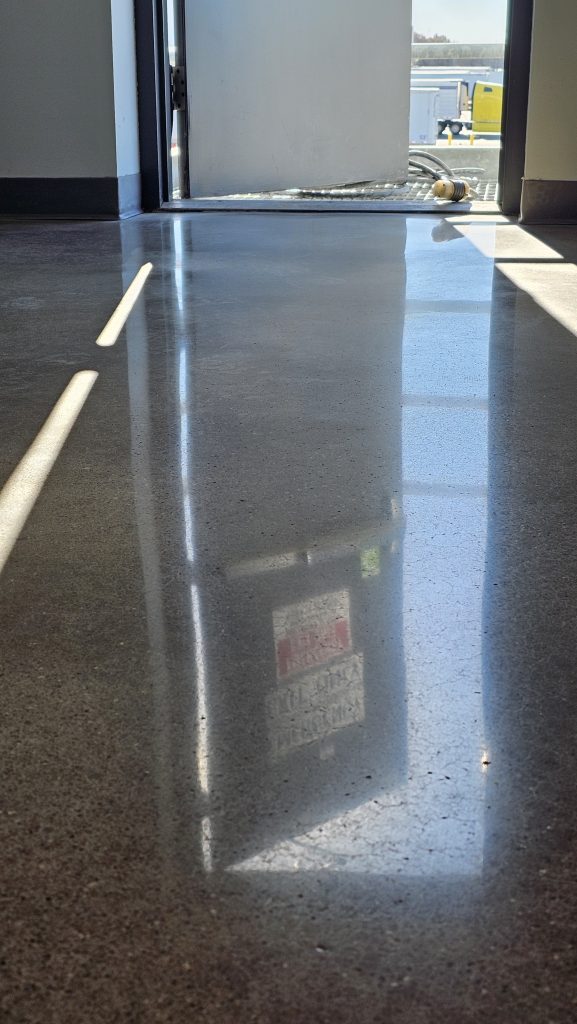
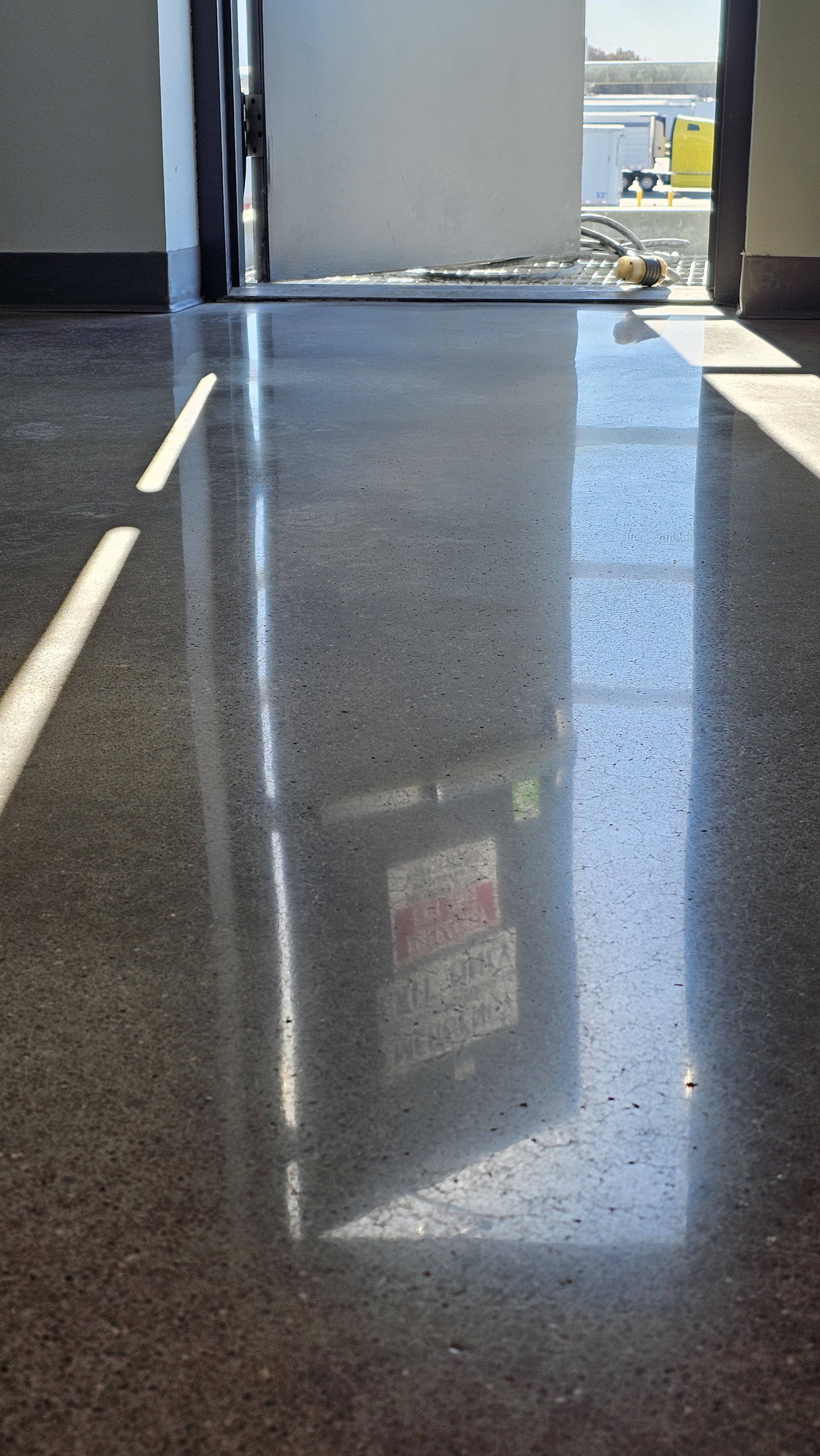
Johnson County school districts, KCMO Unified, and the suburban districts stretching from Blue Valley to Olathe are facing a common facilities challenge: aging VCT (vinyl composite tile) floors that require continuous, expensive maintenance, generate volatile organic compounds during stripping and waxing operations, and still look institutional and dated even when freshly buffed. Polished concrete has emerged as the replacement specification of choice for K-12 schools across the Kansas City metro, driven by compelling 10-year cost data, improved indoor air quality, and a lifespan that outlasts the building’s HVAC system.
The Problem with VCT in Kansas City Schools
VCT was the standard school flooring specification for decades because it was inexpensive to install. The maintenance cost story, however, is deeply unfavorable. A typical 100,000 sq ft school floor on a standard VCT maintenance program requires monthly buffing, quarterly scrubbing and recoating, and annual strip-and-wax cycles. At commercial labor rates in the KC metro ($45–$65/hour for custodial and contracted floor care), this adds up to $0.80–$1.50 per square foot per year in maintenance costs — before factoring in the VOC exposure during chemical stripping.
There is also a structural issue: VCT must be replaced every 10–15 years. Schools built in the 1980s and 1990s are now on their second or third replacement cycle, at $2–$3.50/sq ft installed. The cumulative investment in a floor system that still generates maintenance costs is increasingly difficult to justify when polished concrete offers a permanent alternative.
VCT vs. Polished Concrete: 20-Year Total Cost of Ownership
| Cost Element | VCT (per sq ft) | Polished Concrete (per sq ft) |
|---|---|---|
| Initial installation | $2.00 – $3.50 | $3.50 – $6.00 |
| Annual maintenance (×20 years) | $16.00 – $30.00 | $2.00 – $4.00 |
| Replacement at year 12–15 | $2.00 – $3.50 | $0 (no replacement needed) |
| 20-Year Total | $20.00 – $37.00 | $5.50 – $10.00 |
Indoor Air Quality Benefits for Kansas City Classrooms
VCT stripping and waxing uses solvents and floor finishes that off-gas VOCs into occupied school buildings. The American Lung Association and the EPA have flagged school IAQ as a public health priority, and floor maintenance chemicals are a documented contributor. Polished concrete eliminates this chemistry entirely: the maintenance protocol uses only water and pH-neutral cleaners, with no stripping, no waxing, and no solvent application — ever. For school districts navigating parent and community concerns about chemical exposure in school buildings, the elimination of floor maintenance VOCs is a meaningful and communicable benefit.
Durability in High-Traffic School Environments
K-12 hallways are among the highest foot-traffic environments in any commercial building category. A Level 3 polished concrete floor with a lithium densifier and annual burnishing withstands this traffic without degradation. The densifier chemically hardens the concrete surface to 6,000–8,000 PSI, and the polishing process closes surface pores that would otherwise collect dirt and grit. Kansas City school districts that have transitioned to polished concrete in hallways, cafeterias, and gyms consistently report that maintenance staff spend significantly less time on floor care — hours that are redirected to other custodial priorities.
Kansas City School District Implementation
High Stakes Epoxy has worked with school facilities directors in the Johnson County and KCMO school systems to develop summer-installation schedules that complete full hallway and cafeteria conversions during the 10-to-12-week school break. A typical 100,000 sq ft school floor can be polished in 3–4 weeks at full crew deployment. For districts with phased capital budgets, high-traffic areas (main hallways, cafeteria, gym lobby) can be completed in year one with remaining areas in subsequent summers.
Frequently Asked Questions: School Flooring in Kansas City
Is polished concrete safe for school hallways?
Yes. A Level 2 or 3 polished concrete floor (matte to semi-gloss) provides a slip resistance COF above 0.5 in dry conditions and above 0.4 in typical wet conditions — meeting OSHA and school safety standards. High gloss (Level 4) is not recommended for school corridors; a Level 2–3 finish balances reflectivity for lighting efficiency with appropriate slip resistance.
How much does it cost to replace VCT with polished concrete in a Kansas City school?
Total project cost including VCT removal, surface prep, and Level 3 polishing typically runs $4.50–$8.00 per square foot in the Kansas City market. For a 50,000 sq ft school floor, the total investment of $225,000–$400,000 pays back within 5–8 years through maintenance savings alone.
Can school floors be polished while school is in session?
Polishing generates stone dust and requires ventilation; it is strongly recommended to complete work during school breaks. However, individual classroom or wing conversions can be sequenced during school-year breaks (winter, spring) with proper containment.
How do you maintain polished concrete in a school?
Daily: auto-scrub or dust mop. Weekly: damp mop with neutral cleaner. Annual: high-speed burnish. That is the complete protocol — no stripping, no waxing, no chemical strippers. Most KC school custodians can manage the maintenance with existing equipment after a brief training session.
Does polished concrete work in school gymnasiums?
Polished concrete is not recommended under hardwood gym floors (the substrate must remain stable for hardwood adhesion). For auxiliary gyms and multi-purpose spaces with direct concrete floors, a Level 2 polished concrete with a sport-specific slip resistance treatment is an excellent, durable choice.
See more of our work on the High Stakes Epoxy website.