Most flake floor quotes never mention chip size. The customer picks a color, the crew broadcasts whatever is on the truck, and nobody discusses the one spec that changes how the floor looks, how much grip it has and how well it hides the slab underneath.
For Butler Supply’s new Lenexa, KS branch we specified 1/4-inch flake in a gravel blend rather than the standard 1/8-inch. It was a deliberate call, and on a commercial floor this size it made a visible difference. Here is what flake size actually does, why the larger chip suited this building, and what it means for a commercial budget.
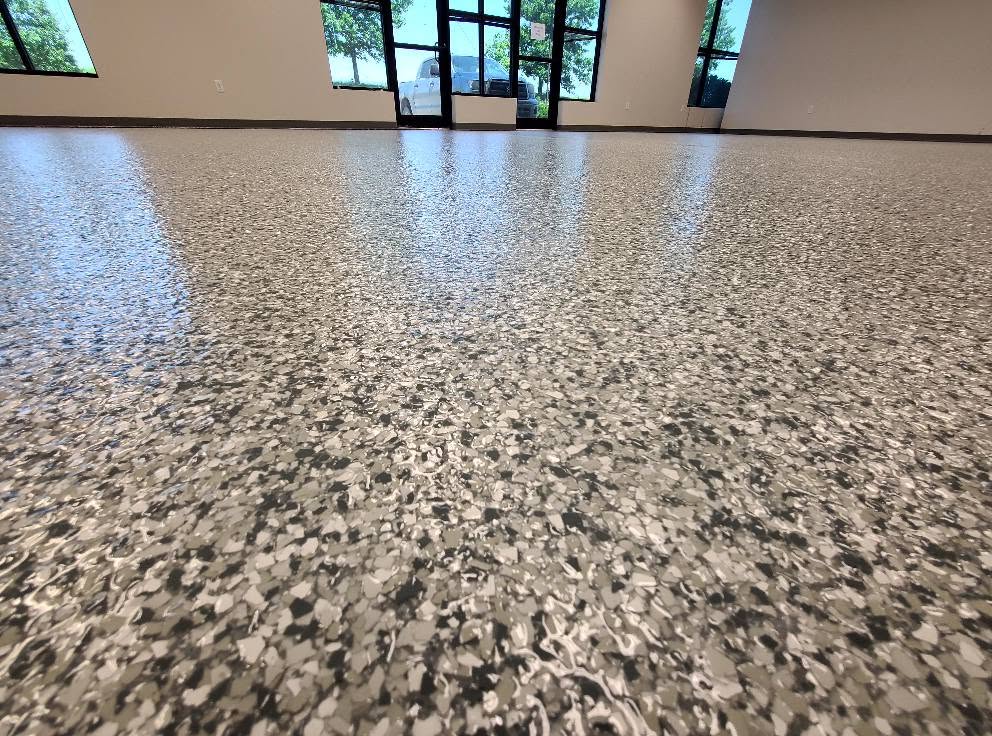
Project snapshot
| Client | Butler Supply, a wholesale electrical and plumbing products distributor |
|---|---|
| Location | New branch in Lenexa, KS (Johnson County) |
| Spaces | Main sales floor and showroom, counter area, corridors, entry vestibule, restrooms |
| Existing floor | Previous floor covering removed, leaving adhesive residue and trowel-swirl shadows across the slab |
| Prep | Full-floor diamond grinding with HEPA dust collection, adhesive removal, joint and crack detail |
| System | 1/4-inch flake, gravel blend, broadcast to rejection, clear protective topcoat |
| Details | Coved base at the perimeter, coating carried through restrooms, corridors and the vestibule |
What “1/4-inch flake” actually means
Flake, chip, fleck: they are the same thing. Colored vinyl chips broadcast into a wet pigmented base coat, then locked down under clear topcoats. The number is simply the nominal size of the chip.
- 1/8 inch is the residential default. It is what most garage floors get and what most people picture when they hear “flake floor”.
- 1/4 inch is roughly double that dimension, which means noticeably more surface area per chip and a much coarser visual grain.
- 1/2 inch and larger exist and read almost like terrazzo, though they demand considerably more topcoat to bury.
“Broadcast to rejection” matters just as much as size. It means chips are thrown into the wet base until the floor will not accept any more, so the surface is fully covered rather than lightly sprinkled. A partial broadcast in any chip size is where cheap floors come from.
1/8 inch versus 1/4 inch: what actually changes
| 1/8-inch flake | 1/4-inch flake | |
|---|---|---|
| Look at standing height | Fine speckle, can read as vinyl or sheet goods across a big room | Coarse, stone-like grain that reads as a finished architectural surface |
| Texture underfoot | Moderate | More pronounced, better grip before any additive |
| Build thickness | Standard | Higher, because a bigger chip carries more material |
| Hiding slab variation | Good | Better, especially over repairs and adhesive shadows |
| Topcoat required | Standard | More, to fill and level between larger chips |
| Cleaning | Easy | Easy, provided the topcoat properly levels the profile |
| Best suited to | Garages, smaller rooms, residential | Large commercial floors, showrooms, entries, anywhere seen at distance |
The last row is the one that decides it. A chip that looks generous in a 400 square foot garage disappears into visual noise across a commercial sales floor. Scale the room up and you have to scale the chip up with it, or the floor reads as flat and cheap from across the room.
Why the larger chip was right for this building
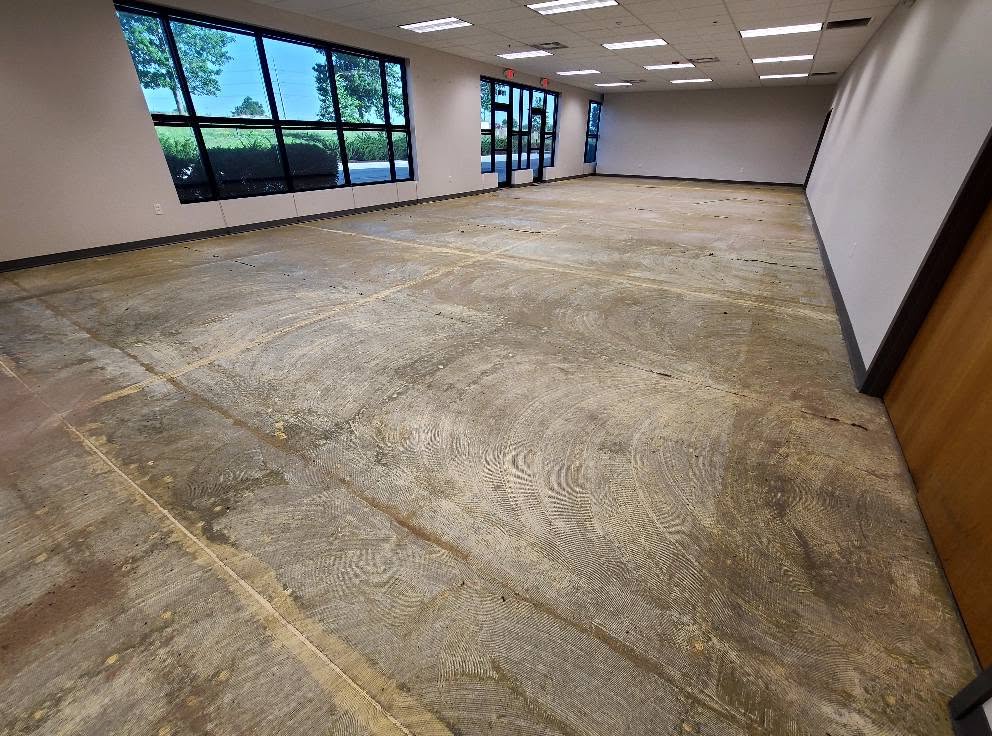
Three things about this space pushed the spec.
It is seen at distance. Open sales floor, long sightlines, big storefront glazing pouring daylight across everything. Nobody experiences this floor from three feet away; they see it as a whole surface from thirty. A coarser grain holds up at that viewing distance where a fine speckle flattens out.
The slab had a history. Under the old floor covering was adhesive residue and trowel-swirl shadowing across the whole area. Grinding takes off the adhesive, but a slab that has carried glue for years is never uniform underneath. A larger chip breaks up the surface far more aggressively, so what is left of the slab’s history stops registering.
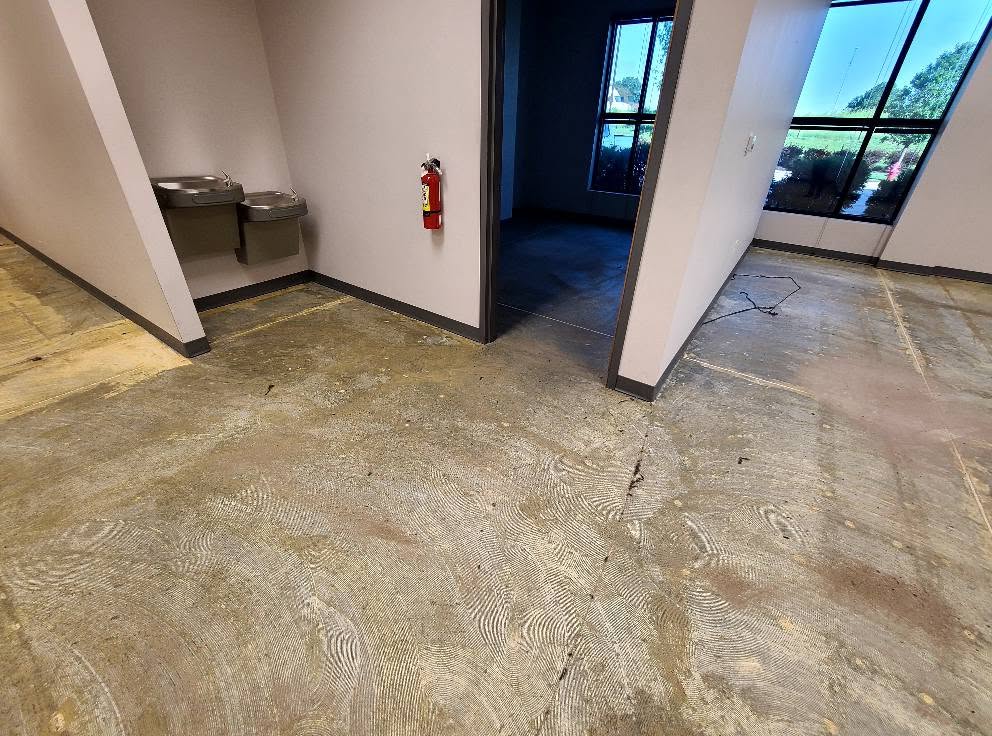
It takes wheels and weight. A supply house floor deals with hand trucks, carts, pallet jacks, staged product and counter traffic all day. The extra film thickness that comes with a bigger chip is genuinely useful, and so is the additional texture at the entry where people walk in wet.
The transformation
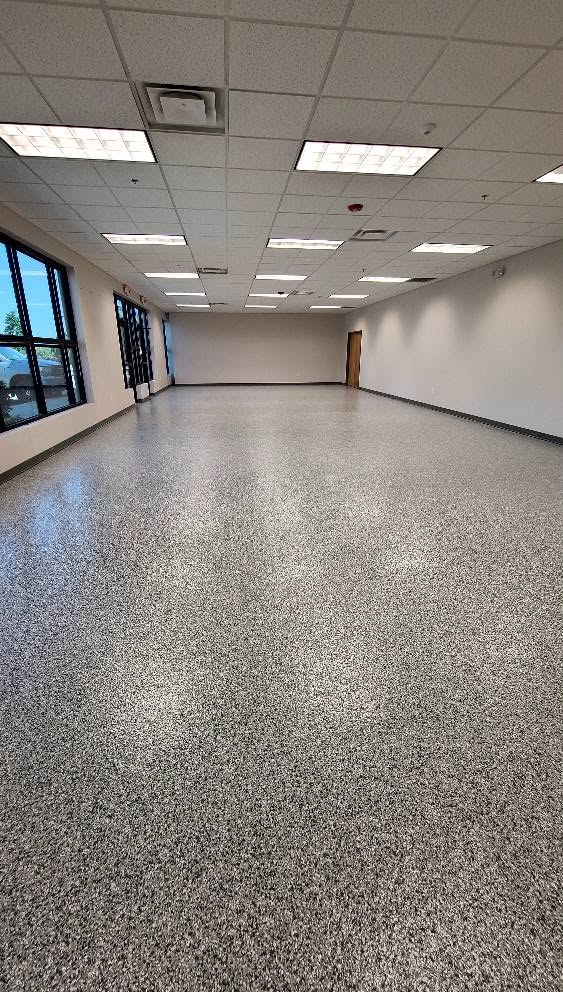
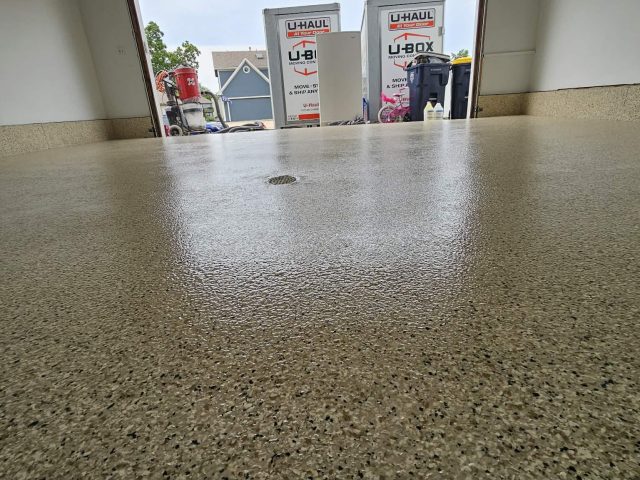
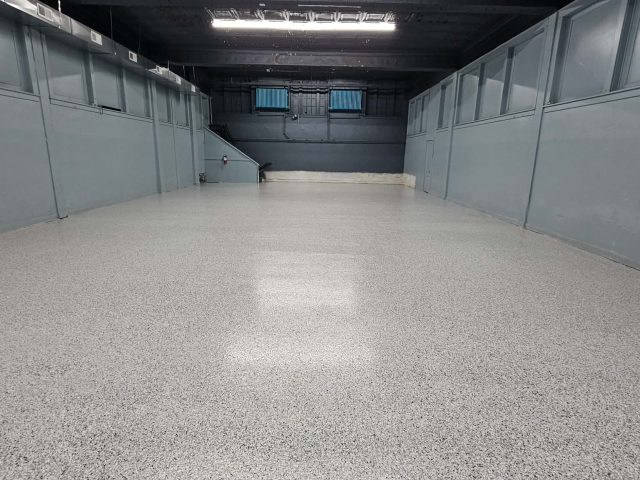
Same room, same sightline. That is what a full-broadcast 1/4-inch floor does to a slab that had spent years under something else.
How it went down
- Grind the entire floor. Adhesive residue and old surface material removed, the concrete opened up so the base coat keys in mechanically. All of it through HEPA dust collection, which matters in a building being fitted out for opening.
- Detail the slab. Joints and cracks addressed before anything is coated, so nothing telegraphs through the finish later.
- Pigmented base coat. Rolled into the profiled concrete, and this is the layer the chips have to land in while it is still wet.
- Broadcast to rejection. The 1/4-inch gravel blend cast in until the floor takes no more. Larger chips are heavier and fall differently than 1/8-inch, so the throw and the coverage rate both change. This is where experience with the specific chip size shows.
- Scrape and vacuum. Loose chip removed so the surface is even before the clear goes on. Bigger flake leaves more standing proud, so this step takes longer than it does on a fine broadcast.
- Clear topcoats. The clear fills between the chips, levels the profile and carries all the abrasion, chemical and traffic resistance. On a 1/4-inch floor you need more of it, and skimping here is how a coarse floor ends up feeling rough instead of finished.
The rooms most bids leave out
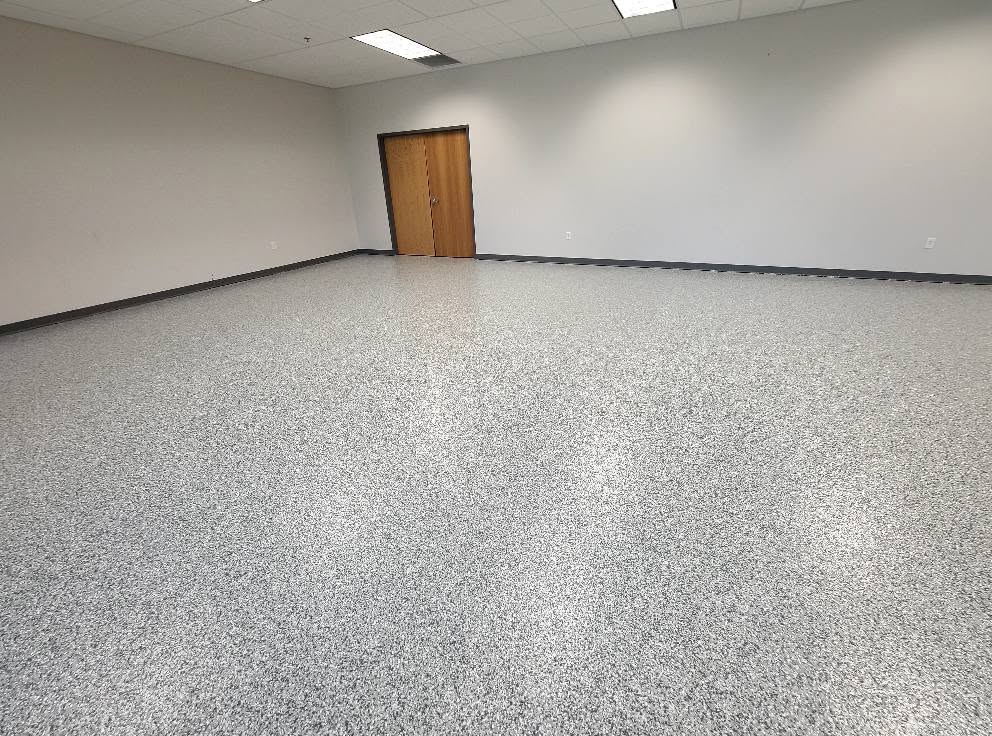
A commercial coating quote is easy to underprice by scoping only the main floor. In a retail or counter environment the floor is continuous in the customer’s experience, so it should be continuous in the specification.
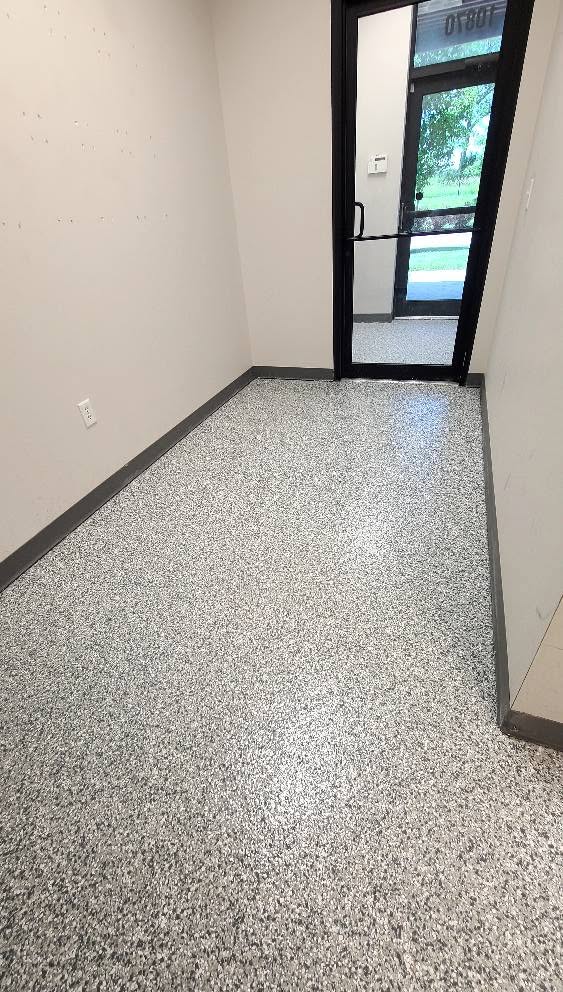
The entry vestibule is the highest-wear square footage in the building and the wettest, because everyone arrives through it in whatever the weather is doing. It is also the first thing anyone sees.
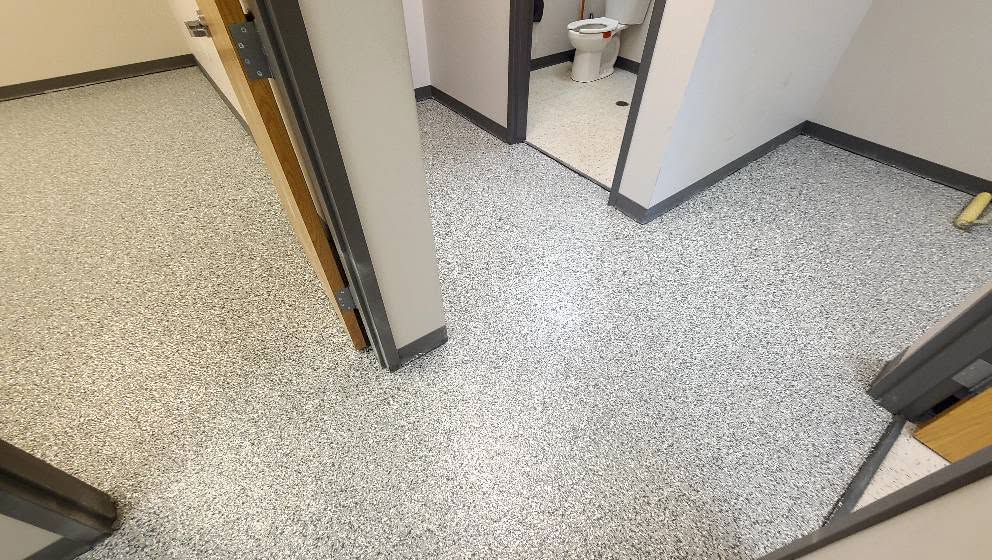
Restrooms and back corridors got the same system rather than a cheaper substitute. That means no transition strips, no change in cleaning routine between rooms, and no grout lines in the one room where grout lines cause the most trouble. Coved base runs the perimeter throughout, which seals the floor-to-wall joint and makes the whole space mop-and-go.
Where the floor belongs in a fit-out schedule
A new location has an opening date, and the floor is one of the few trades that can hold everything behind it. Coating too early means it gets destroyed by the trades that follow. Too late and it delays fixtures, racking and stocking. There is a window, and it is narrower than most schedules assume.
- After the dirty work. Drywall sanding, ceiling grid, paint and overhead mechanical all generate dust and overspray. Coating before those are finished means grinding contamination into a floor you are about to seal.
- Before fixtures and racking. Once shelving is anchored and product is staged, a continuous floor becomes a floor with obstacles, and continuous is the entire point. Coating around installed racking costs more and looks worse.
- Cure time is the constraint, not labor. The crew can be off site quickly. The floor still needs its cure before heavy rolling loads and anchored equipment arrive. That is a scheduling fact, not a negotiation, and building it into the program early costs nothing.
- Protect it afterward. If other trades have to work over a finished floor, it gets covered. A properly cured coating handles traffic fine, but dropped fittings and dragged steel are a different matter.
The practical version for a general contractor or project manager: give the floor a defined slot rather than the leftover days at the end, and tell your coating contractor the open date at the bid stage rather than the week before.
What a commercial flake floor costs
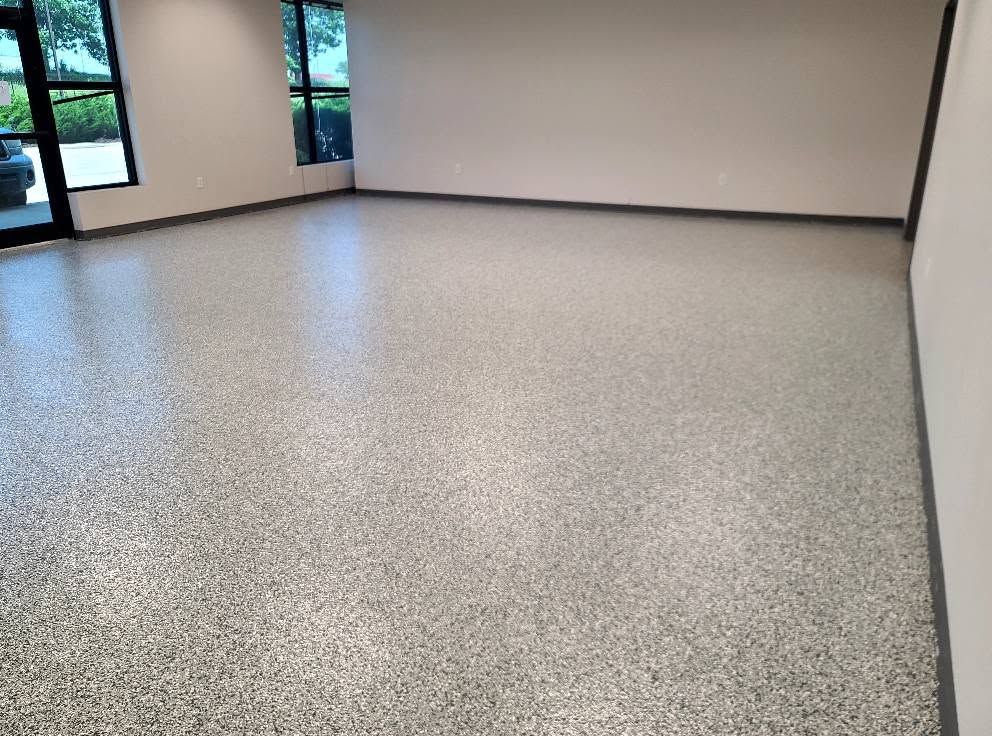
Broadcast flake for commercial spaces generally runs $4 to $8 per square foot installed. Where a project lands inside that range comes down to four things, and chip size is only one of them.
| Variable | Effect on price |
|---|---|
| Removal of existing flooring and adhesive | Usually the largest single variable. Adhesive is slow to grind. |
| Slab repair | Priced after the floor is exposed, so a good contractor sets an allowance |
| Chip size | 1/4-inch carries a modest premium over 1/8-inch, mostly in additional topcoat |
| Square footage | Larger floors cost less per square foot as fixed setup spreads out |
| Schedule | Night, weekend or phased work around other trades adds cost |
Our commercial epoxy flooring cost guide breaks the scaling down by industry and project size.
How to choose a chip size for your space
A short decision guide, since almost nobody is offered this choice:
- Residential garage, small room, tight budget: 1/8-inch. It does the job and there is no reason to pay for more.
- Large open commercial floor, showroom, retail, anything seen at distance: 1/4-inch. The grain holds up at viewing distance and hides far more.
- A slab with a rough history, old adhesive or extensive repairs: lean larger. Bigger chip, better camouflage.
- Wet areas, entries, ramps: larger chip, or 1/8-inch with an anti-slip additive in the topcoat.
- Commercial kitchens, food and beverage, heavy chemical exposure: neither. That is quartz broadcast or urethane concrete territory.
If a contractor cannot tell you what chip size is in their quote, that is worth noticing. It usually means whatever is in the van.
Frequently asked questions
What is 1/4-inch flake flooring?
It is a broadcast flake system using quarter-inch vinyl chips instead of the more common eighth-inch. The chips are cast into a wet pigmented base coat until the floor will take no more, then locked under clear topcoats. The larger chip gives a coarser, stone-like appearance, more texture and more film thickness.
Is 1/4-inch flake better than 1/8-inch?
Not better, different. Quarter-inch suits large commercial floors seen at a distance, slabs with a history to hide, and areas needing extra grip. Eighth-inch is the sensible default for garages and smaller rooms. The room size is usually what decides it.
Does a bigger flake cost more?
Slightly. The chips themselves are a modest part of the cost, but a larger chip needs more clear topcoat to fill and level between the flakes, and that is where the premium sits. On most commercial projects, floor prep and existing-flooring removal move the number far more than chip size does.
Is a 1/4-inch flake floor harder to clean?
No, provided the topcoat properly levels the profile. That is the test of the install: a well-topcoated quarter-inch floor cleans like any other sealed floor, with a dust mop and an auto-scrubber or damp mop. A floor that feels rough underfoot has been under-coated.
How much does commercial flake flooring cost in Kansas City?
Broadcast flake for commercial spaces generally runs $4 to $8 per square foot installed. Removal of existing flooring and adhesive, slab repair, total square footage and the work schedule move a project within that range more than the coating specification does.
Can flake flooring go in a retail sales floor?
Yes, and it suits the environment well. It handles carts, hand trucks and pallet jacks, hides the dirt that comes through a front door, and has no seams or grout lines. A larger chip is worth specifying so the floor still reads well from across a big room.
Do you have to remove the old flooring first?
Yes. Old floor covering and its adhesive both have to come off, and adhesive is ground off rather than pulled up. A coating can only be as sound as the surface it bonds to, so anything left behind becomes a future failure.
Should restrooms and entries get the same floor?
They should. Running one system through restrooms, corridors and the vestibule removes transition strips, keeps one cleaning routine across the building, and eliminates grout lines in the rooms where grout is the biggest maintenance problem. Coved base at the perimeter seals the floor-to-wall joint.
Can this be installed during a store fit-out?
Yes, and it usually is. Coating works best after the messy trades and before fixtures, racking and inventory arrive. The practical constraint is cure time, not labor, so it needs a slot in the schedule rather than a squeeze at the end.
Do you work in Lenexa and Johnson County?
Yes. High Stakes Epoxy LLC serves the Kansas City metro on both sides of the state line, including Lenexa, Overland Park, Olathe and Shawnee.
Specifying a floor for a commercial space?
If you are fitting out a branch, a showroom or a counter operation, the floor is worth more than five minutes at the end of the schedule. Chip size, broadcast coverage, topcoat quantity and what happens to the restrooms and the vestibule are all decisions, and they are all decisions somebody makes whether or not they tell you about it.
Call (816) 820-8193, Monday through Saturday, 7:00am to 6:00pm, or request a free quote online. High Stakes Epoxy LLC is a locally owned, licensed and insured commercial concrete coating contractor serving the Kansas City metro.
More for commercial buyers: our flake coating service page, retail flooring in Kansas City, showroom flooring, the 6,000 sq ft flake install at Central Baptist Church, and concrete prep and removal for what happens before any coating goes down.