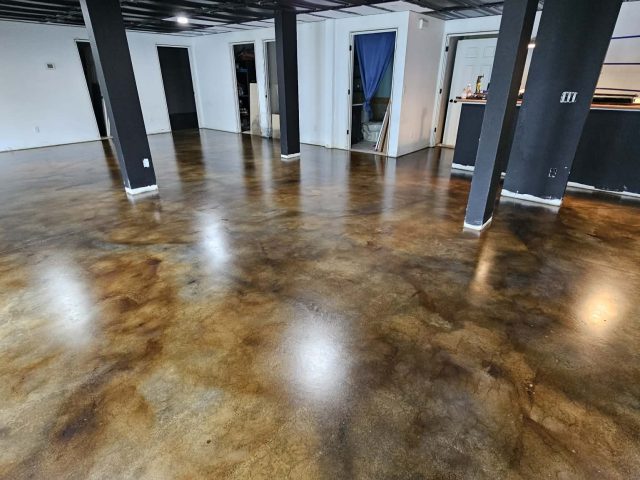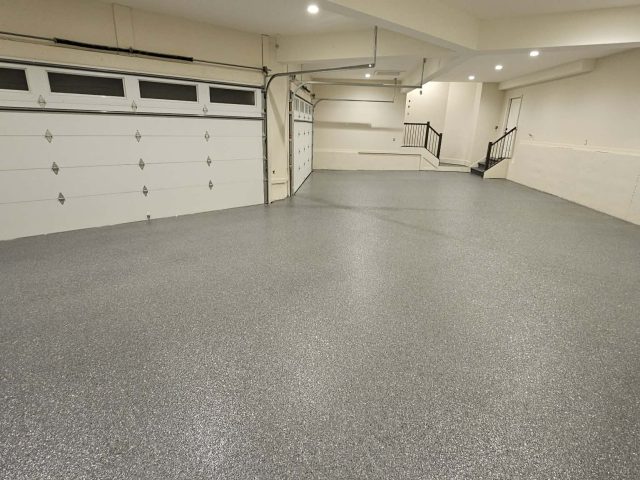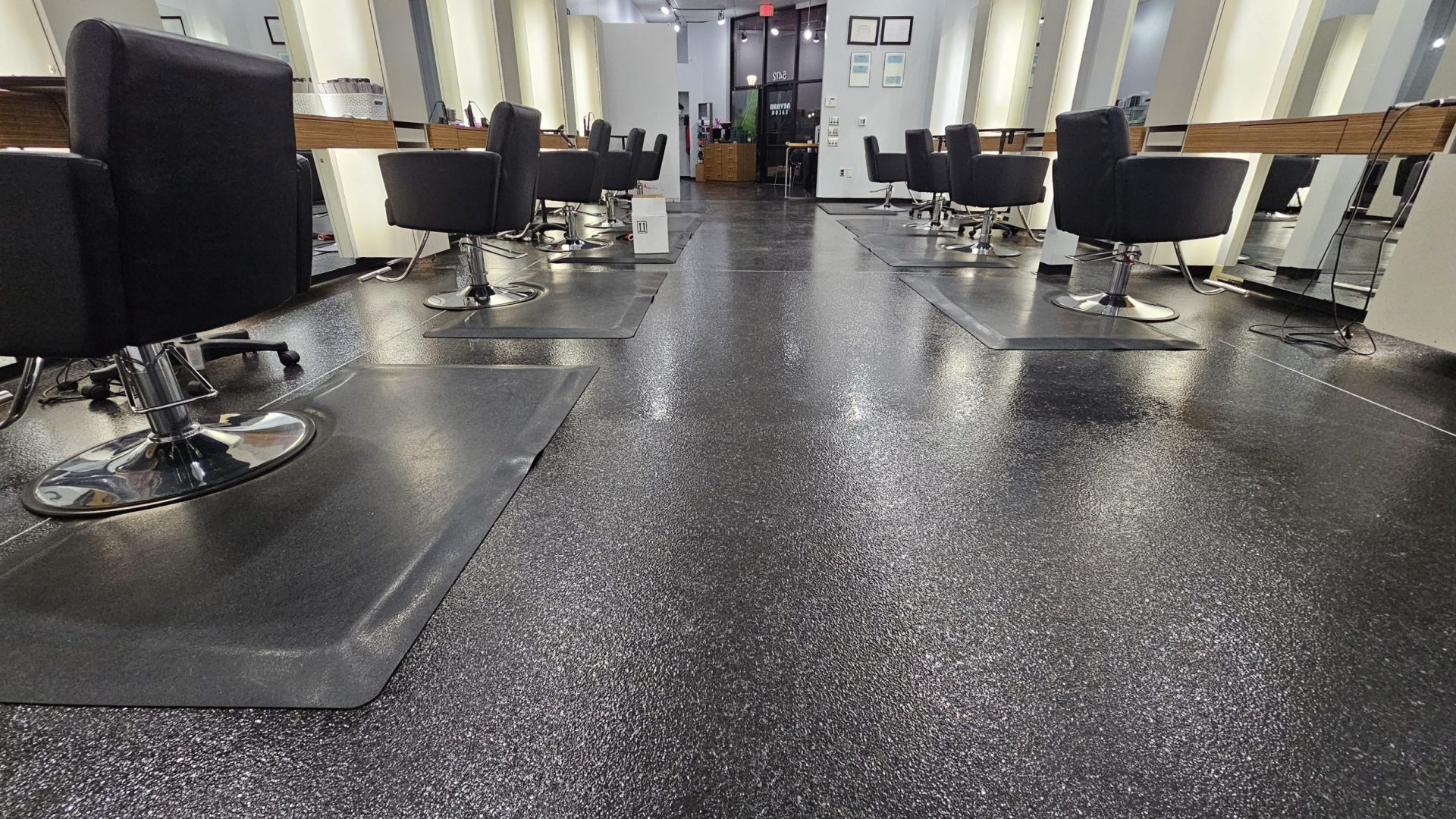
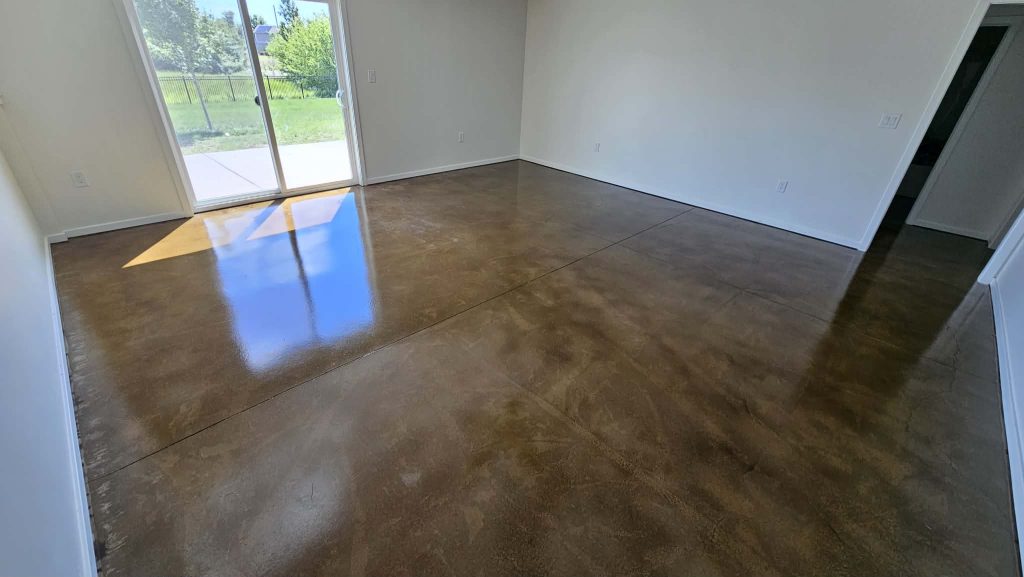
Almost every finished basement in the Kansas City metro gets carpet. Not because anyone chose it, but because it is what goes in by default: it is cheap up front, the builder does it, and nobody thinks about it again until it has to come out. This 1,000 square foot lower level in Peculiar, MO went the other way. The concrete that was already there got stained and sealed, and it now runs continuously through the living area, the bedrooms, the hallway and the walk-in closet. Here is the case for doing that, and the honest version of what you give up.
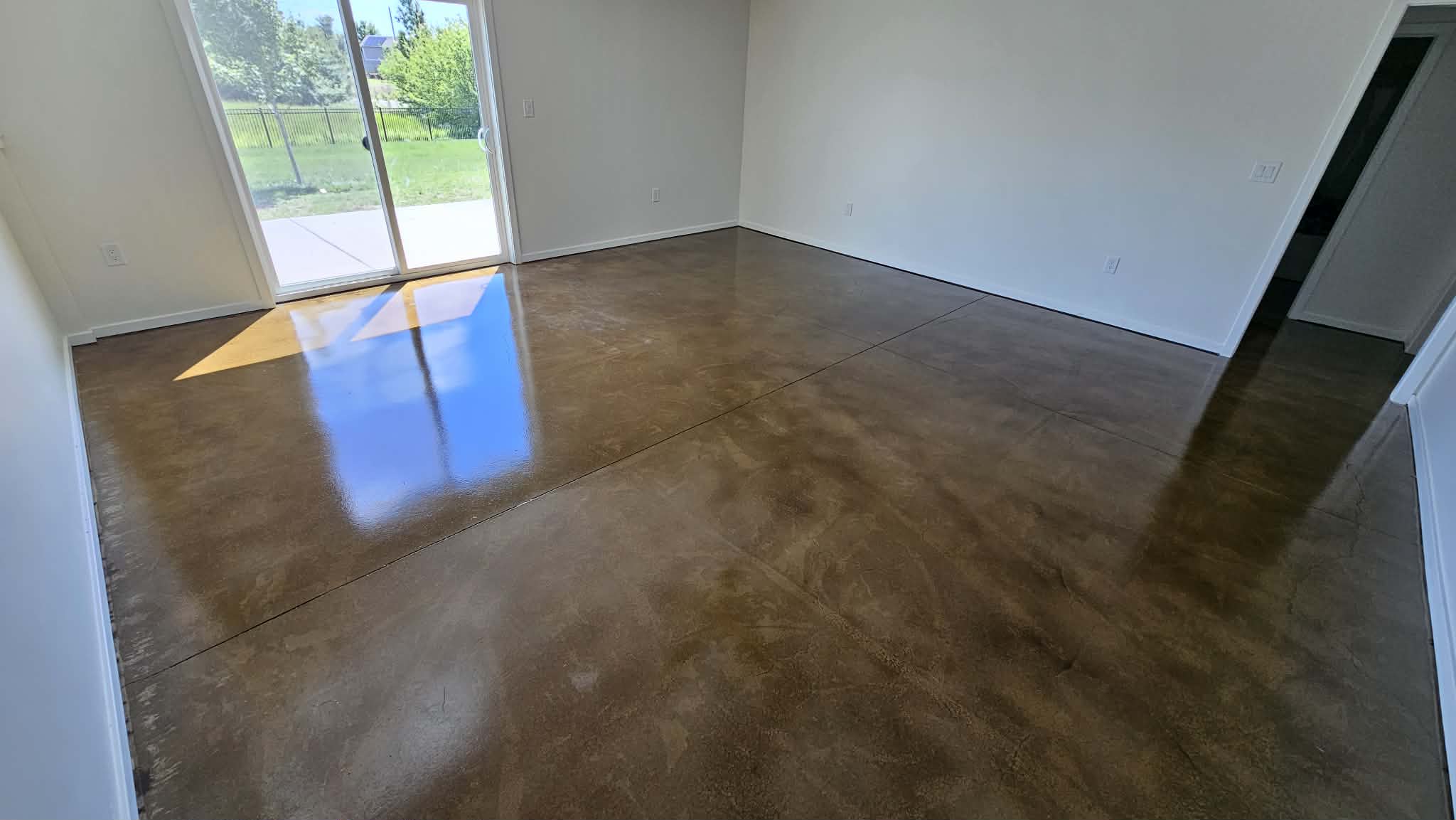
Project snapshot
| Location | Peculiar, MO (Cass County, south Kansas City metro) |
|---|---|
| Space | Finished lower level, approximately 1,000 sq ft |
| Rooms | Main living area, bedrooms, hallway, walk-in closet, all on one continuous floor |
| Starting point | Existing concrete slab, unfinished |
| Prep | Full-floor diamond grinding with HEPA dust collection, clean and rinse |
| System | Concrete stain in warm browns, protective clear sealer |
| Result | Marbled, variegated color with the slab’s saw-cut joints left as a design grid |
Carpet is the default. It should not be.
Nothing is wrong with carpet in the right room. A lower level is not that room, and the reasons stack up.
- It sits on the wettest slab in the house. A basement floor is in contact with ground that holds water year round. Carpet pad is a sponge, and the mold that grows in it happens where nobody looks.
- It is a consumable. Carpet in a lived-in basement is not a 30-year floor. It mats, it stains, it holds smells, and it gets replaced. That replacement is not a repair, it is the whole floor again.
- It holds everything. Dander, dust and allergens live in fibers. In a below-grade room with less air exchange than the rest of the house, that matters more.
- One leak ends it. A sump failure, a water heater, a burst supply line. On carpet that is demolition and a claim. On sealed concrete it is a wet floor and a fan.
- It looks like a basement. Builder carpet in a lower level reads as an afterthought, because it usually is.
The twenty-year number
Carpet wins on the first invoice. It is the only round it wins. For 1,000 square feet:
| Carpet and pad | Stained and sealed concrete | |
|---|---|---|
| Typical installed cost | $3,000 to $6,000 | $3,000 to $5,000 |
| Replacement cycle | Every 7 to 10 years in a used basement | None. The color is in the slab. |
| Over 20 years | 2 to 3 installs, so $6,000 to $18,000 | One install, plus a sealer recoat |
| Routine care | Vacuum, periodic professional cleaning | Dust mop and damp mop |
| After a water event | Tear out pad and carpet, dry, replace | Mop it up |
| Adds floor height | Yes, pad plus carpet | Effectively none |
The carpet figures are typical installed ranges rather than a quote from us, but the shape holds at any price: you buy a stained floor once.
Bedrooms on concrete: the objection everybody has
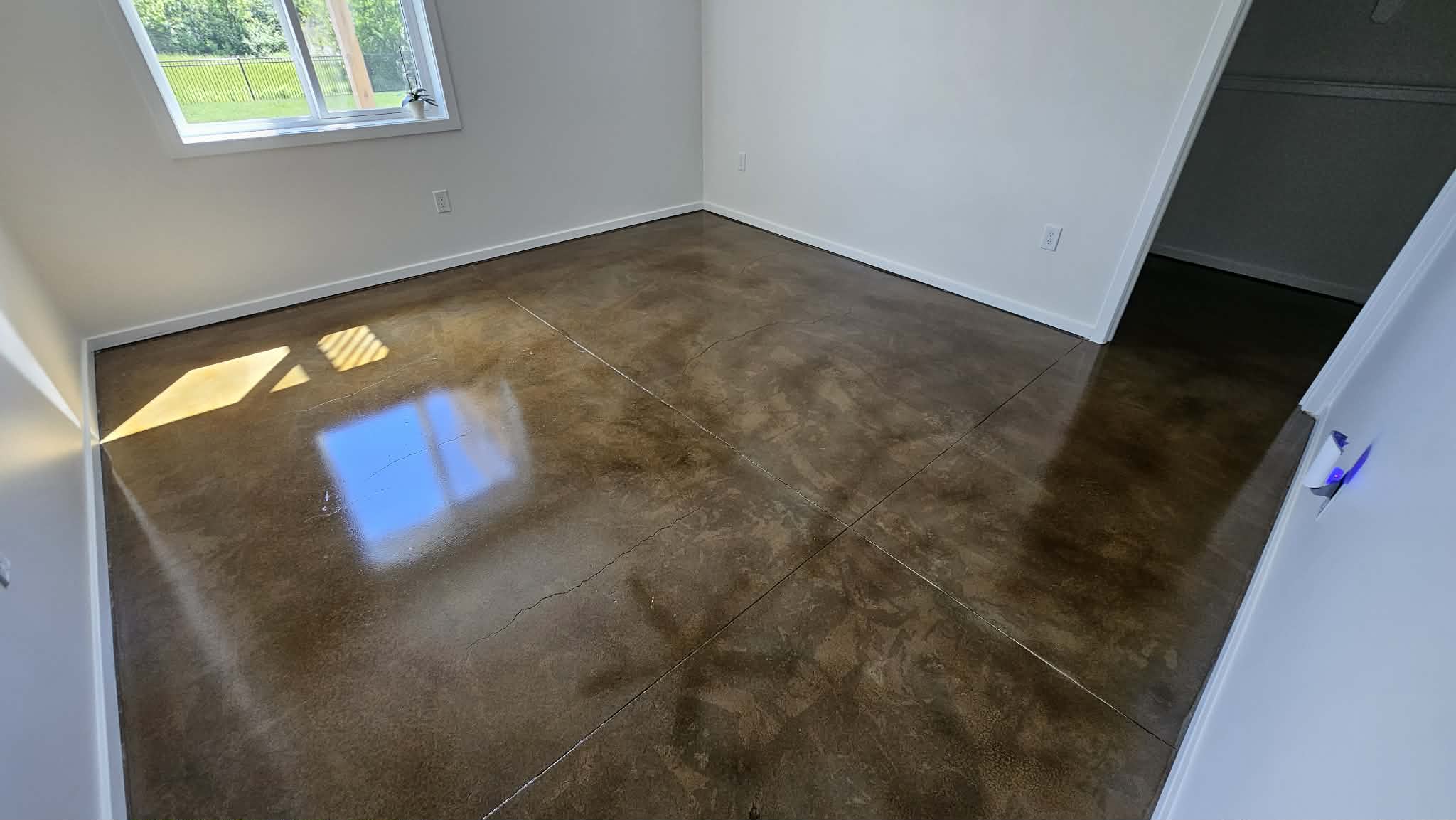
“I get it for a rec room, but a bedroom?” It comes up on every quote, and it is fair. Two honest answers.
It is firm. Concrete does not have give. If you want softness underfoot beside a bed, that is what a rug is for, and a rug on a sealed floor is a rug you can pick up, shake out and put back, which is not true of wall-to-wall.
It is the temperature of the ground. A basement slab runs cool, which is a feature in August and a consideration in January. It works well with radiant heat if that is in the plan, and it holds temperature steadily either way. Most people solve the rest with rugs where their feet actually land.
What you get in exchange is a bedroom floor that cannot hold dust or dander, cannot be ruined by a spilled drink, and will not need replacing when the kid who sleeps there goes to college.
The closet and the hallway, which is where carpet usually wins by default
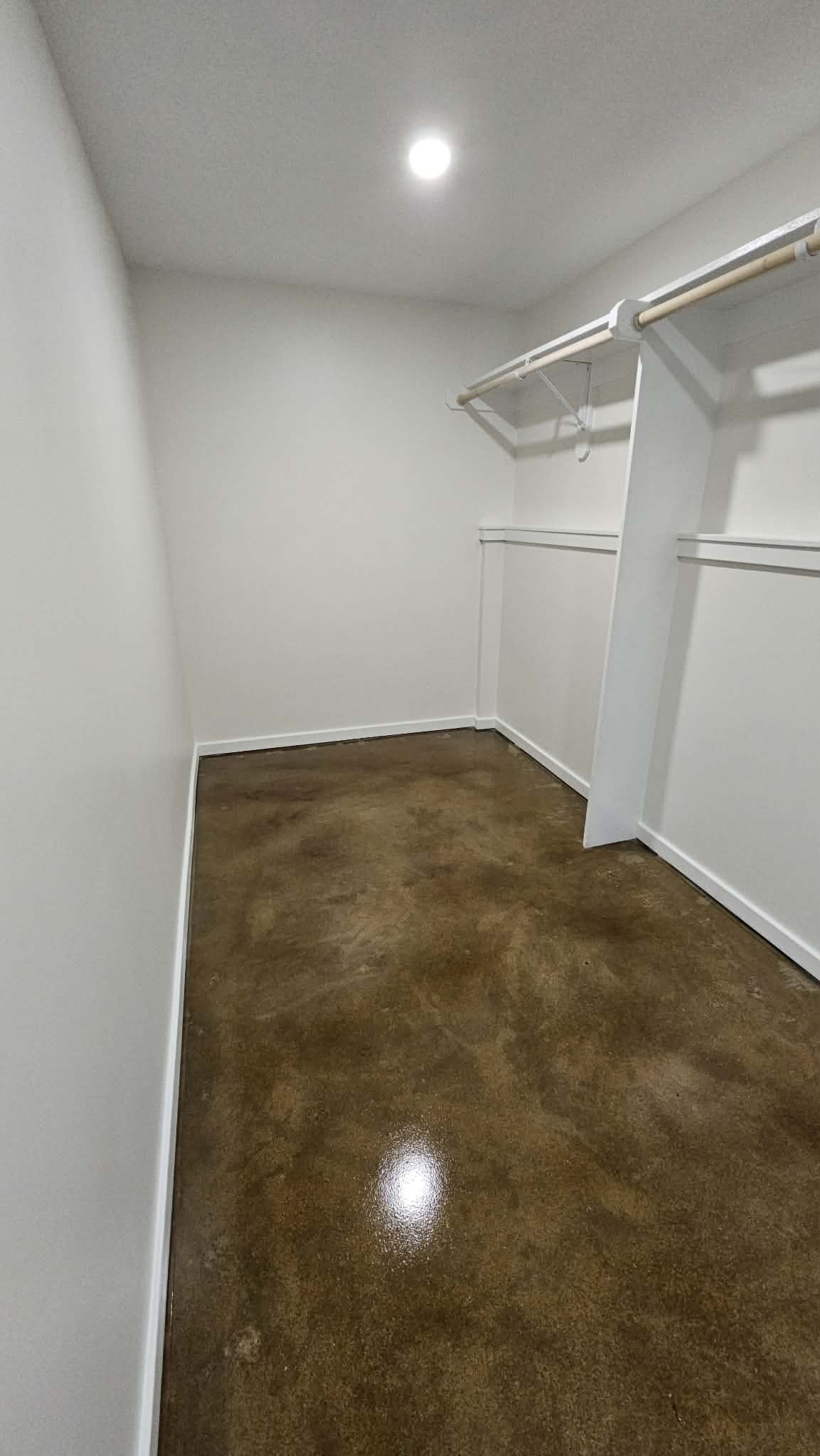
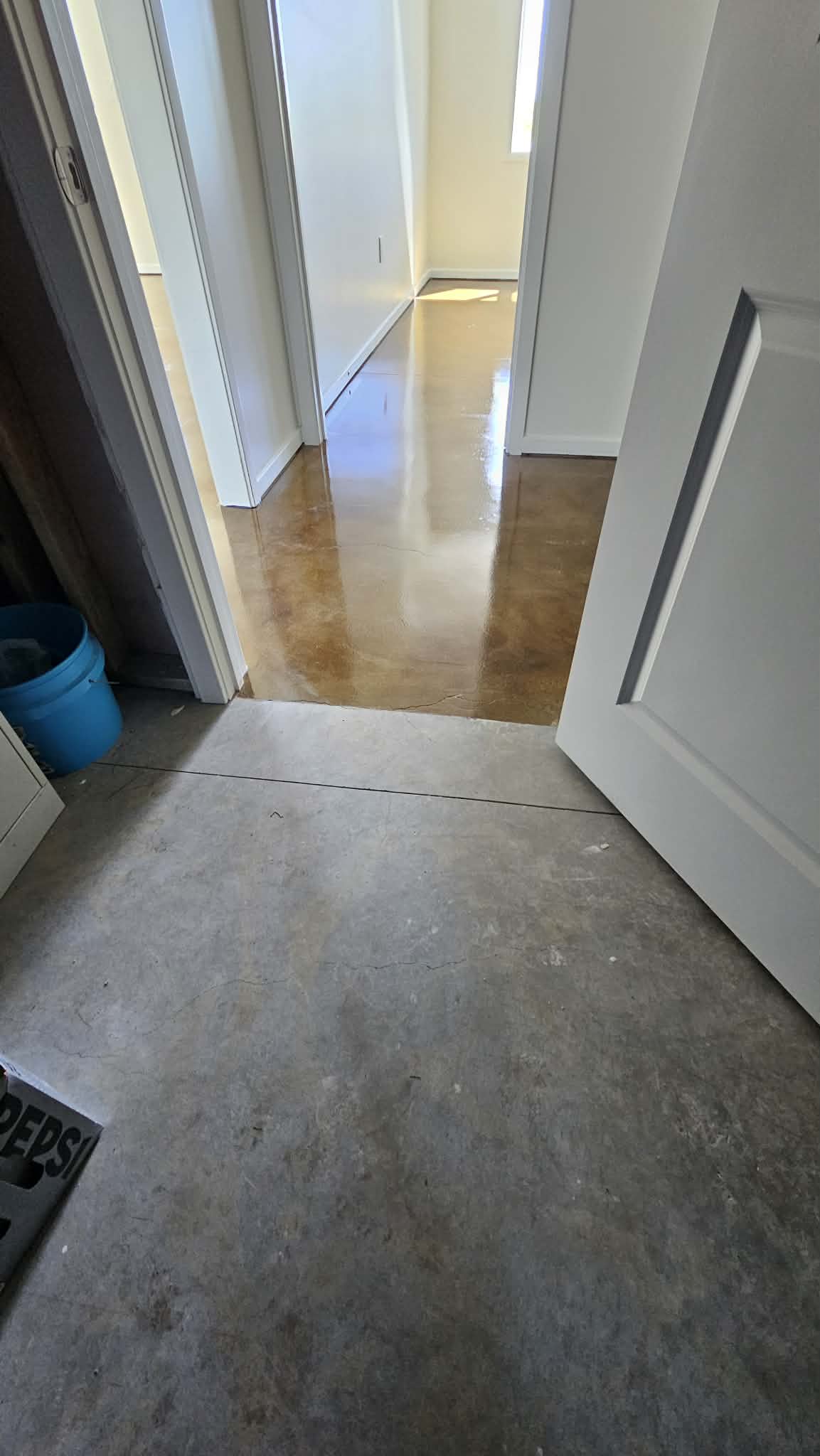
Closets and hallways are where flooring decisions get lazy. Carpet goes in because it is already being installed everywhere else, and you end up with a transition strip at every doorway.
Running one continuous stained floor through the whole level removes all of it: no thresholds, no strips, no change in cleaning routine, no line where one floor stops and another starts. In a closet specifically, a sealed floor also means shoes and storage bins are not sitting on something absorbent.
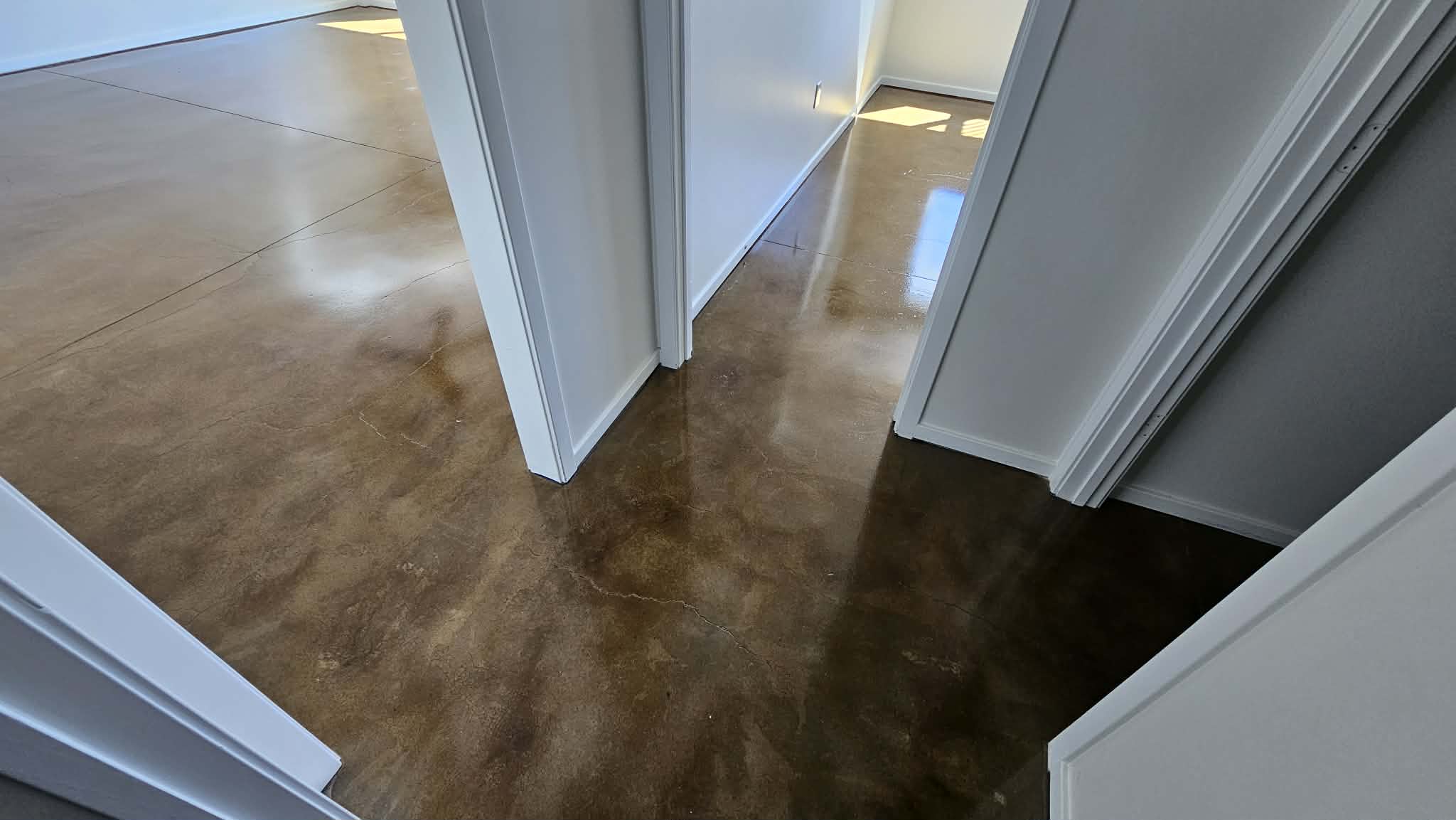
The grid you can see is not a mistake
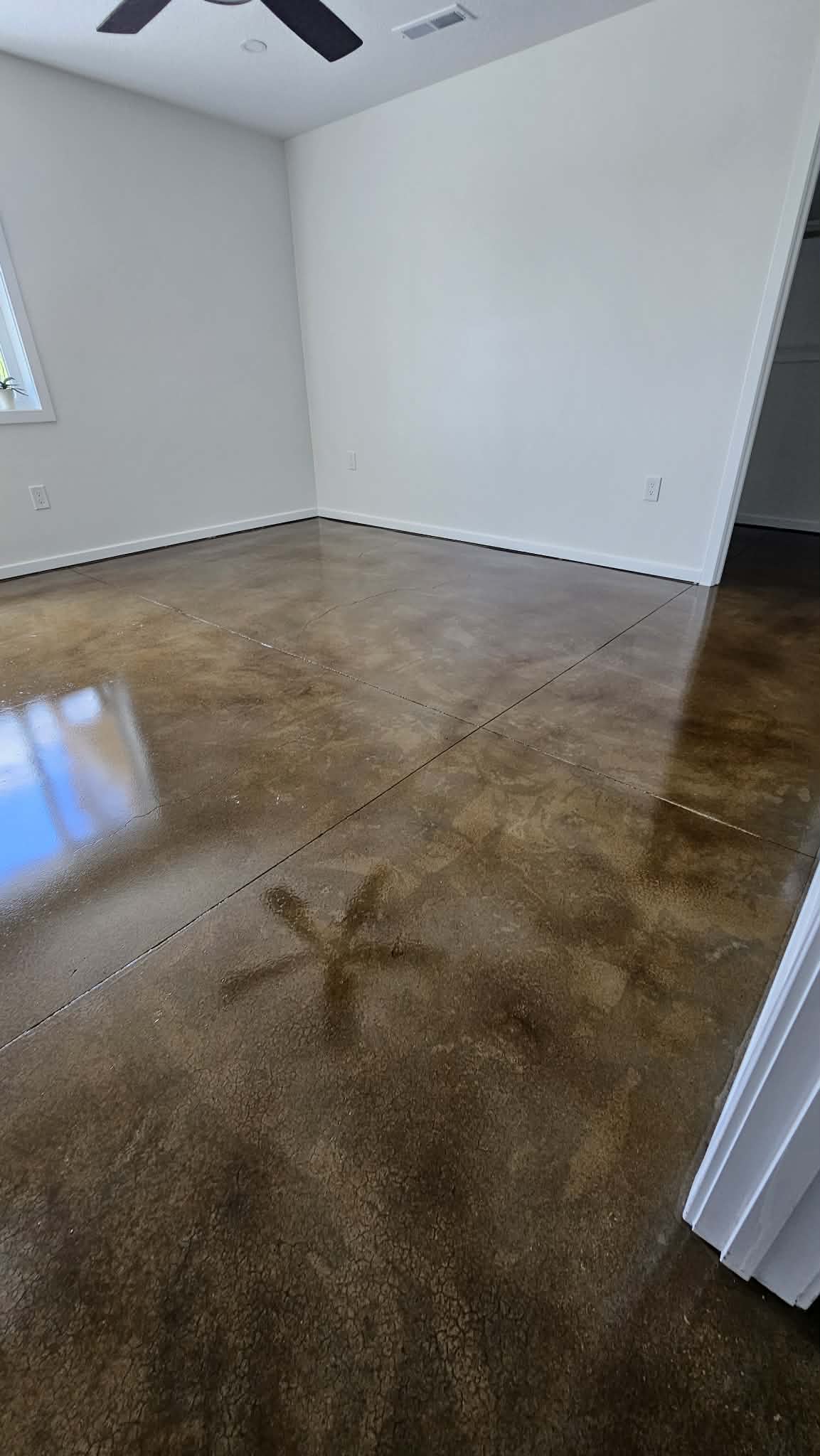
Look at the lines running across these floors in large squares. Those are control joints, cut into the slab when it was poured so that when the concrete shrinks, it cracks along a line somebody chose instead of a line nobody did.
They were always there. Carpet hides them. Stain does the opposite: it takes color slightly differently at the joints, so the grid becomes part of the finished look. On a floor this size that is a genuine design element, and it reads like large-format tile without the grout.
It is also the honest counterpart to what we wrote about the 1,500 square foot basement in La Cygne: stained concrete shows you the slab you have. Joints, movement, patches and character all come through. If you want a floor that hides every mark, flake is the system for that. If you want the concrete to look like concrete, done well, this is it.
What the work looked like
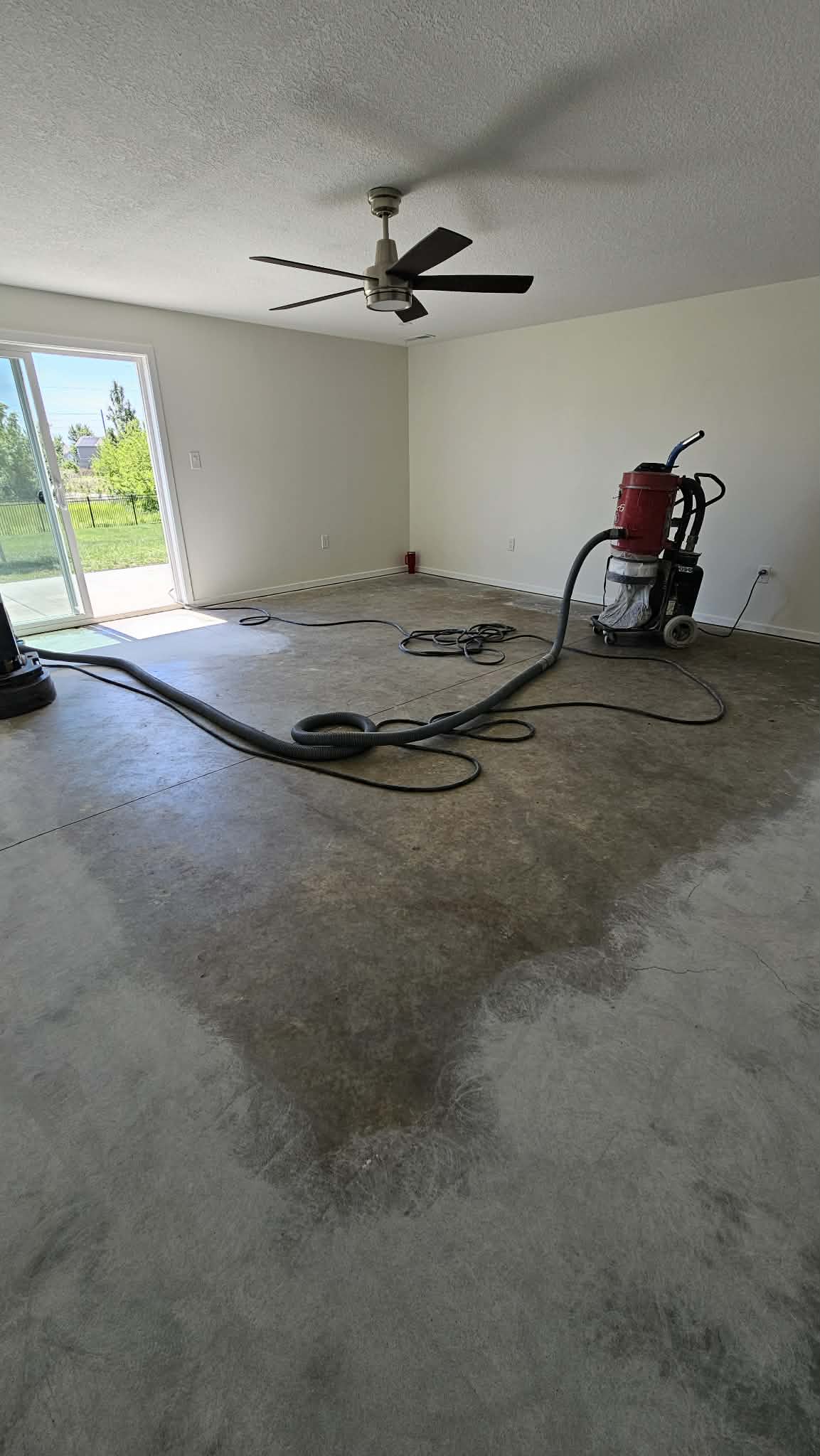
Short version, because the process is the same one we broke down in detail on the La Cygne project:
- Grind the whole floor. Every square foot, through HEPA dust collection. Grinding opens the concrete so the stain can penetrate evenly instead of sitting on a closed surface.
- Clean and rinse. Stain reacts with whatever it touches. Anything left on the slab becomes part of the finished color, permanently.
- Stain. Color goes into the concrete rather than onto it, and the depth comes from how that particular slab takes it.
- Neutralize, dry, seal. Residue removed, floor fully dried, then clear protective coats that lock the color in and give it the sheen.
Drying is the step that cannot be hurried in a below-grade room, and it is the one that separates a floor that stays clear from one that clouds.
What a 1,000 sq ft basement costs
| System | Installed cost / sq ft | 1,000 sq ft basement |
|---|---|---|
| Single-color acid stain + sealer | $3 to $5 | $3,000 to $5,000 |
| Multi-color acid stain + sealer | $4 to $7 | $4,000 to $7,000 |
| Water-based dye, single color + sealer | $3 to $6 | $3,000 to $6,000 |
| Water-based dye, multi-color or patterns + sealer | $5 to $9 | $5,000 to $9,000 |
A bare slab like this one is the cheapest starting point there is, because there is nothing to remove. Where a basement quote climbs is old flooring: carpet tack strip, adhesive, thinset or a failed sealer all have to come off first, and adhesive is slow.
Who this is not for
Worth saying plainly, because the wrong customer for this floor is easy to spot in advance.
- You want soft underfoot everywhere. Rugs cover the spots that matter, but the floor itself is firm. If that is a dealbreaker, it is a dealbreaker.
- You want a floor with no variation. Stain is not paint. Color moves and mottles, and joints show. That is the appeal for most people and a problem for a few.
- You are sensitive to sound. Hard floors and hard walls make a livelier room. Rugs, furniture and window coverings settle it, but a bare, unfurnished lower level will echo.
- Your slab is badly damaged. Heavy cracking or spalling needs a concrete overlay first, or a different system entirely.
Keeping it
- Dust mop, then damp mop with a neutral cleaner. No wax, nothing acidic or abrasive.
- Felt pads under furniture, the same as any hard floor.
- Rugs where you stand and sit. They are a design choice here, not a repair.
- The stain is permanent because it is in the concrete. The sealer is a wear layer and gets recoated eventually. In a basement that horizon is long, and a recoat is a clean and re-seal rather than starting over.
Frequently asked questions
Is stained concrete cheaper than carpet for a basement?
Up front they are close: roughly $3,000 to $5,000 for stained and sealed concrete on 1,000 square feet against $3,000 to $6,000 for carpet and pad. Over twenty years they are not close, because carpet in a used basement gets replaced every 7 to 10 years and stained concrete does not get replaced at all.
Can you put stained concrete in a basement bedroom?
Yes, and it is common. The floor is firm and sits at ground temperature, so most people use a rug beside the bed. In exchange there are no fibers to hold dust or dander, nothing to stain permanently, and no replacement cycle.
What are the lines in the floor?
Saw-cut control joints, cut into the slab when it was poured so shrinkage cracks along a chosen line. Carpet hides them. Stain highlights them, and on a large floor they read as a design grid rather than a defect.
Is a stained concrete basement floor cold?
It sits at ground temperature, which is cool in summer and cool in winter. It works well with radiant heat, holds temperature steadily, and rugs handle the spots where people are barefoot.
Does a concrete floor make a basement echo?
An empty room with hard floors and hard walls will be livelier than one with carpet. Furniture, rugs and window coverings settle it. It is worth thinking about before you commit if the room will stay sparsely furnished.
Can the floor run through closets and hallways too?
Yes, and it should. Carrying one continuous floor through the whole level removes every transition strip and threshold, keeps the cleaning routine the same everywhere, and costs very little extra per square foot.
What if the basement floods?
A sealed concrete floor is mopped up and dried. There is no pad to pull, nothing to grow mold in, and nothing to replace. That single scenario is why many homeowners in the metro switch away from basement carpet.
How long does a 1,000 sq ft basement take?
Grinding, staining, drying and sealing is a multi-day project rather than a one-day install. Drying before the sealer is the step that sets the schedule, and it cannot be rushed below grade.
Will the color be exactly what I pick from a sample?
Not exactly. Stain colors the concrete by working into it, so the result depends on your slab. Samples show the palette and the character, not the finished floor. That variation is the reason these floors look like stone rather than paint.
Do you work in Peculiar and the rest of Cass County?
Yes. High Stakes Epoxy LLC is based in Cleveland, MO, in the same county as Peculiar, and we serve the south Kansas City metro including Belton, Raymore, Harrisonville and Pleasant Hill.
Finishing a lower level?
If you are about to put carpet in a basement, it is worth pricing the alternative before the pad goes down. The concrete is already there. Finishing it costs about the same as covering it, and you only do it once.
Call (816) 820-8193, Monday through Saturday, 7:00am to 6:00pm, or request a free quote online. High Stakes Epoxy LLC is a locally owned, licensed and insured concrete coating company based in Cleveland, MO, serving Peculiar and the wider Kansas City metro.
More reading: our stain and seal concrete service page, the full guide to stain and seal colors and costs, the 1,500 sq ft basement in La Cygne for the process in depth, and finished work in the project gallery.