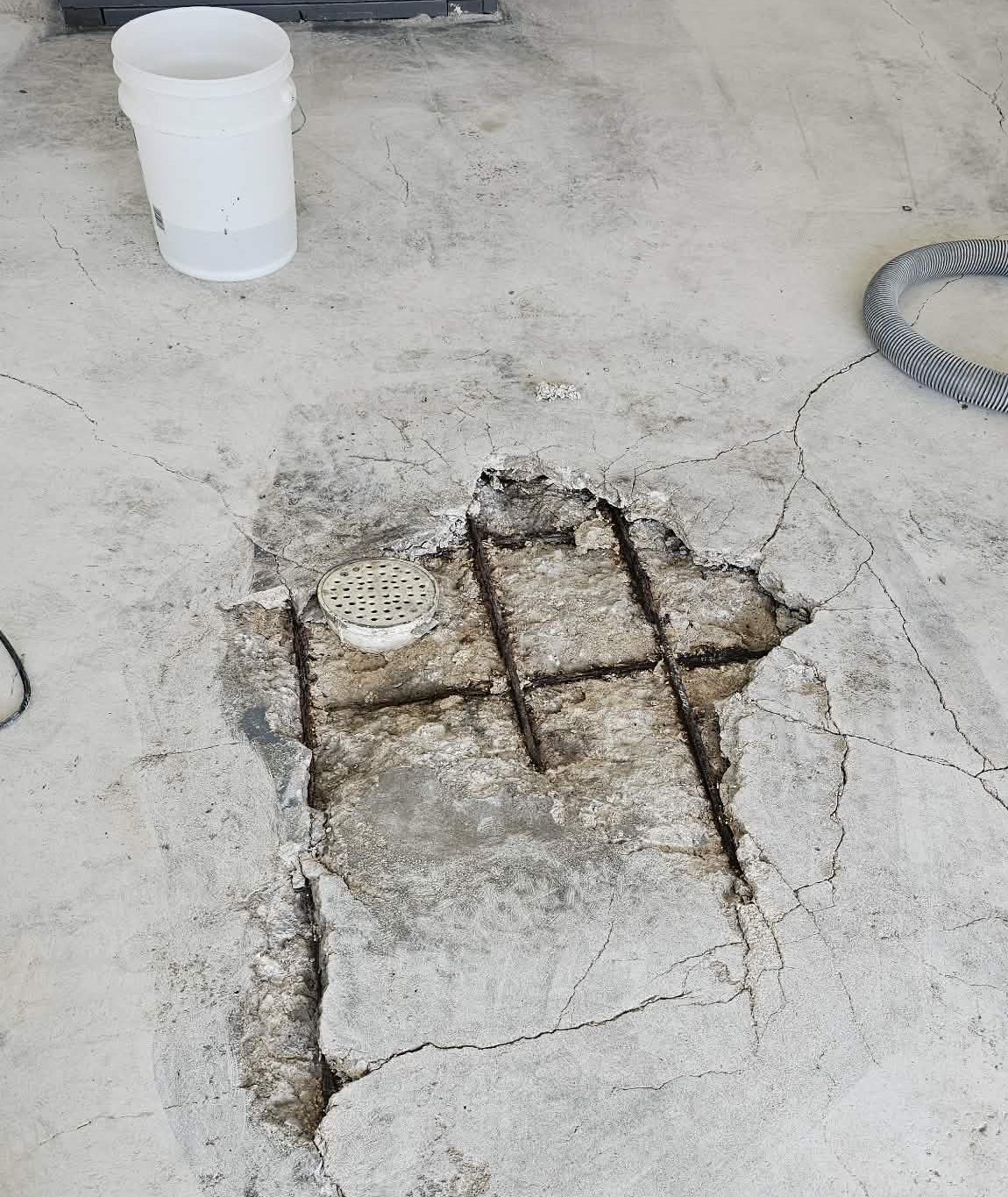
Every crack in this Liberty, MO garage pointed at the same place. Not randomly, not in parallel lines, but radiating outward from a single point like spokes. That point was the floor drain, and by the time we opened it up the concrete around it had broken apart entirely and the rebar underneath was rusted and exposed.
This is the most under-discussed failure in residential concrete, and if your garage has a drain, it is the first place worth looking. Here is what was wrong, why drains fail before the rest of the slab, and what it took to rebuild a standard two-car floor from the drain out.
Project snapshot
| Location | Liberty, MO (Clay County, Northland) |
|---|---|
| Space | Residential 2-car attached garage with a center floor drain |
| Slab condition | Concrete broken out around the drain with reinforcing steel exposed and corroded, cracks radiating outward across the bay, heavy staining |
| Repair | Unsound concrete removed back to solid, steel treated and covered, drain surround rebuilt, radiating cracks chased and filled |
| Prep | Full-floor diamond grinding with HEPA dust collection, re-profiling of all repairs |
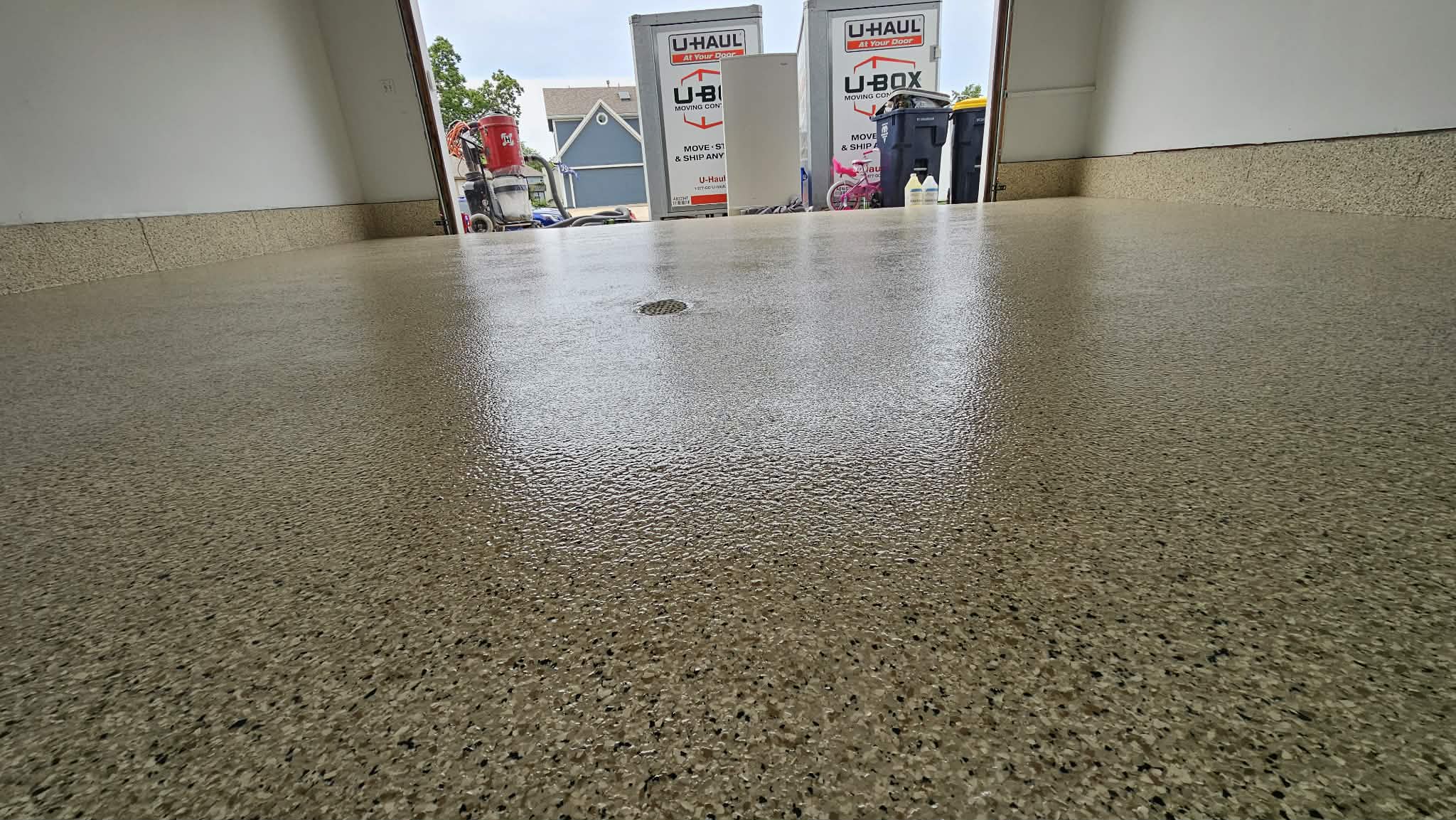
| System | Full-broadcast flake floor, tan, black and white blend, clear protective topcoat |
| Details | Coved wall base, coated service-door step, drain finished cleanly into the floor |
| Return to use | Foot traffic in about 24 hours, vehicles in about 72 hours |
What the floor looked like on day one
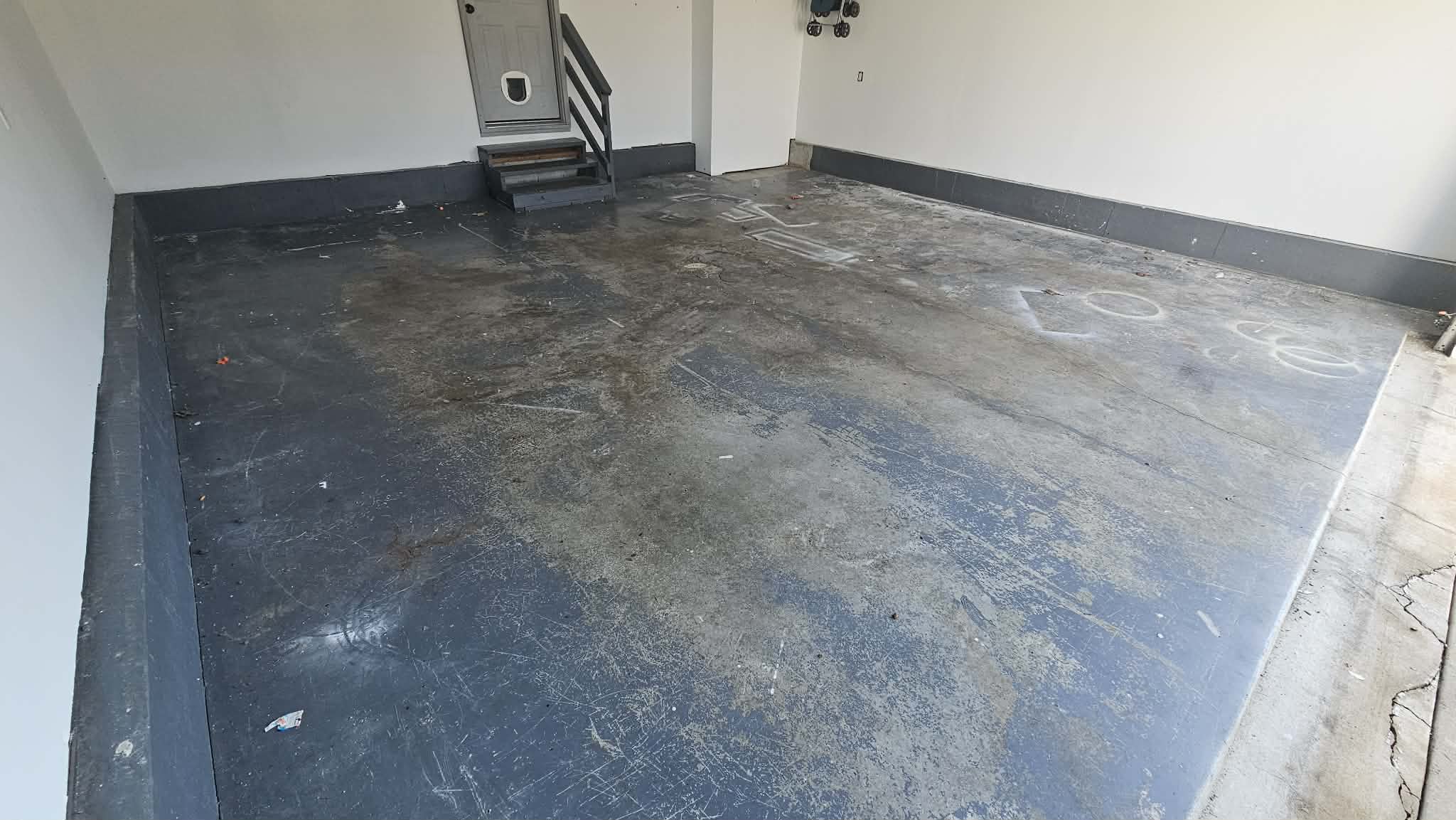
Dark staining across most of the bay, a surface that had clearly been wet a lot, and cracks running out toward the walls. From standing height it looked like a tired garage floor. It was worse than that.
That is the drain, once the loose material came away. The concrete around it had failed completely, and the reinforcing grid underneath is sitting in open air, rusted through. The cracks you can see spreading from the edges of that hole are not separate problems. They are the same problem, radiating.
Why garage floor drains fail before the rest of the slab
A floor drain is the single most hostile spot in a garage slab, for four reasons that all compound each other.
The concrete is thinnest there
A drain works because the floor slopes toward it. That slope is achieved by making the slab shallower as it approaches the drain, so the weakest section of the entire floor sits exactly where the most water goes. Less concrete over the steel means less protection for the steel.
It is a hole in the slab
The drain body is a penetration. Concrete is not continuous through it, and reinforcement gets cut, bent or stopped short to accommodate it. Whatever load transfer the reinforcing provides across the rest of the floor, it does not provide it there. When a slab wants to move, that discontinuity is where it gives.
It is permanently the wettest point in the building
Everything that lands on the floor ends up at the drain. Snowmelt, rain off the car, hose water, whatever leaks. Most of it drains, but the concrete immediately around the drain stays damp far longer than the rest of the slab, and it goes through that cycle every single time a car comes home wet.
Salt concentrates there
This is the part that does the real damage. Road salt melts off the car as brine and runs to the low point. The water evaporates. The chloride does not. Season after season, the concrete around a garage drain accumulates a chloride load far higher than anywhere else on the floor.
Chloride is what breaks down the passive layer protecting reinforcing steel. Once that steel starts to corrode, rust occupies several times the volume of the metal it replaces, and it pushes outward with enough force to break concrete apart from the inside. That is the mechanism, and the star pattern of cracks around the drain is its signature.
What radiating cracks actually tell you
Cracks are readable if you know the vocabulary, and the pattern tells you the cause before anyone picks up a tool.
| Pattern | What it usually means |
|---|---|
| Radiating from a single point | Something at that point is expanding or has failed: a drain, a post base, corroding steel |
| Straight, parallel, evenly spaced | Control joints or shrinkage cracking, normal in most slabs |
| Fine random web across the surface | Map cracking in the surface paste, a finishing issue rather than a structural one |
| Along a wall or at a corner | Settlement or a restrained edge |
| Wide, with broken and lifting edges | Active movement or corrosion underneath, not a cosmetic crack |
Radial cracking is the one homeowners misread most often, because it looks like several separate cracks. It is one failure with several arms.
The repair
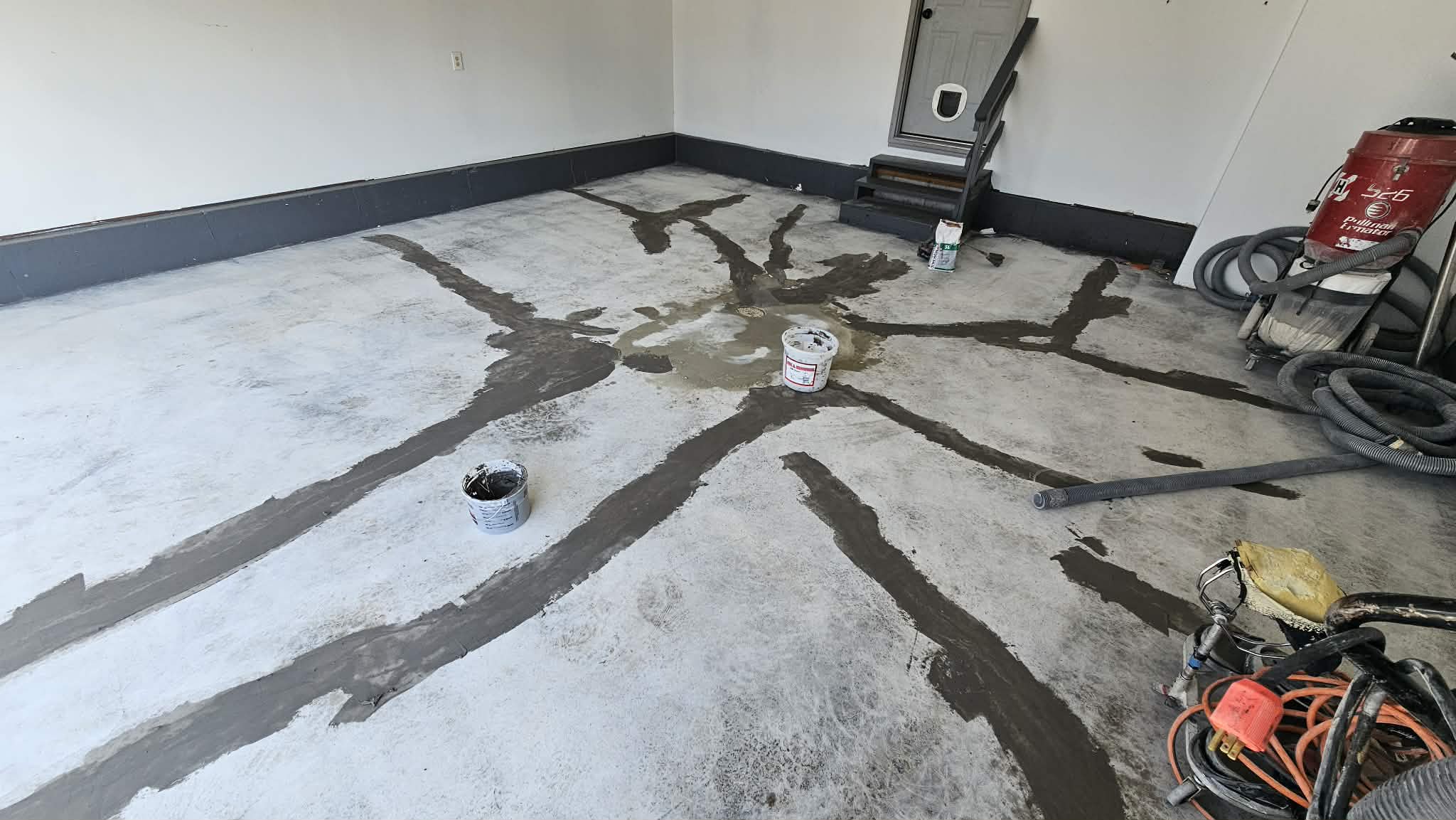
Coating this floor without dealing with the drain would have been cosmetic and temporary, so the sequence went the other way around.
- Remove everything unsound. Broken concrete around the drain came out until we reached material that was actually solid. That footprint is always larger than the visible damage, because concrete that looks intact from above can be hollow underneath.
- Deal with the steel. Corroded reinforcement gets cleaned back and then buried in repair mortar so it is no longer in contact with air and moisture. Leave it exposed and the same failure restarts immediately.
- Rebuild the drain surround. The repair material has to bond to the existing slab, hold the correct slope back into the drain, and finish flush at the drain body. Getting the fall right matters as much as the strength, because a drain that no longer drains recreates the problem.
- Chase and fill every radiating crack. Each crack was opened into a clean channel, vacuumed and filled with a structural repair material that bonds to both faces, so the fill becomes part of the slab rather than a bead of caulk sitting in a gap. The photo above shows this stage, with the repairs spreading out from the center like the arms of a star.
- Grind the entire floor. Not just the repairs. Fresh patch material is denser than aged concrete, so the whole slab is profiled to one consistent texture. Skip this and every repair telegraphs through the finished coating.
Work at this end of the scale falls under concrete prep and removal. For the same failure in a larger garage, our 3-car garage in North Kansas City shows what widespread spalling and exposed mesh look like across an entire bay rather than around one drain.
Why coating over it would have failed
A coating is only as sound as the concrete it is bonded to. Roll a floor over broken material around a drain and three things happen on a schedule: the coating bridges the void and cracks along the same radial lines within a season or two, water finds the crack and goes straight back to the steel, and the corrosion continues underneath a finish that now hides it.
The homeowner ends up paying twice, and the second bill is bigger because the failed coating has to come off before the repair can be done properly.
The finished floor
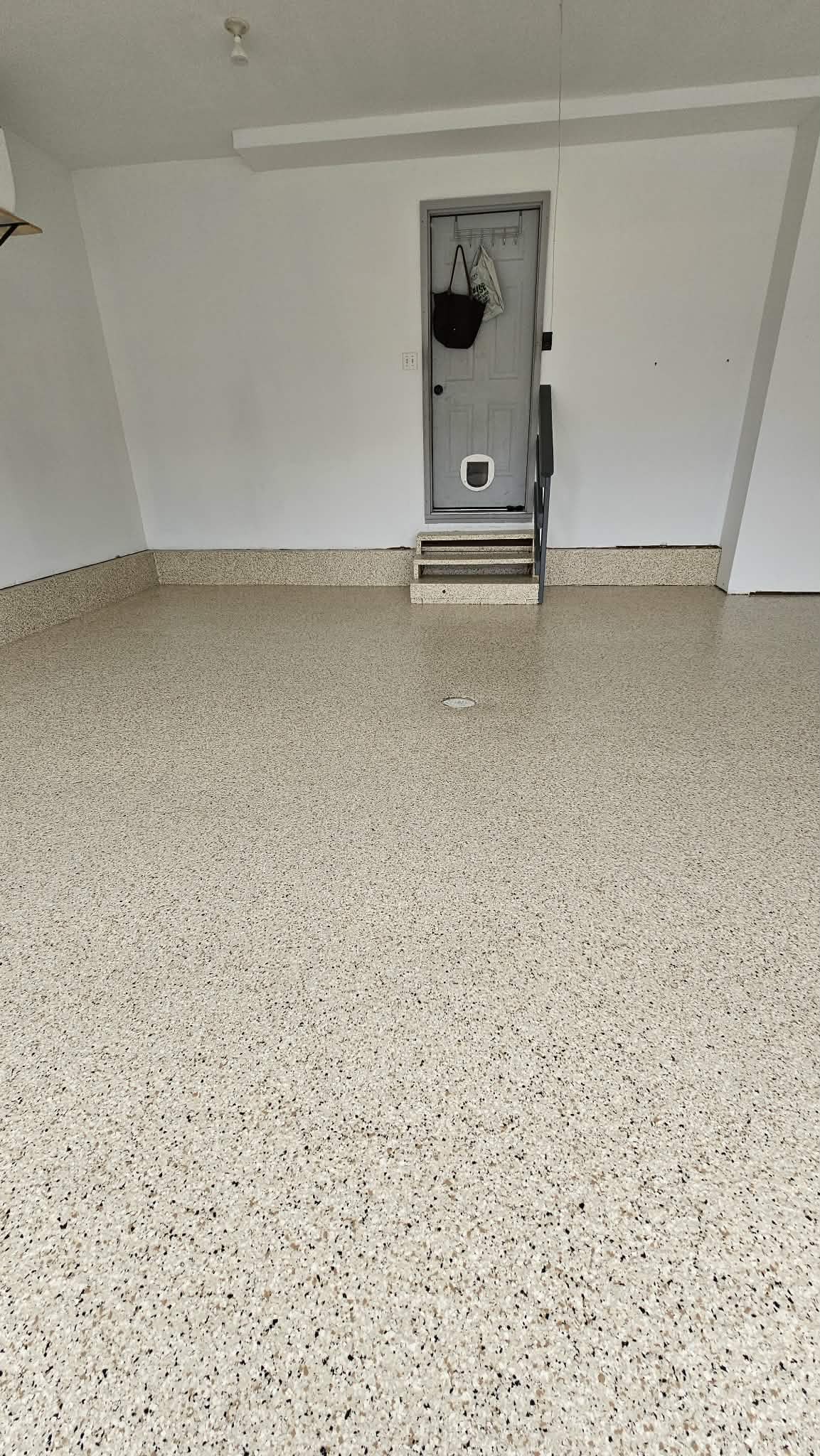
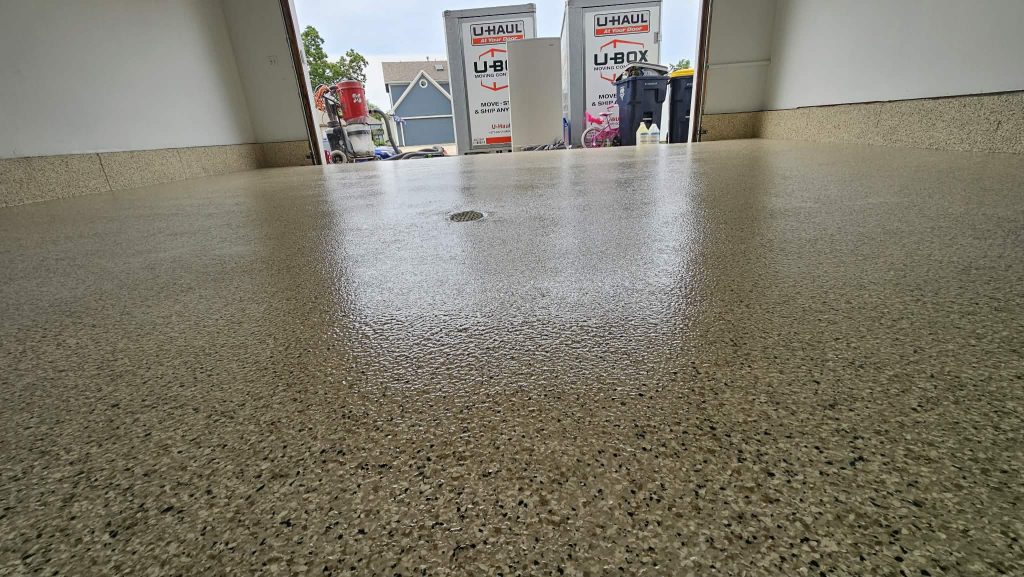
With the slab sound, the coating went down as a full-broadcast flake system: a pigmented base coat rolled into the profiled concrete, vinyl flake cast into it to rejection, the loose chip scraped and vacuumed back, then clear protective topcoats.
The blend here is tan, black and white, which is a good choice for a working two-car garage. It reads warmer than a gray blend under the mixed daylight and overhead lighting most garages have, and the flake texture hides the dust, tire marks and winter grit that a solid color puts on display.
Two details worth pointing out. The coating turns up the wall as an integral coved base rather than stopping at a ragged edge, which seals the floor-to-wall joint and lets the floor be hosed toward the drain without soaking drywall. And the drain itself is finished cleanly into the floor, so there is no bare concrete ring around it, which is the exact spot the whole failure started.
What a 2-car garage floor costs in the Kansas City metro
A typical two-car garage runs about 450 square feet.
| System | Installed cost / sq ft | Typical 2-car garage |
|---|---|---|
| Solid color epoxy | $3 to $5 | $1,350 to $2,250 |
| Full-broadcast flake (most popular) | $4 to $7 | $1,800 to $3,150 |
| Metallic epoxy | $6 to $12 | $2,700 to $5,400 |
| Concrete repair, when needed | $0.50 to $2 extra | $225 to $900 on top |
A floor like this one sits at the top of that repair band, because breaking out and rebuilding a failed drain surround is real material and real labor before any coating is opened. Our Kansas City garage floor coating cost guide breaks the variables down further.
If your garage has a drain, check it now
Garages with center drains are common across Liberty and the wider Northland, and Clay County winters give them the full chloride treatment every year. Five minutes with a flashlight tells you a lot.
- Look for cracks radiating from the drain. Even fine ones. That pattern is the early version of what these photos show.
- Tap around the drain with a hammer handle. A hollow sound means the concrete there has already separated, whether or not it has broken through.
- Check for rust staining. Brown streaking near the drain usually means the steel below is already corroding.
- Check that it still drains. Standing water beside a drain means the slope has been lost, which accelerates everything above.
- Rinse it in winter. Flushing the drain area with clean water after a salty week removes the chloride instead of letting it concentrate.
Caught early, this is a small repair. Caught late, it is the floor in these photos.
Frequently asked questions
Why is the concrete around my garage floor drain cracking?
Because that spot is thinner, has interrupted reinforcement, stays wet longest, and collects the road salt that runs off your car. Chloride reaches the steel, the steel corrodes, rust expands, and the concrete breaks apart from the inside. Cracks radiating out from the drain are the signature of that process.
Can a garage floor be coated over a cracked drain area?
Not successfully. A coating is only as sound as the concrete beneath it. Over broken material it will crack along the same lines within a season or two, water will get back to the steel, and the corrosion continues out of sight. The concrete has to be rebuilt first.
What does it cost to repair concrete around a garage drain?
Concrete repair generally adds $0.50 to $2 per square foot to a garage floor coating, so $225 to $900 on a typical two-car garage. A failed drain surround sits at the upper end because unsound material has to be removed, the steel treated and covered, and the slope rebuilt.
How much does a 2-car garage floor coating cost in Kansas City?
A full-broadcast flake floor runs $4 to $7 per square foot installed, so roughly $1,800 to $3,150 on a typical 450 square foot two-car garage. Solid color is $1,350 to $2,250 and metallic is $2,700 to $5,400, with repair priced on top where the slab needs it.
What do radiating cracks in a concrete floor mean?
Cracks spreading outward from one point mean something at that point is expanding or has failed, most often corroding steel, a drain or a post base. It is one failure with several arms rather than several separate cracks, which is why homeowners often underestimate it.
Will the cracks come back after repair?
Properly chased and filled cracks transfer load across the gap and stop the edges breaking down further, and covering the corroded steel removes what was driving the movement. No contractor can promise a slab will never move again, but removing the cause is what separates a repair from a cover-up.
Should I keep the floor drain when I coat my garage?
Yes, if it works. A drain that still holds its slope is genuinely useful in a Kansas City garage, because it lets you rinse salt off the floor rather than leaving it to dry there. The coating is finished cleanly into the drain so no bare concrete ring is left around it.
How can I tell if my garage slab is hollow around the drain?
Tap it with a hammer handle or a piece of steel. Sound concrete rings; separated concrete sounds dull and hollow. It is the same check we do before deciding how much material has to come out, and it works even when the surface still looks intact.
How long does a 2-car garage take?
Most residential garages are 1 to 2 days on site. Repairs like this one push it to the longer end, because patch material has to cure before it can be re-ground and coated. Foot traffic returns in about 24 hours and vehicles in about 72.
Do you work in Liberty and the rest of the Northland?
Yes. High Stakes Epoxy LLC covers the Kansas City metro on both sides of the state line, including Liberty, Kansas City, Parkville and Richmond.
Get your slab looked at
If there are cracks running out from your garage drain, or the concrete around it sounds hollow, it is not going to hold where it is. Chloride and corrosion do not pause, and the repair only gets larger.
Call (816) 820-8193, Monday through Saturday, 7:00am to 6:00pm, or request a free quote online. High Stakes Epoxy LLC is a locally owned, licensed and insured concrete coating company based in Cleveland, MO, serving Liberty and the greater Kansas City metro.
More reading: the homeowner’s guide to epoxy garage floor coatings, our flake coating service page, what the flake epoxy warranty covers, and finished floors in the project gallery.