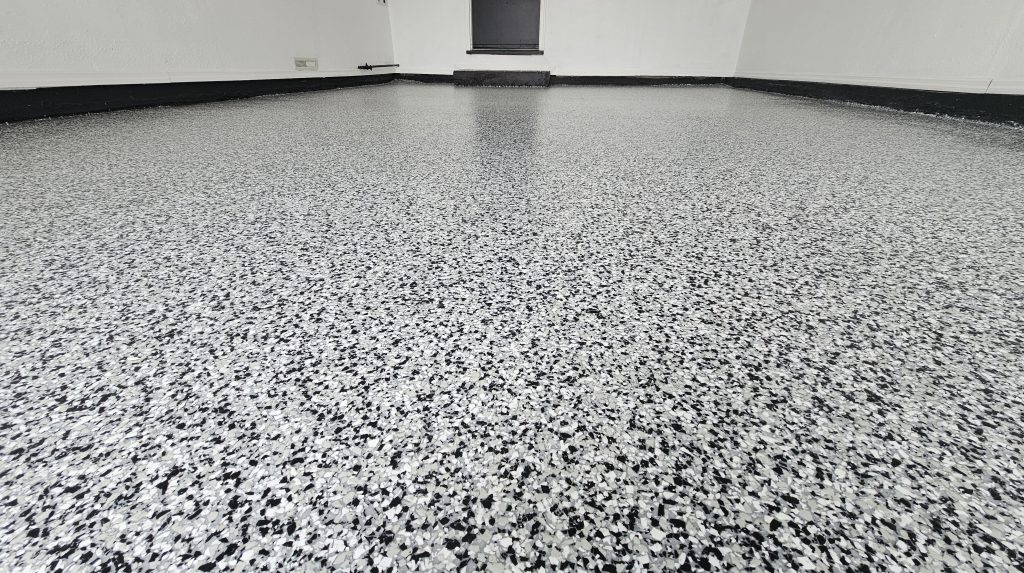
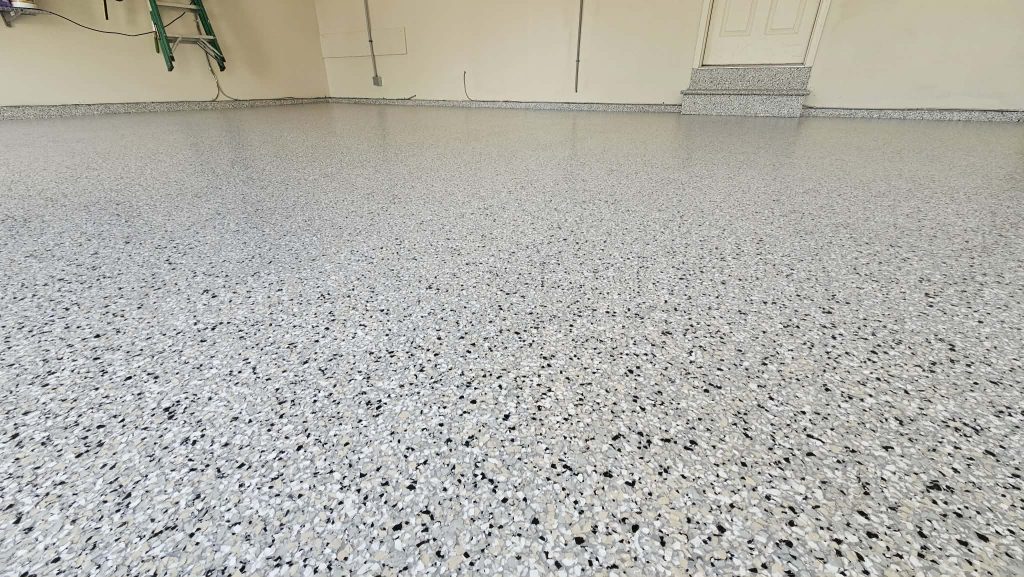
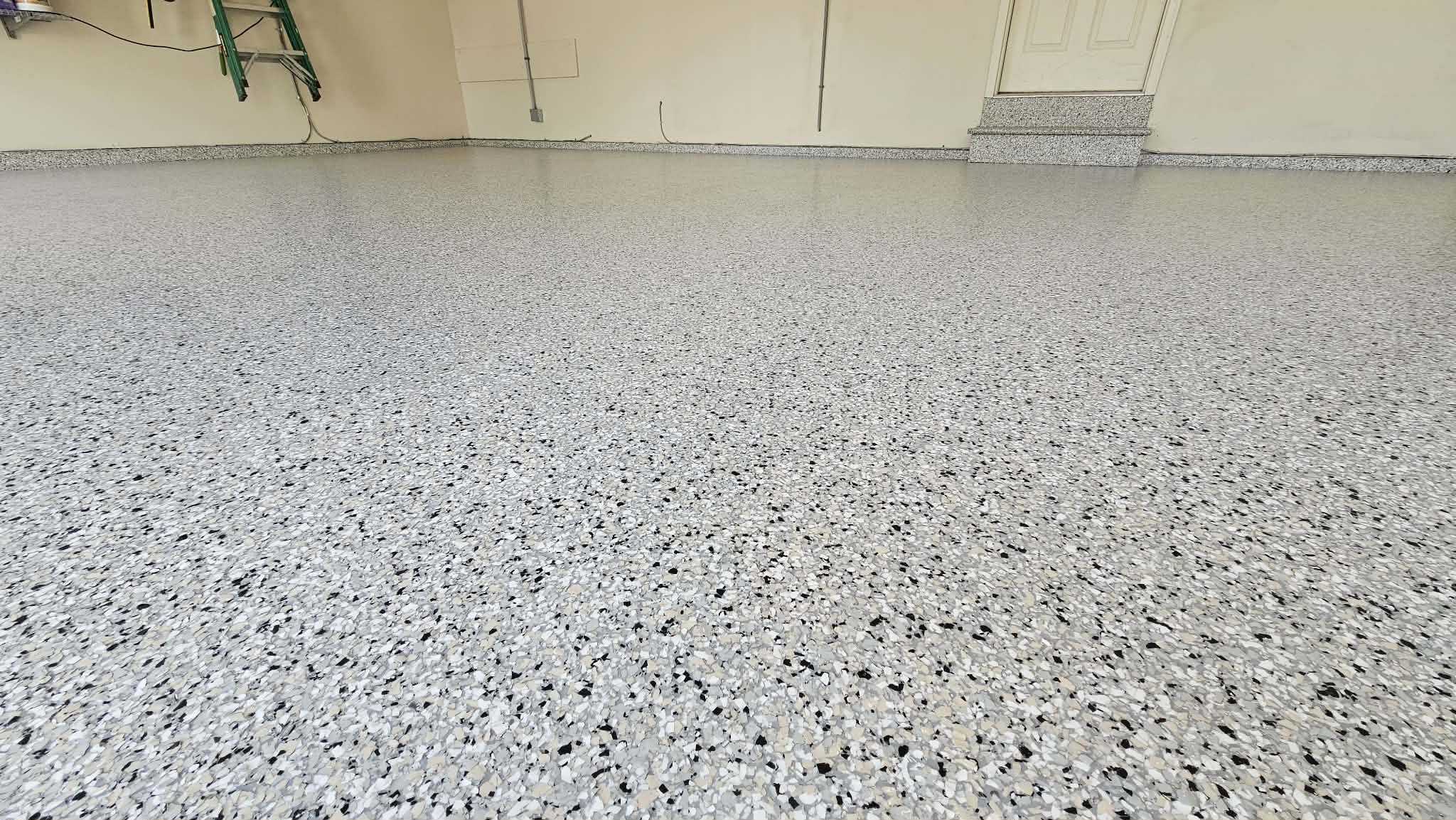
A homeowner in North Kansas City, MO called us about a 3-car garage floor that was falling apart. Not stained. Not dull. Coming apart in sheets, with rusted wire showing through the surface and a spiderweb of cracks running wall to wall. By the end of the install, that same slab was a full-broadcast flake epoxy floor with a coved wall base, a sealed door step, and a surface you can wash with a hose. Here is exactly what was wrong, what we did about it, and what a job like this costs in the Kansas City metro in 2026.
Project snapshot
| Location | North Kansas City, MO (Clay County, Northland) |
|---|---|
| Space | Residential 3-car attached garage |
| Slab condition | Surface spalling and delamination, map cracking, exposed corroded wire mesh |
| Prep | Diamond grinding with HEPA dust collection, crack chasing, polymer-modified patching, re-profiling |
| System | Full-broadcast flake floor, gray / black / white blend, clear protective topcoat |
| Extras | Coved wall base, coated service-door step, sealed door line |
| Install window | 1 to 2 days on site |
| Return to use | Foot traffic in about 24 hours, vehicles in about 72 hours |
What we found: a slab that was shedding its surface
The photo below is the floor on day one. The gray areas are sound concrete. The pale, rough patches are where the top layer had already broken away and taken the smooth finished surface with it. Look closely at the two straight rust-colored lines in the middle of the frame: that is the wire mesh inside the slab, exposed to open air and actively corroding.
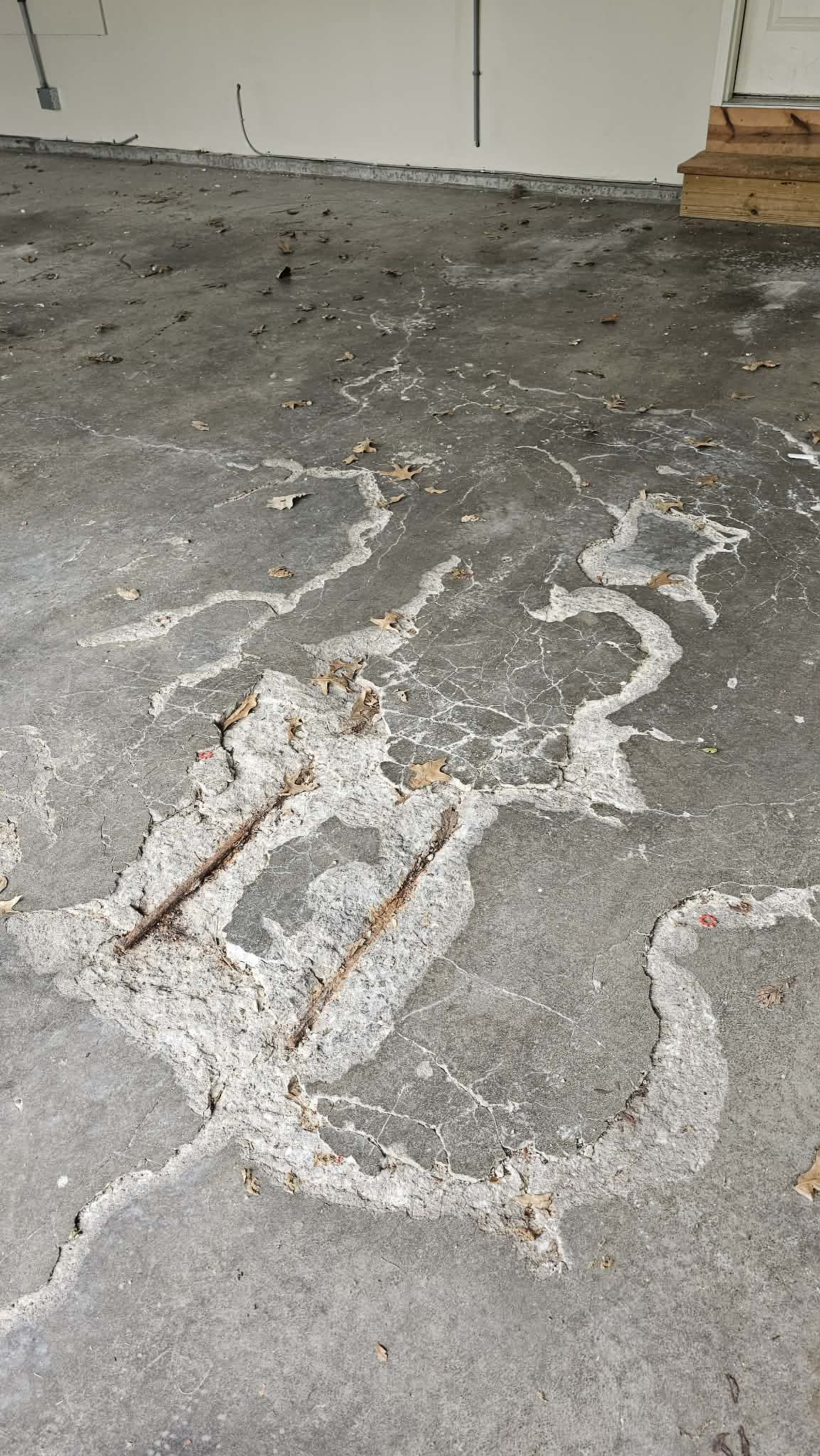
Three separate problems are visible in that one shot:
- Spalling and delamination. The top quarter inch of concrete had separated from the slab below and popped off in irregular islands. The edges are sharp and undercut, which is the signature of a weak surface layer rather than impact damage.
- Map cracking. The fine, random web of hairlines across the sound areas tells you the surface paste shrank harder and faster than the concrete underneath it.
- Corroding reinforcement. Once steel is exposed to moisture and chloride, it rusts, and rust occupies more volume than the steel it replaces. That expansion keeps lifting and breaking the concrete around it. This gets worse every winter until someone stops it.
A floor in this condition is not a cosmetic problem. Left alone, the spalled areas grow, the exposed mesh keeps expanding, and the homeowner eventually pays to demo and replace the slab.
Why North Kansas City garage slabs fail this way
We see this pattern constantly across the Northland, and the causes are usually the same three or four, stacked.
Freeze-thaw plus road salt
Kansas City winters cycle above and below freezing repeatedly, often within the same week. Water that has soaked into the top of a slab expands as it freezes and pushes the surface apart from the inside. Add the chloride that rides into every attached garage on the tires and undercarriage of a car, and two things happen at once: the salt brine lowers the freezing point and drives more moisture deeper into the concrete, and the chloride reaches the reinforcing steel and starts it rusting. An attached garage takes the worst of this because the car melts its load of slush directly onto the floor, then the space warms up and refreezes overnight.
How the slab was finished the day it was poured
Delamination that pops off in wide sheets, like the areas in the photo, usually traces back to finishing. If a slab is troweled too early or too hard, the surface densifies and seals while bleed water and air are still rising underneath. That trapped layer becomes a weak plane a few millimeters down. The floor looks perfect for years, then the first hard winter or a heavy tire load breaks it loose and it comes away as a sheet.
The age of the housing stock
North Kansas City was incorporated in 1912 and much of the surrounding Northland was built out decades ago, so plenty of garages here sit on slabs poured before air-entrained concrete and modern curing practice were standard. Newer builds around Briarcliff have better concrete, but they still get the salt.
Nobody sealed it
Bare concrete is porous. It drinks water, oil and brine. Most garage slabs in the metro have never had any protective coating at all, so every winter of exposure counts against them.
Why coating straight over a floor like this always fails
This is the part homeowners get burned on, and it is worth being blunt about. A coating is only as strong as the concrete it is stuck to. If you roll epoxy over a delaminated surface, the epoxy bonds beautifully to a layer that is itself already detached from the slab. Six months later the coating lifts, and it takes the loose concrete with it, and the failure looks like the coating’s fault.
The same logic sinks big-box DIY kits and the one-day “we can do it Saturday” crews. Those systems rely on an acid etch or a light scuff instead of mechanical profiling, which cannot remove a weak surface layer, reach the bottom of a crack, or do anything at all about exposed steel. On a floor like this one, prep is not a step before the real work. Prep is the work.
The repair: grind, chase, patch, re-profile
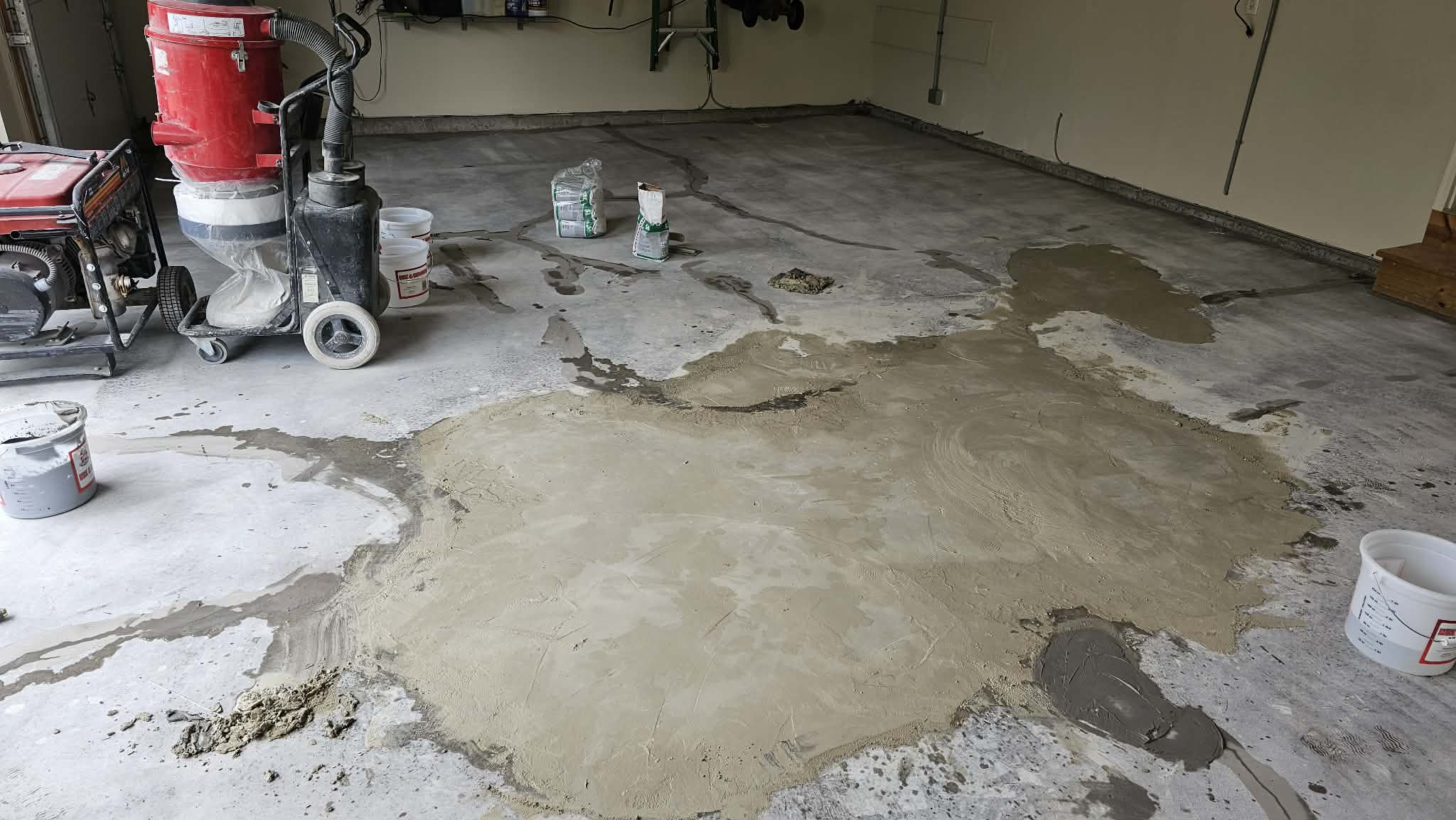
Here is the sequence we ran on this garage.
- Diamond grind the entire floor. Not the damaged areas, the whole slab. Grinding strips old sealers, paint and contamination, removes the weak surface paste, and opens the concrete’s pores so the coating can key into it mechanically. Everything runs through a HEPA dust collection system, so the garage does not turn into a dust storm and neither does the rest of the house.
- Sound out the delaminated areas. Anything hollow gets removed until we reach concrete that is actually attached. This is why the repair footprint in the photo above is larger than the visible damage in the before photo. Hollow concrete that looks fine from the top is still hollow.
- Chase and fill the cracks. Cracks get opened into a clean V, vacuumed, and filled with a structural repair material that bonds to both faces rather than sitting in the gap like caulk.
- Treat and cover the exposed steel. Corroded mesh gets cleaned back and buried under repair mortar so it is no longer in contact with air and moisture.
- Rebuild the spalled areas. Polymer-modified patching compound goes down and gets troweled flush with the surrounding slab, then feathered so the transitions do not telegraph through the finished floor.
- Re-grind the patches. Fresh patch material is denser than the concrete around it, so the whole floor gets profiled again to one consistent texture. Skip this and you can see every repair through the finished coating.
- Vacuum, tack, and moisture check. A clean, dry, correctly profiled slab is the whole ballgame.
Extensive slab repair like this falls under our concrete prep and removal work. When a slab is too far gone for patching, the next option up is a concrete overlay, which resurfaces the whole floor before coating. This one did not need to go that far.
The flake system that went down
With the slab sound, the coating went on in layers:
- Pigmented base coat. A commercial-grade epoxy primer and body coat rolled into the profiled concrete, penetrating the open pores rather than sitting on top of them.
- Full broadcast of vinyl flake. Chips are cast into the wet base to rejection, meaning the floor is fully covered rather than lightly sprinkled. Full broadcast is what builds thickness, hides the repairs and any remaining variation in the slab, and gives the floor its texture.
- Scrape and vacuum. Once cured, the loose flake gets scraped back and vacuumed so the surface is even before the clear coats.
- Clear protective topcoat. The topcoat locks the flake in, carries the abrasion, UV, chemical and hot-tire resistance, and sets the sheen. It is also the layer that makes the floor easy to clean, because there is nothing porous left for oil or brine to soak into.
The homeowner chose a gray, black and white blend, which is the most requested residential blend we install in the metro for a reason: it reads clean and modern under LED garage lighting, and it hides dust, tire marks and winter grit far better than a solid color. If you are weighing looks, our guides on flake color combinations and metallic epoxy versus flake are the two worth reading. For a plain, budget-conscious finish, solid color epoxy is the other option, and metallic epoxy is where people go when the garage is really a car showroom.
The details that separate a real install from a cheap one
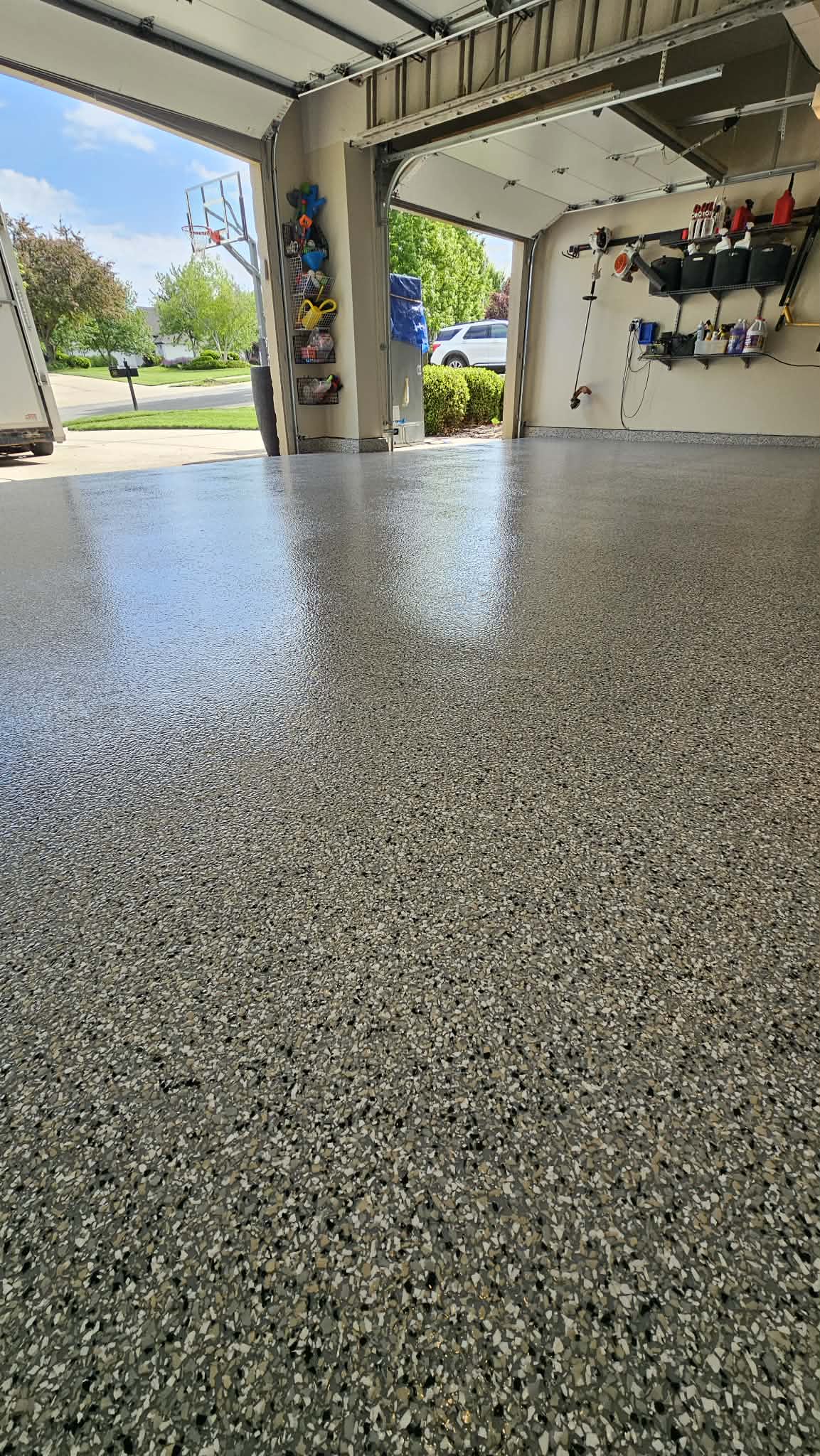
Look at the wall line in these photos. The flake runs up the wall a few inches as an integral coved base instead of stopping at the floor with a ragged edge. That does three things: it removes the seam where water and dirt collect, it lets you hose or squeegee the floor without soaking drywall, and it is the single fastest way to tell a professional install from a weekend one.
Same story at the service door. The step is coated and based rather than left as bare, absorbent concrete, which is the exact spot where a snowy boot drips every time somebody walks in from the house. And along the garage door line, the coating is terminated in a clean, straight edge so it does not chip when the door seal lands on it or when the weather beats on the exposed lip.
How long the job took
Most residential garages we coat are a 1 to 2 day install, and a floor with this much repair sits at the top of that window because the patch material has to cure before it can be re-ground and coated. On our residential work foot traffic returns in about 24 hours and vehicles in about 72, so nobody is living around an open project for a week.
What a 3-car garage floor costs in the Kansas City metro
Most 3-car garages in the Northland run roughly 600 to 900 square feet. Here is how the systems compare, using our current installed pricing for the Kansas City metro.
| System | Installed cost / sq ft | Typical 3-car garage (600 to 900 sq ft) | Best for |
|---|---|---|---|
| Solid color epoxy | $3 to $5 | $1,800 to $4,500 | Clean, simple, budget-first finish |
| Full-broadcast flake (most popular) | $4 to $7 | $2,400 to $6,300 | Durability, texture, hiding dirt and repairs |
| Metallic epoxy | $6 to $12 | $3,600 to $10,800 | Showpiece garages and car collections |
| DIY big-box kit | $2 to $4 | $1,200 to $3,600 | Short-term appearance only, no meaningful prep |
Two things move a quote off those ranges. The first is slab repair: a floor like this one, with widespread spalling and exposed steel, carries real material and labor cost before any coating is opened. The second is what the floor has on it already, since removing failed paint or an old coating adds grinding time. We price both after seeing the floor, not over the phone.
Compare that to replacing the slab. Tearing out and repouring a 3-car garage floor runs several times the cost of coating it, adds days of cure time, and leaves you with bare concrete again, which is exactly the material that failed in the first place.
Keeping it looking like the day it cured
- Dust mop or blow it out, and rinse with a hose or a mop when it needs it. No wax, no harsh acid cleaners.
- Wipe road salt and brine off in winter instead of letting it dry on the surface. The coating stops it reaching the concrete, but salt residue dulls the finish.
- Use a mat or a drip tray under a vehicle that leaks, and clean up oil and brake fluid reasonably promptly.
- Put a pad under jack stands and anything with sharp steel feet. The coating resists abrasion well, but concentrated point loads are a different kind of stress.
- Expect 15 to 20 years from a professionally installed system in a residential garage when it is prepped correctly, which is why the prep matters more than the color.
Frequently asked questions
How much does a 3-car garage epoxy floor cost in North Kansas City?
A full-broadcast flake floor runs $4 to $7 per square foot installed, so a typical 600 to 900 square foot 3-car garage lands between roughly $2,400 and $6,300. Slabs that need repair before coating, like the one in this project, cost more because the repair is real work. We give a fixed number after looking at the floor.
Can you coat a garage floor that is already spalling and cracked?
Yes, and that is most of what we do. The concrete has to be repaired first: the loose surface ground off, delaminated areas removed back to sound concrete, cracks chased and filled, exposed steel covered, and the patches re-profiled. Coating over damage without that work is why so many garage floors fail within a year.
How long does the installation take?
Most residential garages are 1 to 2 days on site. Heavy concrete repair pushes a job to the longer end because patch material has to cure before it can be re-ground and coated.
When can I park on it?
Foot traffic in about 24 hours, vehicles in about 72 hours. Driving on a coating before the topcoat has fully cured is one of the few ways to damage a properly installed floor early.
Will a flake floor peel like the kits from the hardware store?
Those kits fail because they rely on acid etching rather than mechanical grinding, and they use thin, water-based products. A professionally ground slab with a commercial-grade base coat, a full flake broadcast and a protective topcoat is a different system built to a different thickness. Ours is backed by a written warranty, and you can read how our flake epoxy warranty works.
Is a flake floor slippery when it gets wet?
The flake broadcast itself creates texture, so it has more grip than a smooth epoxy or a polished slab. For garages where cars come in wet all winter, we can add an anti-slip additive to the topcoat for extra traction.
Do you work in North Kansas City and the rest of the Northland?
Yes. We are based in Cleveland, MO and cover the Kansas City metro on both sides of the state line, including North Kansas City, Kansas City, Liberty, Parkville, Richmond and the surrounding Clay and Platte County communities.
Does a coated garage floor add value when I sell?
A finished garage shows dramatically better than a stained, cracked slab, and buyers in the Kansas City market read it as a maintained house. It also solves the inspection conversation that a spalling floor with exposed reinforcement tends to start.
Get a quote for your North Kansas City garage
If your garage floor is chalking, cracking, popping in sheets, or just tired, the fix is usually less involved than people expect, and it gets more expensive the longer the concrete stays open to salt and water. High Stakes Epoxy LLC is a locally owned, licensed and insured concrete coating company serving North Kansas City and the greater Kansas City metro.
Call (816) 820-8193, Monday through Saturday, 7:00am to 6:00pm, or request a free quote online. You can see more finished floors in our project gallery, or read the full homeowner’s guide to epoxy garage floor coatings before you decide.