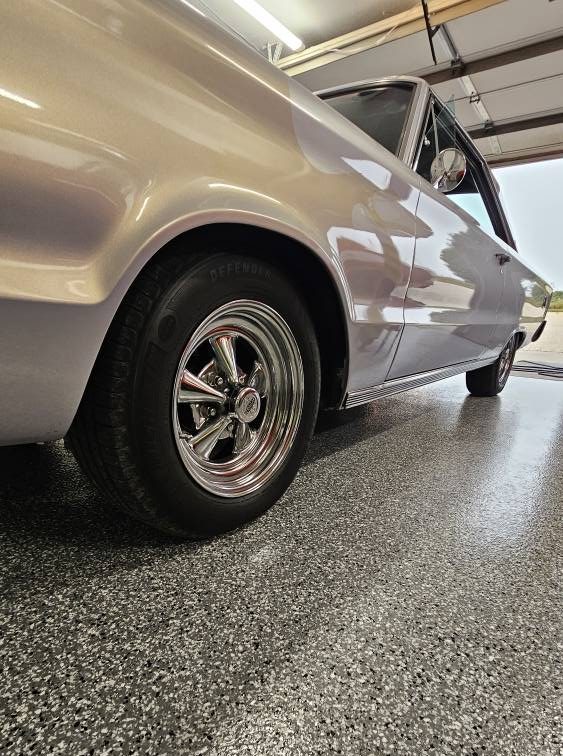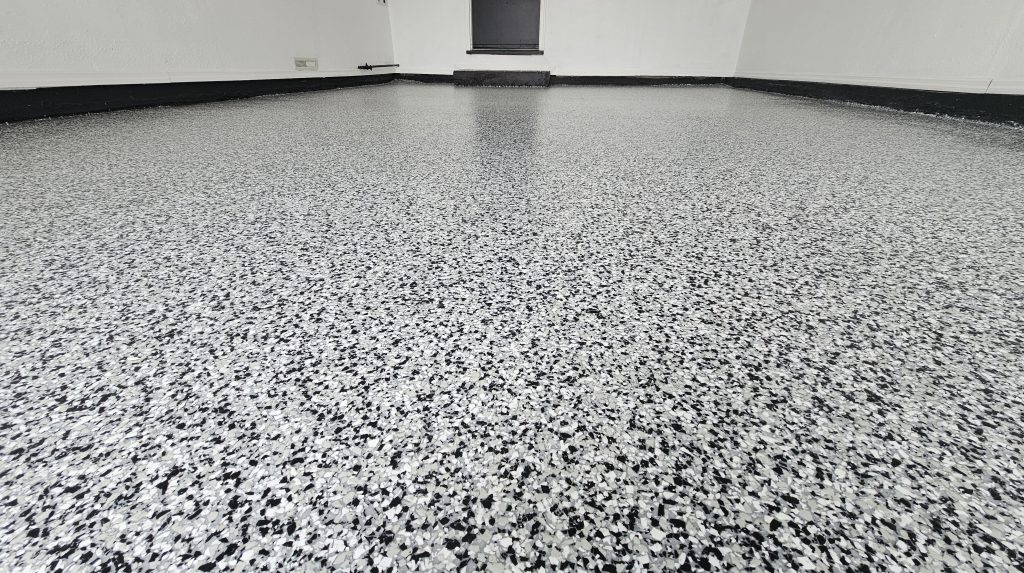
A 1,300 square foot garage in Loch Lloyd, MO is not a bigger version of a normal garage job. It is a different job. At that size you are coating more floor in one continuous pour than most contractors handle in a week, and every decision about crew size, product batching and where you start rolling has to be made before anyone opens a bucket. Here is how this flake epoxy floor came together, what changes when a garage is this large, and what 4-car garage epoxy flooring costs in the south Kansas City metro.
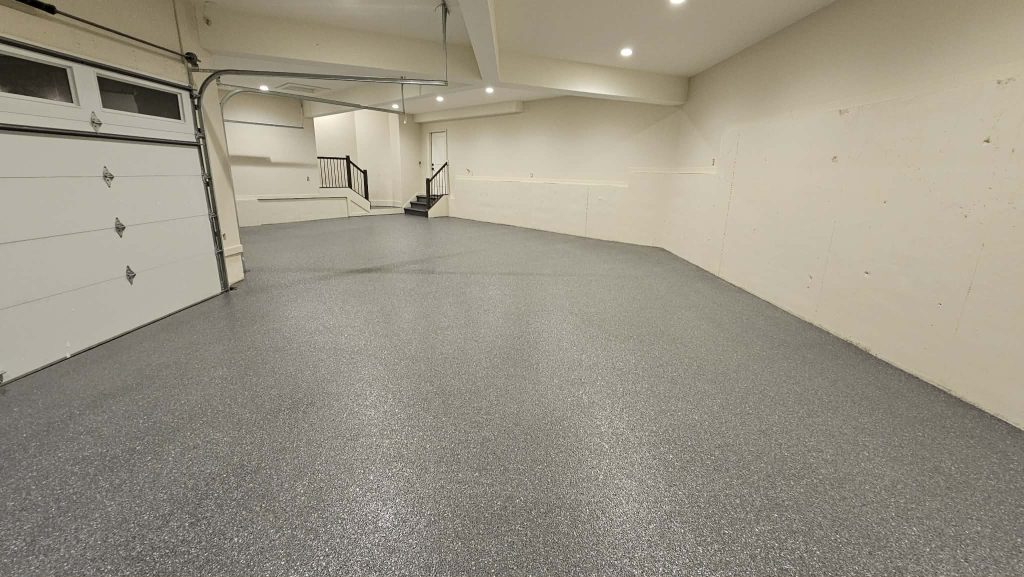
Project snapshot
| Location | Village of Loch Lloyd, MO (Cass County, south KC metro) |
|---|---|
| Space | Oversized residential garage, roughly 1,300 sq ft, 4-car footprint plus interior stair landing |
| Slab condition | Sound existing concrete, light prep |
| Prep | Full-floor diamond grinding with HEPA dust collection, joint and crack detail, vacuum and tack |
| System | Full-broadcast flake floor, gray and white blend, clear protective topcoat |
| Extras | Coved wall base throughout, coated stair treads, risers and landing, sealed door lines |
| Install window | 1 to 2 days on site |
| Return to use | Foot traffic in about 24 hours, vehicles in about 72 hours |
What 1,300 square feet actually looks like
For scale: a standard two-car garage is around 400 square feet, and a typical three-car runs 600 to 900. At 1,300, this garage is roughly three times a standard two-car and comfortably a four-vehicle footprint with room left for a workbench, a cart and storage along the walls. In estate homes around Loch Lloyd, Raymore and south Belton, garages at this size are common, and they usually connect straight into the house through a finished stair landing, which is exactly what this one does.
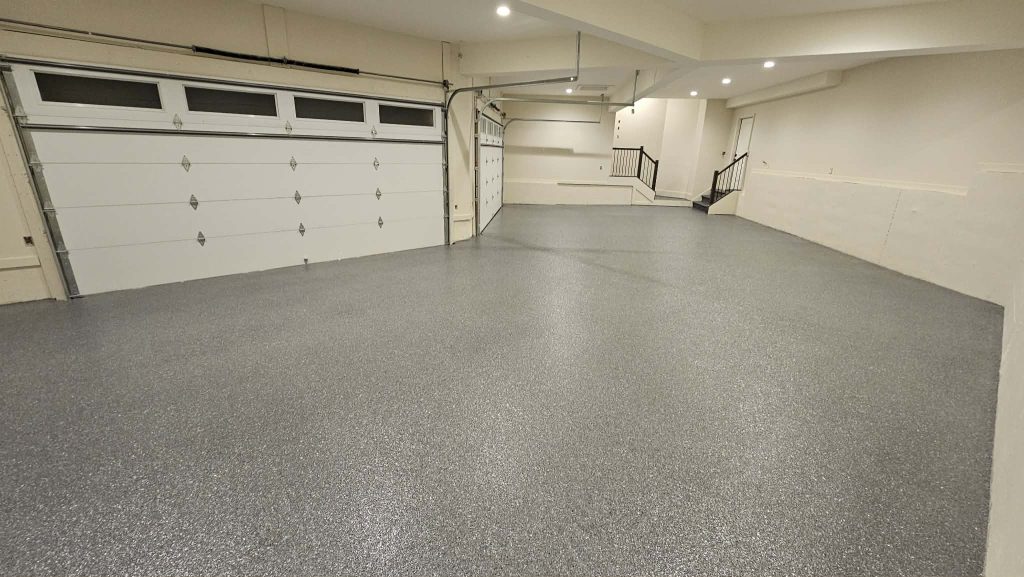
That size is the whole story of the job. Everything below follows from it.
Why a big garage floor is harder than it looks
The floor has to go down in one continuous pass
Epoxy has a working time. Once a batch is mixed it starts to react, and the edge of what you have already rolled starts to set. If the next section is rolled into an edge that has begun to cure, you get a visible lap line that no amount of topcoat hides. On 400 square feet, one person can stay ahead of that comfortably. On 1,300 square feet, staying ahead of the wet edge is a crew problem: mixing has to be staged so material arrives at the right moment, and the rolling has to move across the floor in a planned direction so no seam is ever cold. This is the single biggest reason large garage floors go wrong.
Batch consistency across a large area
Pigmented coatings are mixed in batches, and batches can vary slightly. On a big floor those variations sit side by side under one set of ceiling lights where anyone can see them. Keeping color consistent across a floor this size means controlling mix ratios and mix times batch to batch rather than eyeballing it.
Broadcasting flake evenly over three times the area
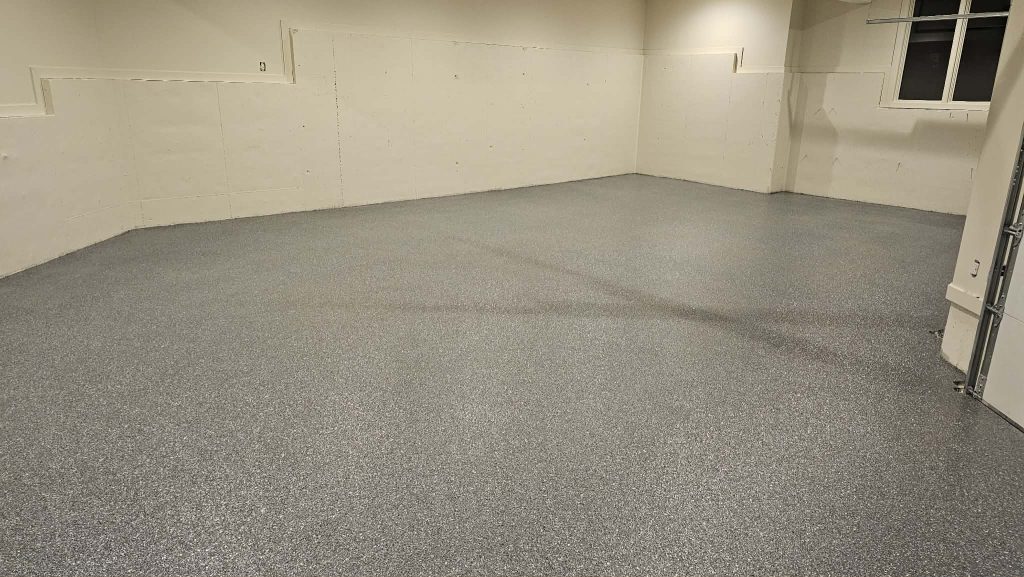
Flake is thrown by hand, up and out, so it falls rather than lands. Getting an even, fully covered broadcast over 1,300 square feet, without heavy patches or thin spots, takes both people and practice. The floor in these photos is uniform corner to corner, which is what a full broadcast is supposed to look like.
Dust control inside a finished house
Grinding a floor this large generates real volume. In an attached garage that opens into a finished home, dust management is not a courtesy, it is the job. Everything runs through HEPA dust collection at the grinder so silica dust never gets a chance to travel into the house.
Prep on a sound slab still means grinding the whole floor
This slab was in good shape, which means the prep was straightforward. It did not mean the prep was optional.
A coating does not stick to concrete by chemistry alone, it sticks by keying into an open, profiled surface. A slab that looks clean is still closed on top: it carries curing compounds, sealers, tire residue and a dense layer of surface paste that a coating can only sit on rather than bite into. So the entire floor gets diamond ground to open the pores, joints and any hairline cracks get detailed, and the slab is vacuumed and tacked before the first coat goes on. On a light-prep job the grinder moves faster, but it still covers every square foot.
This is where cheap quotes are made. Skipping or shortcutting the grind is invisible on install day and obvious two winters later. If you are comparing bids on a garage this size, ask each contractor what their prep is, specifically, and how they handle the dust. For floors that need more than a grind, our concrete prep and removal page covers the heavier end, and a nearby project we published, a 3-car garage in North Kansas City, shows what a slab looks like when repair genuinely is required.
The system, layer by layer
- Pigmented base coat. Commercial-grade epoxy rolled into the profiled slab, penetrating the pores that grinding opened.
- Full broadcast of vinyl flake. Chips cast into the wet base to rejection, so the floor is fully covered rather than lightly sprinkled. Full broadcast is what builds thickness, evens out the slab and gives the surface its texture.
- Scrape and vacuum. Once cured, loose flake is scraped back and vacuumed so the surface is flat before the clear coats.
- Clear protective topcoat. This is the layer doing the work: abrasion, hot tire pickup, chemical and UV resistance, and the sheen. It also leaves nothing porous for oil, brine or fertilizer to soak into.
The details: stairs, landing and wall base
In a garage that opens into the house, the stairs are the part everyone actually touches, and they are the part most quotes leave bare.
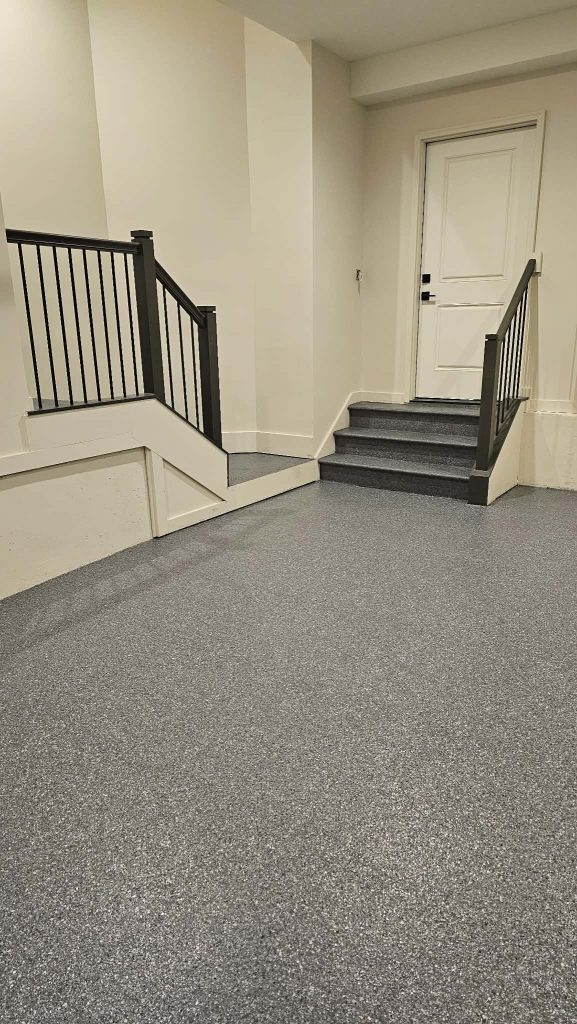
Here the flake system carries up the treads, over the nosings and across the landing in the same blend as the floor, so the transition into the house reads as one surface instead of a coated floor and three gray concrete steps. That matters practically, not just visually: stair treads take concentrated foot traffic and the worst of the wet boots, and bare concrete there stains, dusts and eventually chips.
The same logic applies to the coved wall base running the perimeter. Instead of stopping at the wall with a ragged edge, the coating turns up a few inches to form an integral base. It closes the seam where water and dirt collect, it lets the floor be hosed or squeegeed without soaking drywall, and it is the fastest way to tell a professional install from a weekend one. At the garage doors, the coating is terminated in a clean straight line so the door seal is not landing on an exposed edge.
Why a gray flake blend works in a garage this size
Large garages have a lighting problem. A dark or solid floor swallows light and makes a big space feel like a cave, especially in a lower-level garage where the ceiling is low and the light is all artificial. A light gray and white flake blend does the opposite: it bounces the ceiling lights back up, so the same fixtures make the room noticeably brighter.
It also hides everything. Flake blends break up the surface visually, so dust, tire marks, winter grit and the drips that happen in any working garage do not read as stains the way they do on a solid color. Over 1,300 square feet, that is the difference between a floor that looks maintained and one that needs constant attention. If you want to compare finishes before you commit, our guides on flake color combinations and metallic epoxy versus flake are the two to read. Metallic epoxy is the showpiece option when a garage doubles as a car room, and solid color epoxy is the simplest finish for a pure utility space.
How long a floor this size takes
Our residential installs run 1 to 2 days on site, and a 1,300 square foot floor uses that full window with a full crew rather than a two-person team. Foot traffic returns in about 24 hours and vehicles in about 72. The cure schedule is the same regardless of size, so a big garage does not mean a longer wait to park, it means more people on site to get the coating down inside its working time.
What a 1,300 sq ft garage floor costs in the Kansas City metro
Here are our installed ranges, applied to this floor’s size.
| System | Installed cost / sq ft | 1,300 sq ft garage | Best for |
|---|---|---|---|
| Solid color epoxy | $3 to $5 | $3,900 to $6,500 | Simple, clean utility finish |
| Full-broadcast flake (most popular) | $4 to $7 | $5,200 to $9,100 | Durability, texture, hiding dirt and wear |
| Metallic epoxy | $6 to $12 | $7,800 to $15,600 | Showpiece garages and car collections |
| DIY big-box kit | $2 to $4 | $2,600 to $5,200 | Short-term appearance only, no real prep |
Two things worth knowing about pricing a large floor. First, big garages usually land toward the lower end of the per-square-foot range, because mobilization, setup and grinder time spread across more area. Second, extras change the number more than size does: coated stairs and landings, coved base, a heavily contaminated or previously coated slab, or an anti-slip additive all add scope. We quote after seeing the floor rather than over the phone, and the number we give is the number.
Living with it in Cass County
Loch Lloyd is a private village built around a lake and two golf courses, so the garages here take a specific kind of traffic: golf carts, utility vehicles, mowers, trailers, and cars that come home wet and salted from November through March. All four are hard on bare concrete in different ways.
- Road salt and brine. Chloride is what drives concrete deterioration and rusts the reinforcement inside a slab. A sealed floor stops it reaching the concrete at all. Wipe or rinse the residue off rather than letting it dry on the surface, which dulls the sheen.
- Cart and mower tires. Turning tires scuff a floor more than driving on it does. The topcoat is what carries that, which is why the final layer is not the place to save money.
- Fertilizer, fuel and oil. All of it wipes off a coated floor. On bare concrete it soaks in and stays.
- Point loads. Put a pad under jack stands and anything with sharp steel feet. Coatings handle abrasion well; concentrated point loads are a different stress.
Day to day the maintenance is a dust mop, a rinse when it needs it, and no wax or acid cleaners. Expect 15 to 20 years from a professionally installed system in a residential garage that was prepped correctly.
Frequently asked questions
How much does a 1,300 sq ft garage floor coating cost?
A full-broadcast flake floor runs $4 to $7 per square foot installed, so 1,300 square feet lands between roughly $5,200 and $9,100. Large floors usually price toward the lower end of that range because setup time spreads across more area. Coated stairs, coved base and heavy prep add scope.
How big is a 4-car garage in square feet?
A four-car garage typically runs 1,000 to 1,400 square feet, against roughly 400 for a two-car and 600 to 900 for a three-car. At 1,300 square feet this Loch Lloyd garage sits at the large end of four-car, with room for storage and a stair landing into the house.
Can a garage floor this large be coated in one day?
The coating has to go down in one continuous pass so the wet edge never sets between sections, which on 1,300 square feet takes a full crew rather than one or two installers. Our residential installs run 1 to 2 days on site, and a floor this size uses the full window.
When can I park on it?
Foot traffic in about 24 hours and vehicles in about 72. That cure schedule does not change with the size of the floor.
Does a garage floor in good condition still need to be ground?
Yes. A clean slab is still closed on top, carrying curing compounds, sealers and dense surface paste. Diamond grinding opens the pores so the coating keys in mechanically. Light prep means the grinder moves faster, not that any of the floor gets skipped.
Can you coat the stairs and landing too?
Yes, and on a garage that opens into the house it is worth doing. The same flake system carries up the treads, nosings and landing so the transition reads as one surface, and the concrete that takes the most foot traffic and the wettest boots is protected rather than left bare.
Is a flake floor slippery when wet?
The flake broadcast creates texture, so it grips better than smooth epoxy or polished concrete. For garages that see wet cars and carts, an anti-slip additive can be added to the topcoat for extra traction.
Do you work in Loch Lloyd and the rest of Cass County?
Yes. High Stakes Epoxy LLC is based in Cleveland, MO, in the same county, and we cover the whole south Kansas City metro including Loch Lloyd, Belton, Raymore, Grandview and Harrisonville.
Get a quote for your garage
Whether it is a two-car that needs rescuing or 1,300 square feet that has to look right under every ceiling light, the work is the same in order: grind it properly, coat it in one pass, finish the edges and the stairs. High Stakes Epoxy LLC is a locally owned, licensed and insured concrete coating company based in Cleveland, MO and serving the Kansas City metro.
Call (816) 820-8193, Monday through Saturday, 7:00am to 6:00pm, or request a free quote online. More finished floors are in our project gallery, and our homeowner’s guide to epoxy garage floor coatings covers the decision end to end. For high-end residential work specifically, see our notes on flake epoxy in high-end homes and how our flake epoxy warranty works.