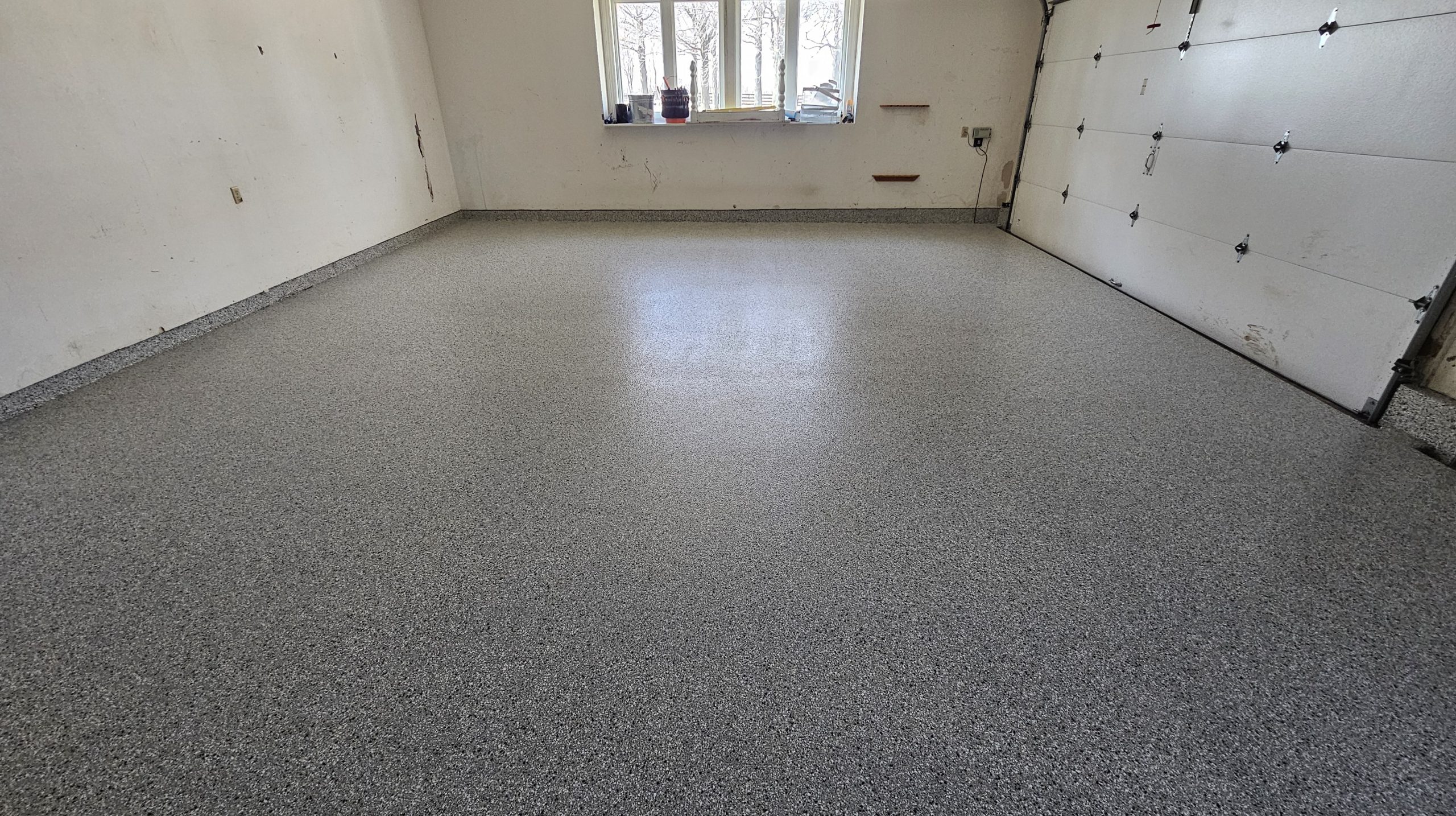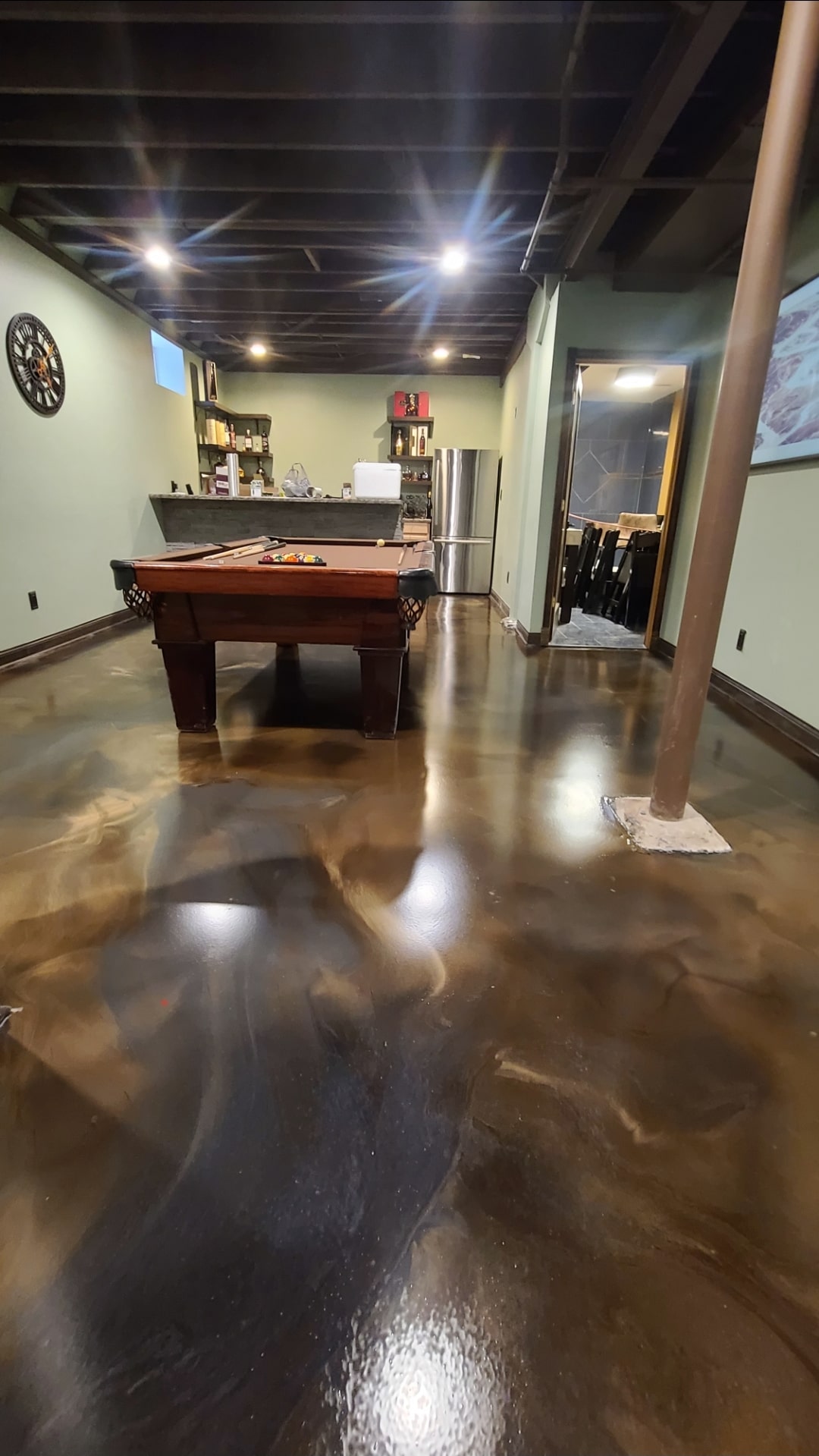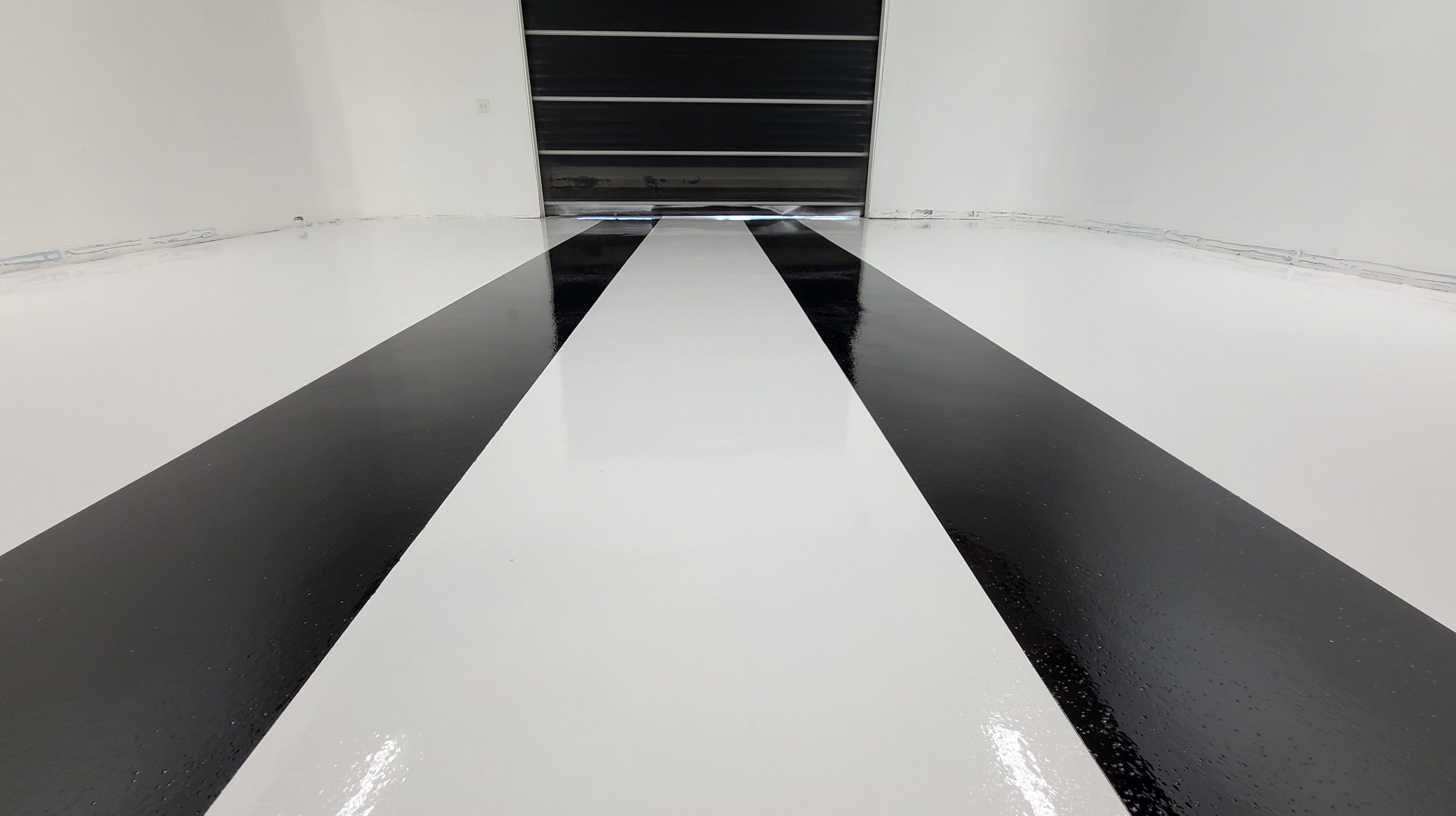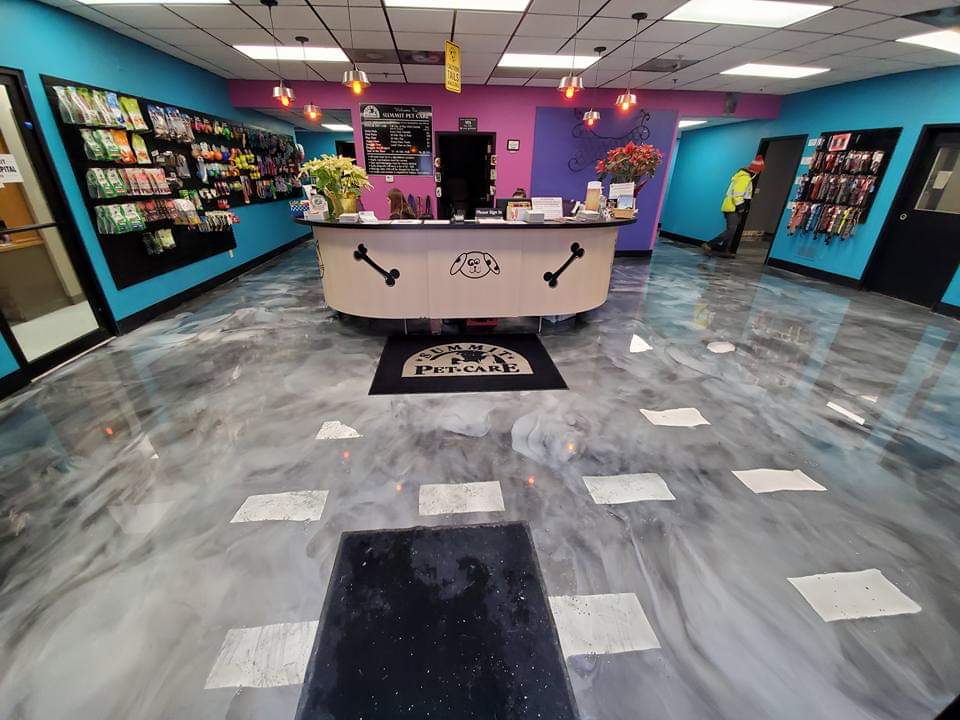
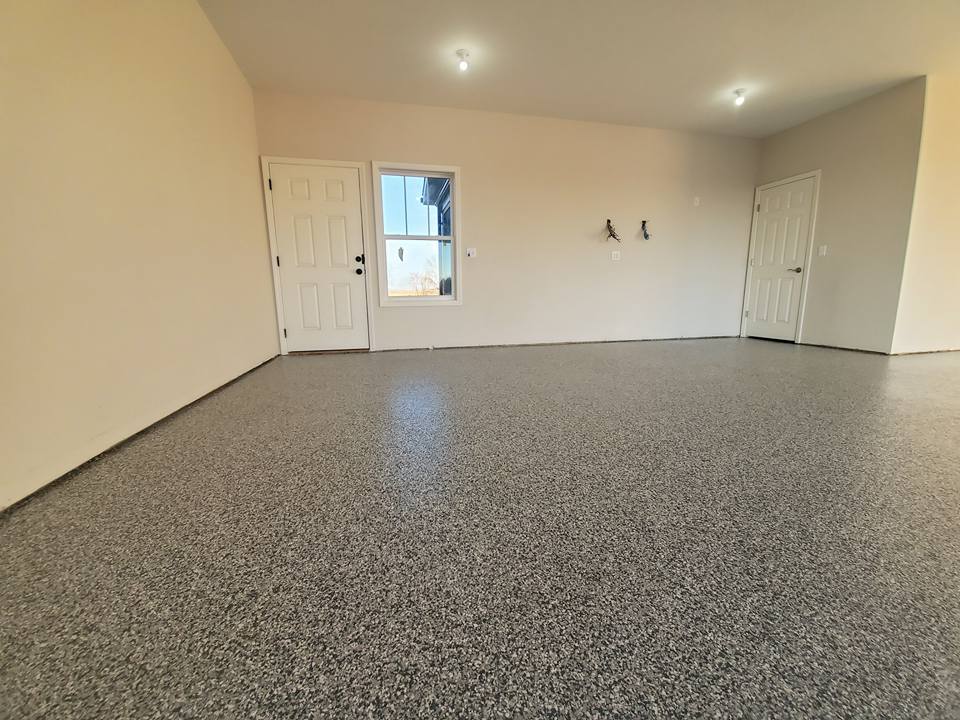
Short answer: most Kansas City homeowners pay $4 to $7 per square foot for a professionally installed flake garage floor, which works out to roughly $1,800 to $3,150 for a standard two-car garage and $3,000 to $5,250 for a three-car. Solid color epoxy is cheaper at $3 to $5 per square foot, metallic runs $6 to $12, and the condition of your concrete moves the final number more than anything else on this page.
That is the range. What follows is where your garage lands inside it, why two quotes for the same floor can differ by thousands, and what a number should include before you sign it.
Garage floor coating cost in Kansas City at a glance
| System | Installed cost per sq ft | Expected life | Best for |
|---|---|---|---|
| DIY big-box kit | $2 to $4 | 1 to 3 years | Short-term appearance, no real prep |
| Solid color epoxy | $3 to $5 | 10 to 15 years | Clean, simple, budget-first finish |
| Full-broadcast flake (most popular) | $4 to $7 | 15 to 20 years | Durability, texture, hiding dirt and wear |
| Metallic epoxy | $6 to $12 | 15 to 20 years | Showpiece garages and car collections |
Those are installed prices for residential garages across the Kansas City metro, on both sides of the state line. Pricing does not change between Overland Park and Blue Springs. What changes is your slab.
What that means for your garage
Garage sizes vary, so here are the totals using typical footprints: about 250 sq ft for a single, 450 for a standard two-car, 750 for a three-car, and 1,200 for an oversized four-car.
| Garage size | Solid color epoxy | Full-broadcast flake | Metallic epoxy |
|---|---|---|---|
| 1-car (about 250 sq ft) | $750 to $1,250 | $1,000 to $1,750 | $1,500 to $3,000 |
| 2-car (about 450 sq ft) | $1,350 to $2,250 | $1,800 to $3,150 | $2,700 to $5,400 |
| 3-car (about 750 sq ft) | $2,250 to $3,750 | $3,000 to $5,250 | $4,500 to $9,000 |
| 4-car / oversized (about 1,200 sq ft) | $3,600 to $6,000 | $4,800 to $8,400 | $7,200 to $14,400 |
Measure your own floor rather than trusting the car count. Garages described as two-car run anywhere from 380 to 550 square feet, and that spread alone is several hundred dollars.
What actually drives the price
1. The condition of your concrete
This is the biggest variable and the one homeowners never budget for. A sound slab needs grinding, which is included in every honest quote. A slab that is cracked, spalling, oil-soaked, or shedding its surface needs work before any coating goes down, and that work is real labor and real material.
Concrete repair, crack and joint detail, moisture mitigation and removing a failed coating typically add $0.50 to $2 per square foot. On a two-car garage that is $225 to $900 on top of the coating. It is not an upsell. A coating bonded to loose concrete fails with the concrete, usually inside two winters.
2. How big the floor is
Bigger floors cost more in total and less per square foot. Mobilization, setup, grinder time and cleanup are largely fixed, so they spread across more area. A 1,200 square foot garage usually prices nearer the bottom of the per-foot range, while a single-car garage prices near the top because the crew still has to show up, set up and tear down for a small floor.
3. Which system you choose
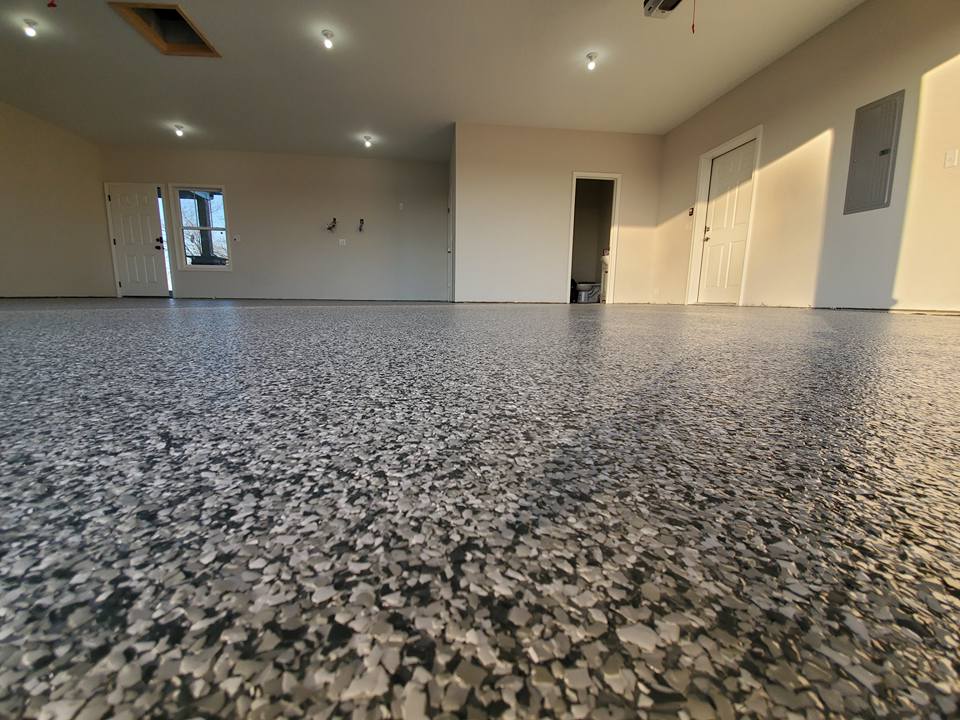
Flake is the default for garages because the chips add thickness, texture and grip, and they hide the dust, tire marks and winter grit that a solid color shows. Solid color is the budget option and looks sharp when it is clean. Metallic is a design choice: it costs more, it is smooth rather than textured, and it belongs in a garage that functions as a showroom. Our comparison of metallic epoxy versus flake covers the tradeoff in detail.
4. The extras that are not really extras
A coved wall base, coated stair treads and landings, and an anti-slip additive in the topcoat all add scope. They also make the difference between a floor that looks finished and a floor that stops at a ragged edge four inches from the drywall. Ask for them to be quoted as line items so you can see what they cost rather than discovering they were never included.
5. What the quote does not say
Two quotes for the same garage can differ by 40 percent because they are not describing the same job. One may include a full flake broadcast to rejection and two clear topcoats. The other may include a light flake scatter and a single thin topcoat, which is the layer that carries all the wear. Neither line item will say so. That is covered further down.
The same garage, three slab conditions
To show what that first variable really does, here is one 450 square foot two-car garage getting the identical full-broadcast flake system, priced against three different starting points.
| Starting condition | Prep and repair | Coating | Estimated total |
|---|---|---|---|
| Sound slab, never coated | Standard diamond grind, included | $1,800 to $3,150 | $1,800 to $3,150 |
| Minor cracking, a few small spalls | About $0.50 per sq ft, roughly $225 | $1,800 to $3,150 | $2,025 to $3,375 |
| Widespread spalling, or an old coating to grind off | $1.50 to $2 per sq ft, $675 to $900 | $1,800 to $3,150 | $2,475 to $4,050 |
Same square footage, same product, same crew, and a spread of more than $2,000 from top to bottom. This is why nobody can give you a real number over the phone, and why a contractor who quotes one without seeing the floor is either padding the price to cover themselves or planning to raise it once the grinder is running.
What your budget actually buys
If you are working backward from a number rather than forward from a system, here is roughly where each budget lands on a standard two-car garage.
- Under $1,500. Realistically a DIY kit, or a professional solid color floor on a small or single-car garage. On a full two-car it usually means something was left out: a light broadcast, a single thin topcoat, or no edge and base detail.
- $1,500 to $2,500. The working range for a professional job on a sound two-car slab. Solid color comfortably, or flake at the lower end of the flake range if the concrete is in good shape.
- $2,500 to $4,000. Full-broadcast flake with real prep, coved base, and room in the number for the concrete repair most older Kansas City garages actually need. This is where most of our residential two-car work lands.
- $4,000 and up. Larger garages, metallic systems, or a slab that needs serious repair before anything goes down. Also where coated stairs, landings and anti-slip additives sit comfortably in scope.
Two real Kansas City jobs and what made them cost what they did
Ranges are useful; examples are better.
A 3-car garage in North Kansas City came to us with widespread spalling, map cracking and corroded wire mesh breaking through the surface. That floor sat in the flake range for the coating itself, but the concrete repair was the larger half of the day: removing delaminated areas back to sound concrete, chasing and filling cracks, burying exposed steel, rebuilding the spalled areas and re-grinding the patches so they did not telegraph through the finish. If you own a slab like that, budget the repair adder at the top of the $0.50 to $2 band and treat the coating as the cheaper part of the project.
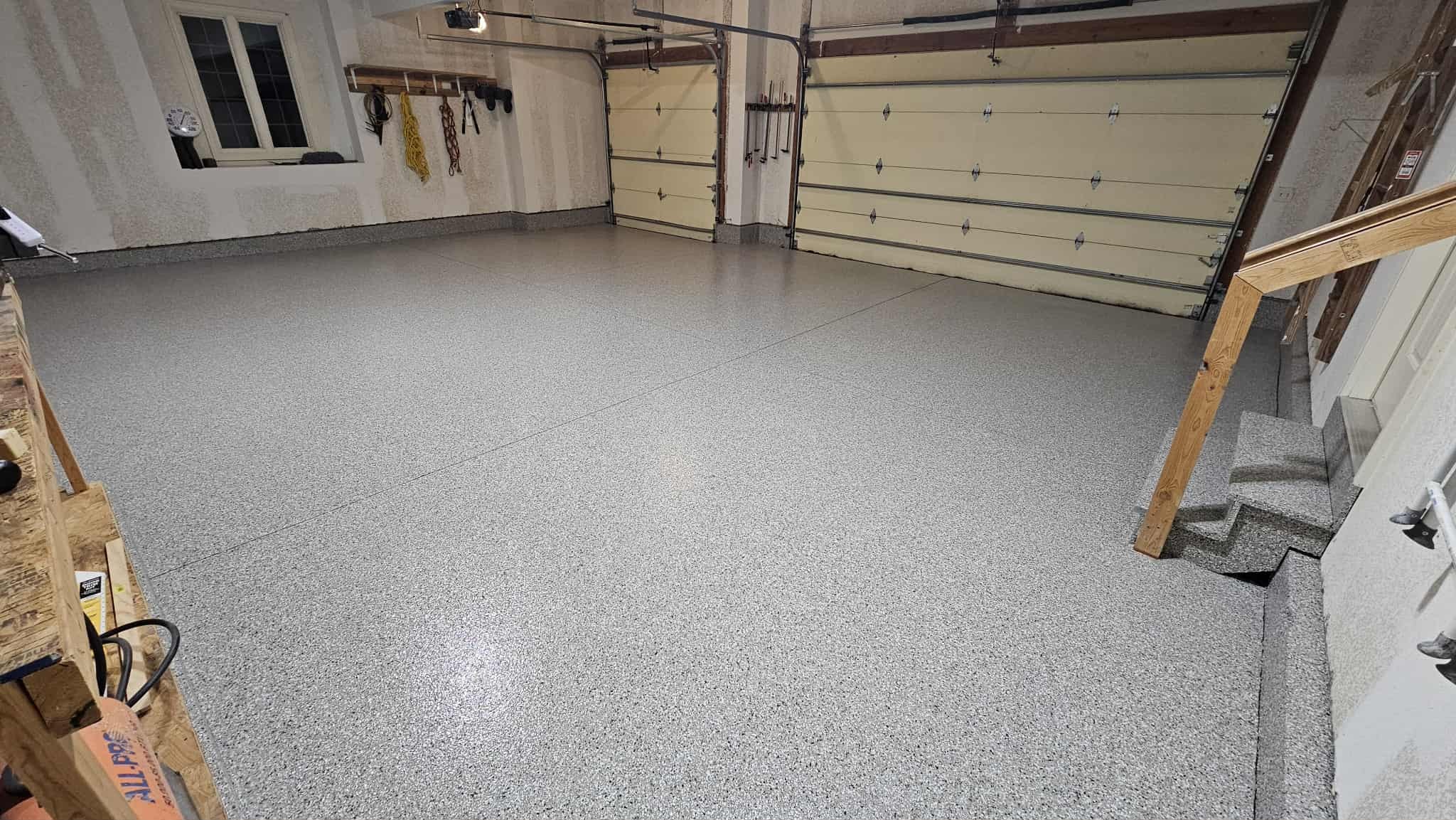
A 1,300 square foot garage in Loch Lloyd was the opposite: a sound slab, light prep, and the cost driven almost entirely by size and by the extras, which included a coved base throughout and coated stair treads and landing. Per square foot it priced toward the lower end of the flake range. In total it was one of the larger residential floors we install.
Same system, same crew, very different invoices, and the difference had almost nothing to do with the coating itself.
DIY kit versus professional install: the ten-year math
A big-box kit for a two-car garage is $200 to $500 in materials, or roughly $2 to $4 per square foot once you add rental prep equipment and the second kit almost everyone ends up buying. Against $1,800 to $3,150 for a professional flake floor, the kit looks like an obvious win. Over ten years it usually is not.
| DIY kit | Professional flake floor | |
|---|---|---|
| Up-front cost (2-car) | $200 to $500 in materials | $1,800 to $3,150 installed |
| Surface prep | Acid etch or light scuff | Full diamond grind with HEPA dust collection |
| Coating thickness | Thin, water-based, single coat | Commercial-grade base, full flake broadcast, clear topcoat |
| Typical life | 1 to 3 years before peeling or hot tire pickup | 15 to 20 years |
| Ten-year cost | 3 to 5 redos plus your weekends | One install |
| Removal cost later | Grinding a failed coating off adds to the next quote | None |
The part people miss is the last row. A failed DIY coating does not leave you back at bare concrete. It leaves you with a floor that has to be ground off before anything else can go on, and that removal lands on your professional quote later.
What about polyaspartic and one-day coatings?
You will see this in Kansas City quotes, usually pitched as “installed in a day.” Polyaspartic and polyurea are topcoat chemistries that cure much faster than standard epoxy, which is what makes the one-day claim possible. They also cost more per gallon, so a polyaspartic system typically prices above a comparable epoxy one.
Two things are worth knowing before you pay the premium. First, the speed is in the cure, not the preparation. A one-day install still needs the floor fully ground, and any crew that fits grinding, repair, base coat, broadcast and topcoat into a single day on a large garage is either running a real crew or skipping something. Ask which. Second, faster cure means a shorter working window, so on a big floor the wet-edge problem gets harder, not easier.
The honest summary: chemistry is worth discussing, but it is a second-order decision. A well-prepped epoxy floor outlives a badly prepped polyaspartic one every time, and the prep line in your quote tells you more about the result than the product name does.
What a complete quote should include
Before you compare two numbers, make sure they are describing the same work. A quote that covers all of this is comparable. One that does not is a different job wearing the same price tag.
- Surface preparation method, named. Diamond grinding or shot blasting, not “surface preparation” and not acid etching.
- Dust control. HEPA collection at the grinder, especially for an attached garage.
- Crack, joint and repair scope. What is being repaired, and what happens if more damage appears once the grinder opens the floor.
- The system, by layer. Base coat, flake broadcast (full or partial), number of clear topcoats.
- Edges and details. Coved base, stairs, door lines, thresholds. Named, or assume they are excluded.
- Cure and return-to-use times. When you can walk on it and when you can park on it.
- Warranty, in writing. What is covered, for how long, and what voids it.
- License and insurance. Verifiable, not asserted.
Five things that make a cheap quote expensive
- Acid etching instead of grinding. Etching cannot remove a weak surface layer or open dense concrete properly. It is the single most common reason coatings peel.
- A partial flake broadcast. Scattering flake instead of casting it to rejection saves material and costs you thickness, which is where the durability lives.
- One thin topcoat. The clear coat carries abrasion, hot tire pickup, chemical and UV resistance. It is the last place to economize.
- Skipping the repair. Coating over delaminated concrete bonds the coating to something that is already detached. It fails, and it takes the concrete with it.
- No wall base or edge detail. Cheap to leave out, obvious forever, and it is where water and dirt collect.
None of these are visible on install day. All of them are visible in year two.
Is a coated garage floor worth it in Kansas City?
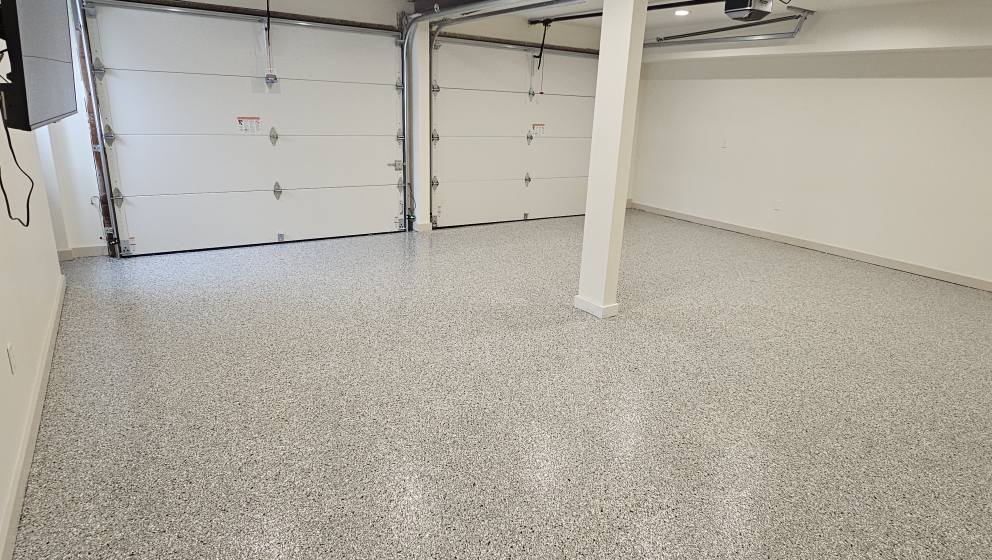
Kansas City is hard on garage concrete for a specific reason: the winter cycles above and below freezing repeatedly, and every car brings home a load of road salt that melts onto the slab. Chloride reaches the steel inside the concrete and rusts it; freeze-thaw opens the surface. Bare concrete absorbs both. A sealed floor stops the process at the surface, which is why coating is usually cheaper than the alternative.
Compare it to replacing the slab. Tearing out and repouring a two-car garage floor runs several times the cost of coating it, takes days of cure time before you can park, and hands you bare concrete again, which is the material that failed in the first place. Repair and coat is normally the better spend, and it comes with a finished surface at the end.
On resale, a finished garage reads as a maintained house. It also removes the inspection conversation that a spalling floor with exposed reinforcement tends to start.
Frequently asked questions
How much does it cost to epoxy a 2-car garage in Kansas City?
A professionally installed full-broadcast flake floor on a typical 450 square foot two-car garage runs about $1,800 to $3,150. Solid color epoxy is $1,350 to $2,250 and metallic is $2,700 to $5,400. Concrete repair, if the slab needs it, adds $0.50 to $2 per square foot.
How much does a 3-car garage floor coating cost?
Around $3,000 to $5,250 for flake on a typical 750 square foot three-car garage, $2,250 to $3,750 for solid color, and $4,500 to $9,000 for metallic. Larger floors usually price toward the lower end of the per-square-foot range.
Why are garage floor coating quotes so different from each other?
Because they are usually describing different work. The variables that move price most are the preparation method (diamond grinding versus acid etching), whether the flake is broadcast to full coverage or scattered, how many clear topcoats are included, and whether concrete repair and edge details are in scope. Ask each contractor to name all four.
Does concrete repair add much to the cost?
Crack and joint repair, spall repair, moisture mitigation and removing a failed coating typically add $0.50 to $2 per square foot, so $225 to $900 on a two-car garage. It cannot be skipped on a damaged slab: a coating is only as sound as the concrete it is bonded to.
Is epoxy cheaper than replacing the concrete?
Considerably. Coating a garage floor costs a fraction of tearing out and repouring the slab, takes 1 to 2 days instead of a week, and produces a sealed, finished surface rather than new bare concrete.
Do prices change across the Kansas City metro?
No. Pricing is the same on the Missouri and Kansas sides of the metro, from Overland Park and Olathe to Independence, Liberty and Belton. What changes the number is the size and condition of your slab, not your ZIP code.
How long does a garage floor coating take to install?
Most residential garages are 1 to 2 days on site. Foot traffic returns in about 24 hours and vehicles in about 72 hours.
How long does a professionally installed garage floor last?
15 to 20 years in a residential garage when the concrete was prepped correctly. Prep, not product, is what determines the lifespan.
Are DIY epoxy kits worth it?
For a short-term cosmetic fix, sometimes. They rely on acid etching rather than mechanical grinding and use thin water-based coatings, so they typically last 1 to 3 years before peeling or hot tire pickup. A failed kit also has to be ground off before a professional system can go down, which adds to the cost of doing it properly later.
Can you give a price over the phone?
A range, yes, and the tables above are that range. A fixed number needs eyes on the floor, because the slab’s condition is what decides the difference between the low end and the high end.
Get a real number for your garage
Every quote we give is based on seeing the floor: its size, its condition, and what you want the finished garage to do. No phone-call guesses, and no number that changes once the grinder comes out.
Call (816) 820-8193, Monday through Saturday, 7:00am to 6:00pm, or request a free quote online. High Stakes Epoxy LLC is a locally owned, licensed and insured concrete coating company based in Cleveland, MO, serving the whole Kansas City metro including Kansas City, Overland Park, Olathe, Liberty, Blue Springs and Belton.
More reading: our homeowner’s guide to epoxy garage floor coatings, the flake coating and solid color epoxy service pages, what our flake epoxy warranty covers, and finished floors in the project gallery.