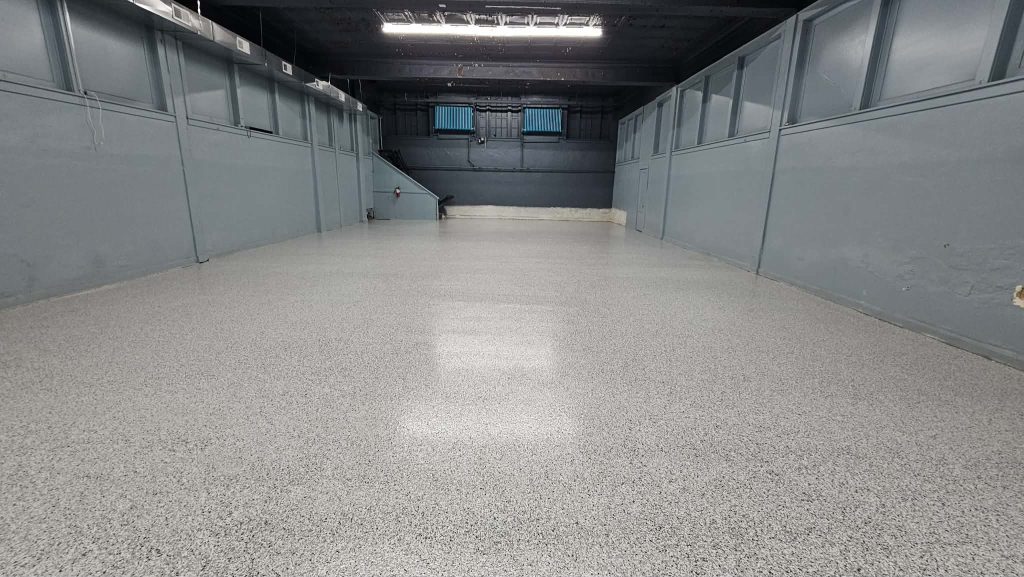
Central Baptist Church in Kansas City had a floor problem most older churches will recognize: 6,000 square feet of aging tile across the fellowship hall, gym, kitchen and corridors, sitting on a slab with cracks running wall to wall, and a maintenance routine that ate volunteer weekends every year. The building could not close, the budget had to survive a board meeting, and the floor had to outlast everyone who voted on it. Here is how that flake floor was done, what the hard parts actually were, and what a project this size costs in Kansas City.
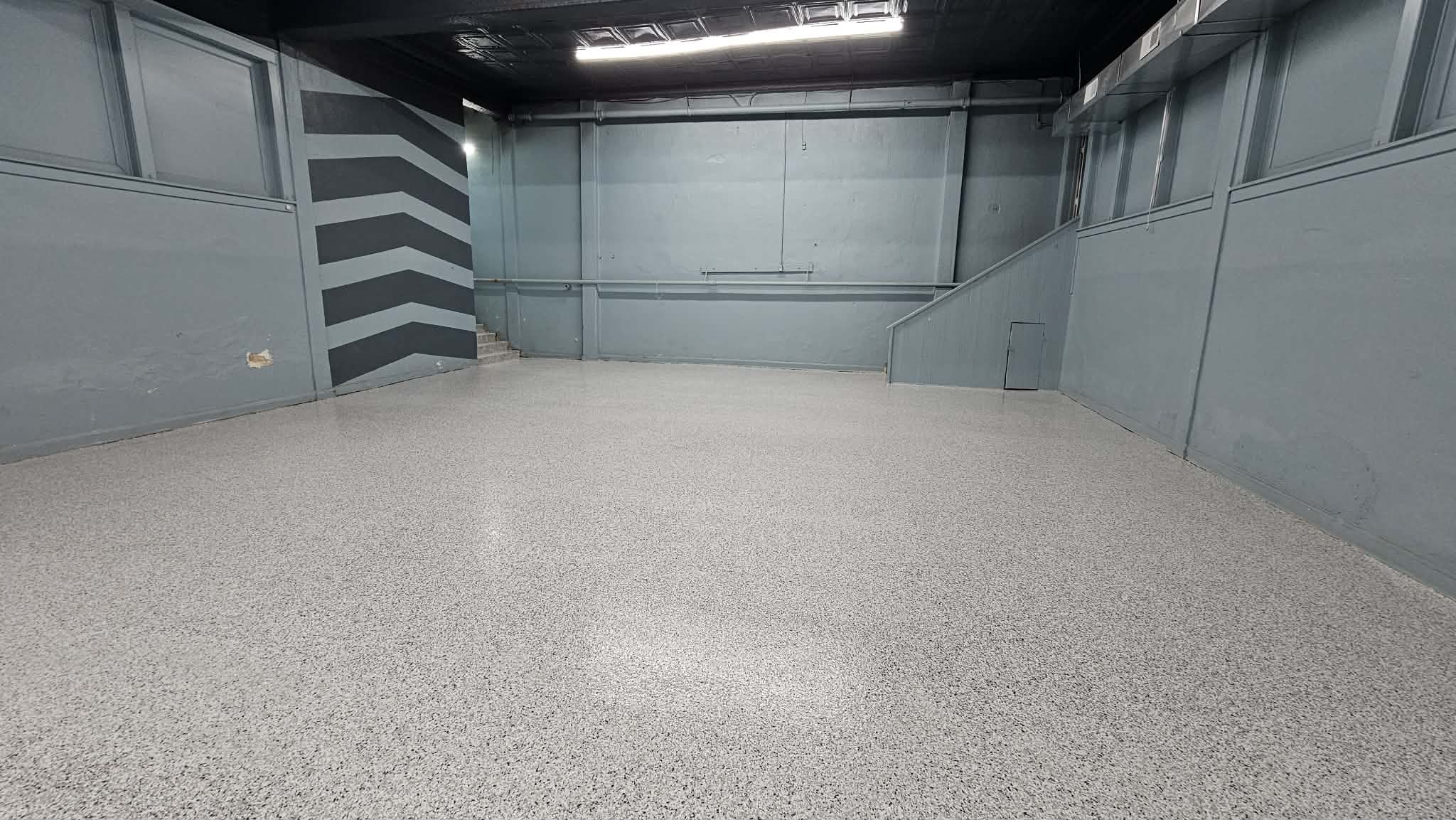
Project snapshot
| Facility | Central Baptist Church, Kansas City, MO |
|---|---|
| Area | Approximately 6,000 sq ft across multiple connected spaces |
| Spaces | Fellowship hall and gymnasium, commercial kitchen, serving area, corridors, stair landing |
| Existing floor | Old tile with adhesive residue, staining, and wide cracking across the slab |
| Scope | Tile and adhesive removal, crack chasing and repair, full-floor diamond grinding with HEPA dust collection |
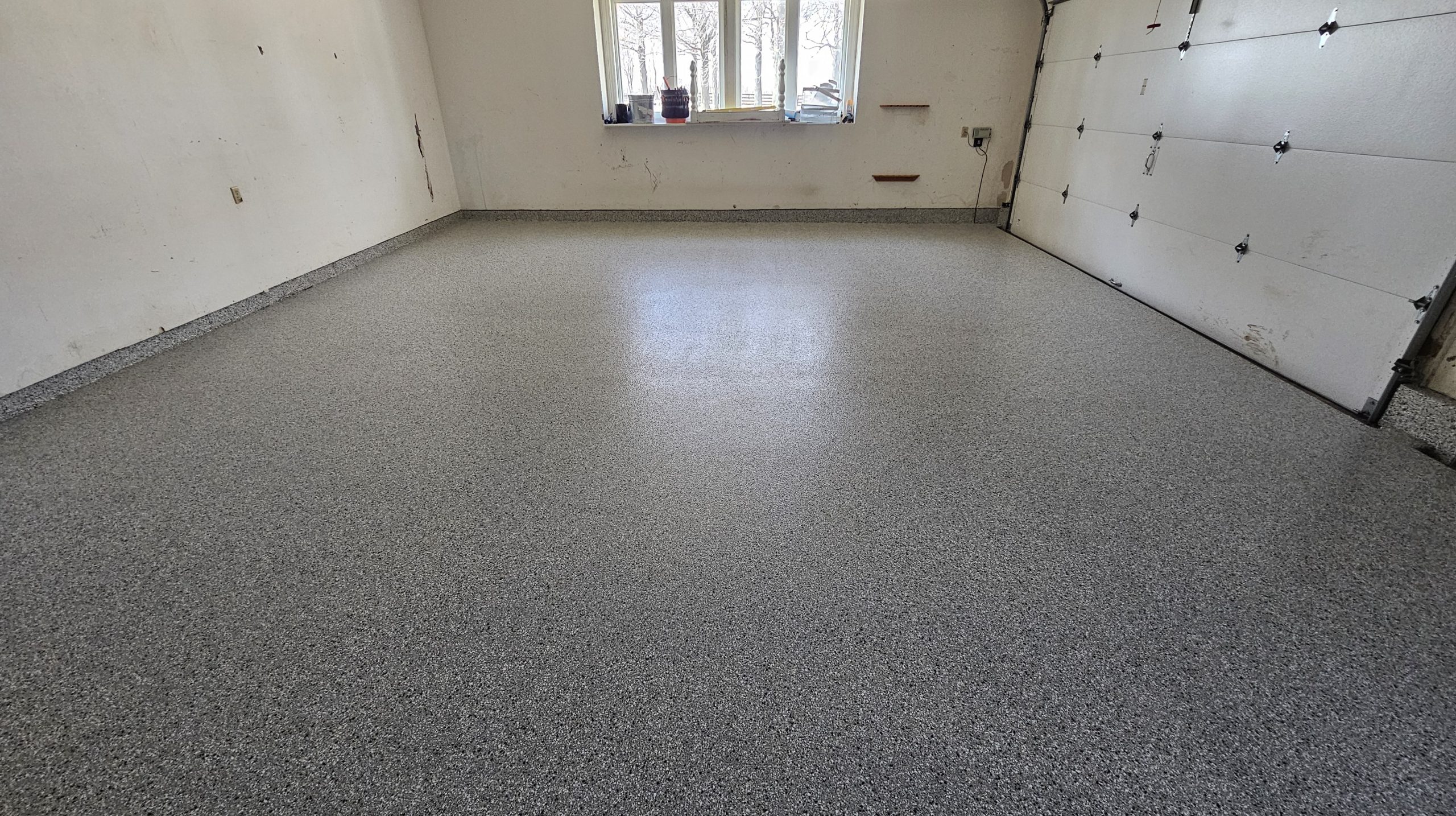
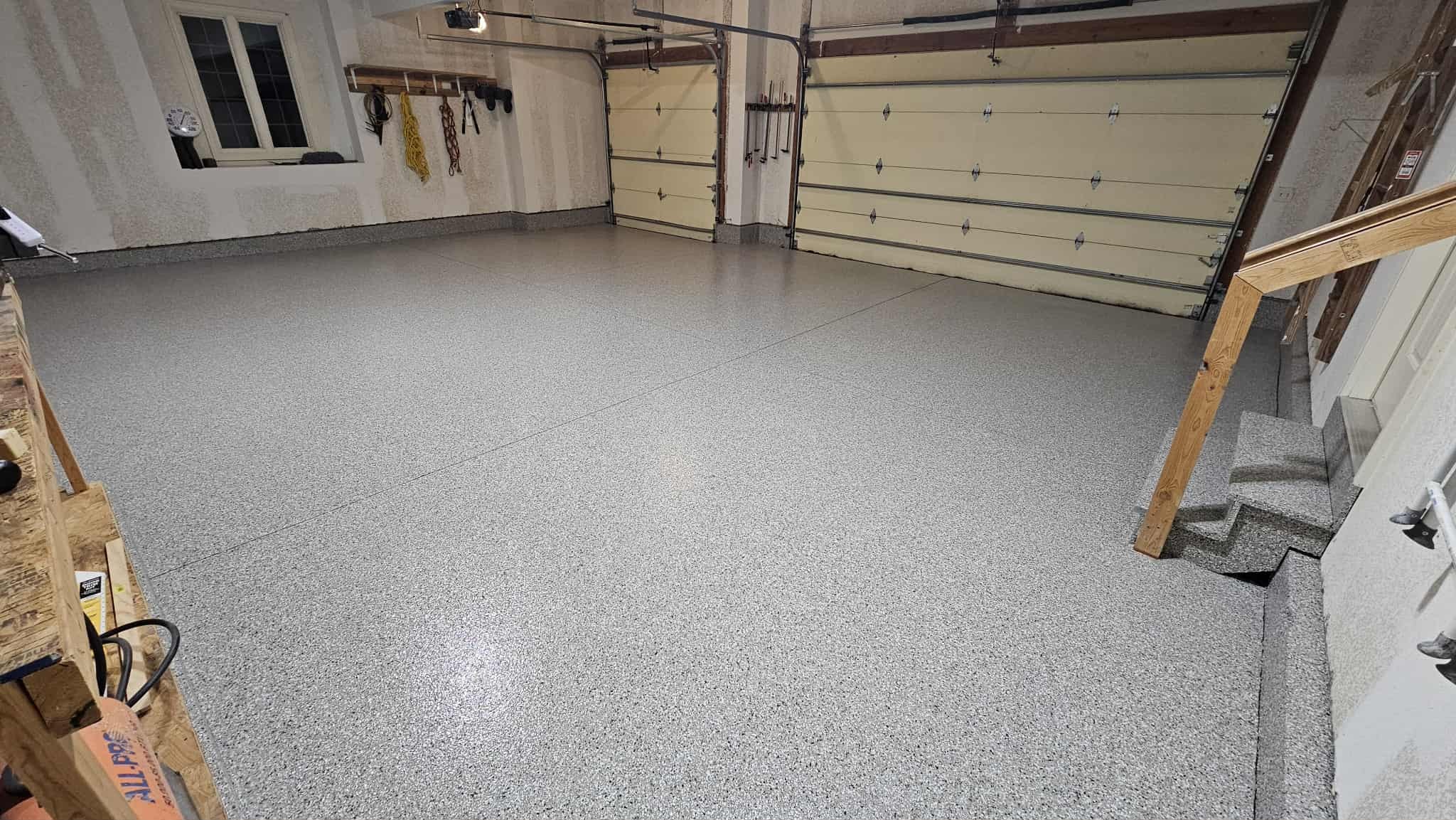
| System | Full-broadcast flake floor, gray, white and black blend, clear protective topcoat |
| Details | Integral coved base, coated stair landing, finished around floor drains and fixed cabinetry |
| Constraint | Occupied building, work sequenced around the church calendar |
What was actually on the floor
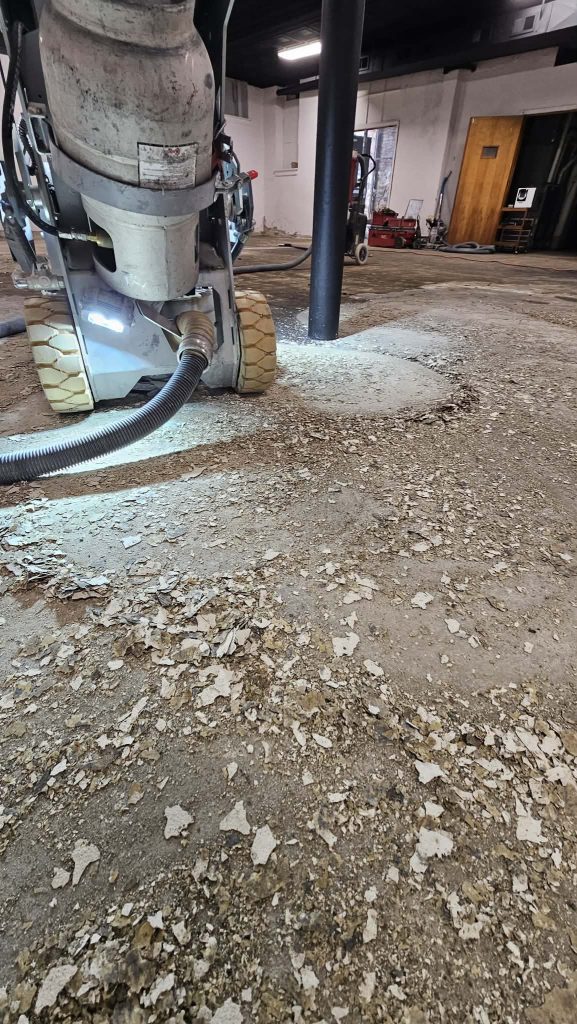
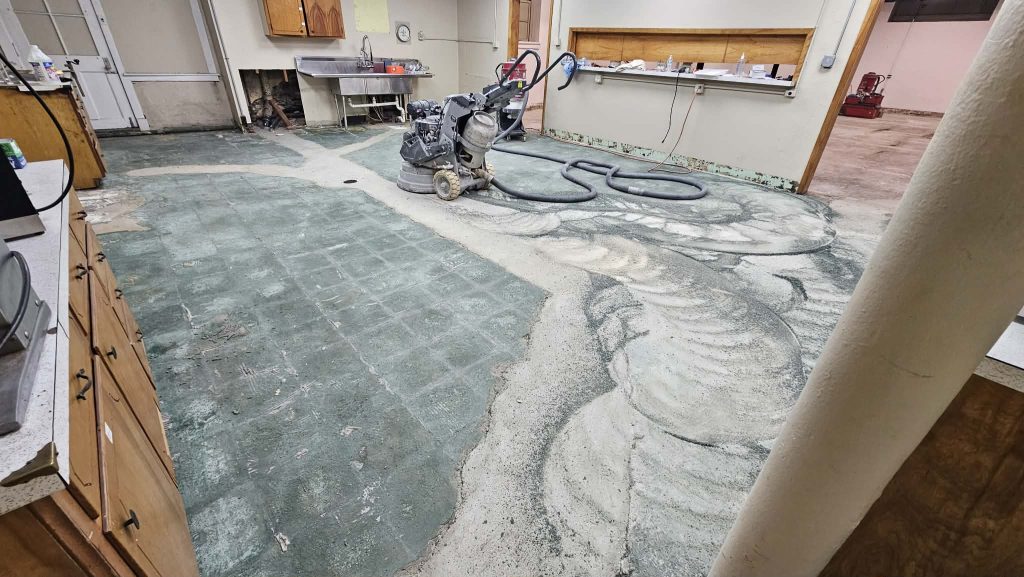
The starting condition is the part every church underestimates. Underneath the tile was a slab that had been covered for decades: adhesive residue baked into the surface, dark staining where moisture and traffic had worked on bare concrete, and structural cracks running the length of the main hall.
None of that is unusual in a building of this age. It is simply invisible until the tile comes up, which is why the honest version of a church flooring quote includes a plan for what might be found rather than a flat number that pretends the slab is perfect.
One planning note for any church in an older building: existing resilient flooring and its adhesive should be tested before removal begins. In buildings from certain eras those materials can contain regulated substances, and testing is a routine planning step rather than an alarm. Budget for it at the start so it does not become a surprise in the middle.
Why churches are leaving tile behind
Tile is not a bad floor. It is a bad floor for a building run by volunteers on a stewardship budget, and the reasons are cumulative rather than dramatic.
- The wax cycle never ends. A VCT floor has to be stripped and re-waxed on a schedule to keep its finish. That is a contractor bill several times a year, or a Saturday that a group of volunteers gives up, every year, forever.
- Seams collect everything. Every tile edge is a joint. In a fellowship hall that means dirt and mop water; in a kitchen it means grease and a health inspection conversation.
- Tiles pop, and matching is a myth. Once a run is discontinued, replacements never quite match, and the patchwork becomes permanent.
- It hides nothing. A light tile floor in a high-traffic hall shows scuffs from folding chairs, table carts and 300 pairs of shoes.
It is the same calculation Kansas City schools are running when they replace VCT, for the same reasons.
The ten-year math a church board actually cares about
Coating a floor costs more up front than another round of stripping and waxing. Across a capital planning horizon, the comparison usually inverts. For a 6,000 square foot facility:
| Keep the tile | Flake floor coating | |
|---|---|---|
| Up-front cost | $0 today | One capital project |
| Strip and wax | Typically 2 to 4 times a year at commercial rates of roughly $0.30 to $0.60 per sq ft per service, so about $3,600 to $14,400 a year at this size | None. Ever. |
| Routine cleaning | Mop, with a finish that dulls between services | Dust mop and rinse, no wax, no stripping |
| Tile replacement | Ongoing as tiles pop and crack | None |
| Expected life | Depends entirely on the wax program | 15 to 20 years in a commercial setting |
| Volunteer hours | Several weekends a year | Zero |
The strip-and-wax figures above are typical commercial service rates rather than a quote, but the shape of the comparison holds at almost any rate: within a few years the recurring maintenance on a tile floor this size passes the cost of never needing to maintain it again.
Taking up 6,000 square feet of tile and adhesive
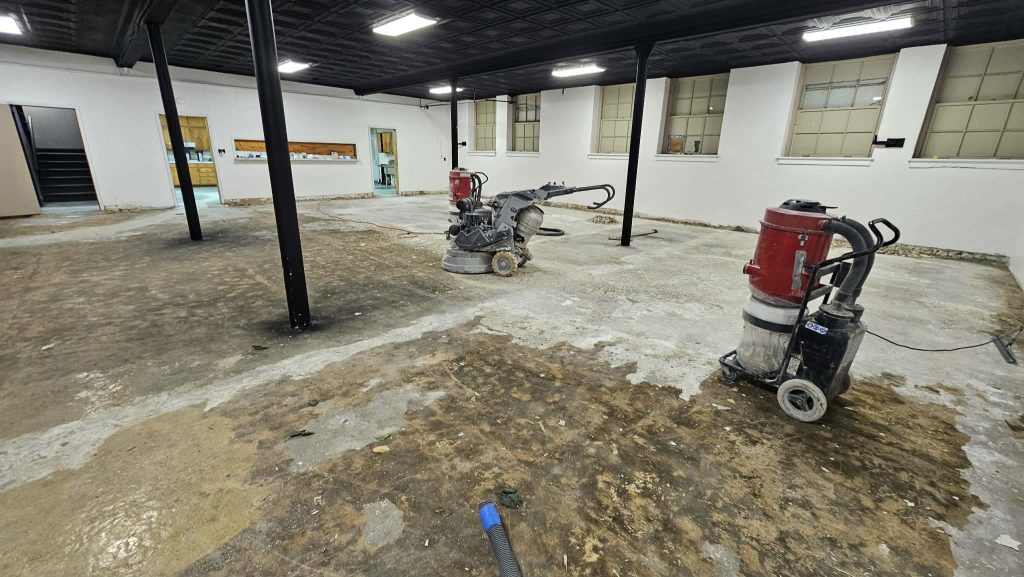
Removal is the part of the project that costs real money and takes real time, and it is the part cheap bids leave vague. Tile comes up in pieces. Adhesive does not come up at all in the usual sense, it gets ground off, and old adhesive loads grinding tooling in a way that slows the whole floor down.
That photo is the actual work: a planetary grinder pulling adhesive and tile residue off the slab, with the debris coming up in flakes and every bit of dust going into HEPA collection. Across 6,000 square feet, in an occupied building, dust control is not a nicety. It is the difference between a project the congregation tolerates and one they complain about for a year.
Then the cracks
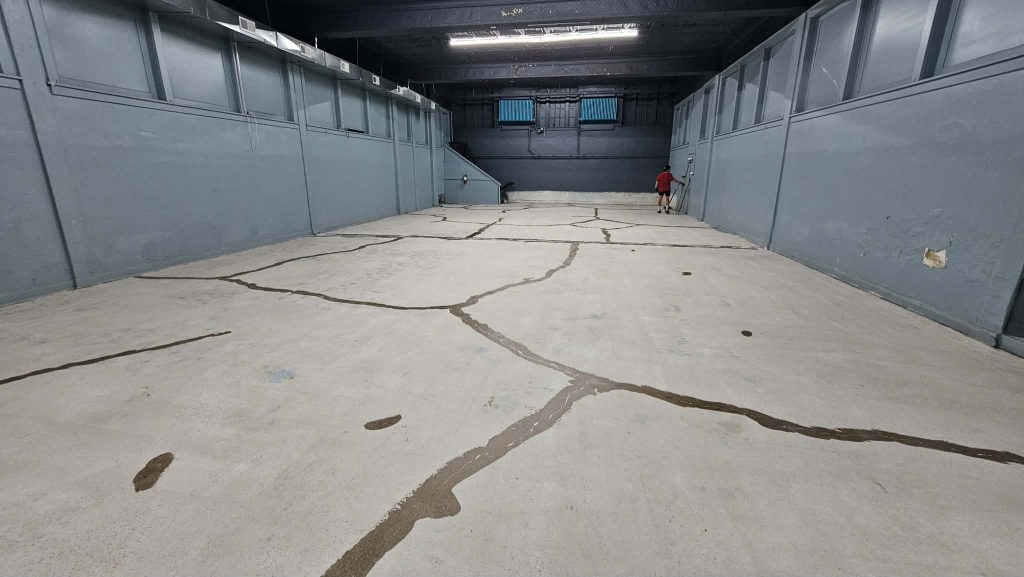
Once the floor was bare, the cracks were visible for what they were: full-length movement cracks across the main hall, not hairlines. Each one gets chased open into a clean channel, vacuumed, and filled with a structural repair material that bonds to both faces so the fill becomes part of the slab rather than a strip of caulk sitting in a gap.
Filling cracks is not the same as stopping them. A slab that moves will keep moving, and any contractor who promises a crack will never show again is selling something. What proper repair does is transfer load across the crack, stop the edges from spalling, and give the coating a continuous surface to bond over, which is what keeps the finished floor looking like one floor.
And then the whole thing gets ground
Every square foot, including the areas that looked fine, gets diamond ground to open the concrete’s pores so the coating keys in mechanically. In a church this also means grinding tight to fixed cabinetry, around steel columns, up to door lines and around floor drains, which is hand and edger work rather than machine work and is a real part of the labor on a job with this many rooms. Heavier removal work like this falls under concrete prep and removal.
Coating a building that cannot close
A warehouse can shut down for a week. A church has services, a preschool, a food pantry, a men’s breakfast and a funeral that was not on the calendar on Monday.
That is the single biggest difference between a church floor project and a commercial one of the same size, and it is a scheduling problem, not a coating problem. The work gets broken into zones that can be closed off and returned to use in sequence, staged around the church’s own calendar, with the areas that have to be walkable for Sunday finished first. Cure times drive the plan: foot traffic in about 24 hours, heavier use after 72.
Ask any contractor bidding a church exactly which rooms will be out of service on which days. A bid that cannot answer that has not thought about your building.
Zone by zone
Fellowship hall and gym
The largest single space and the hardest to get right, because it is one continuous floor under one set of ceiling lights, where any lap line or thin broadcast is visible from the far end. It also takes the widest range of abuse in the building: folding tables and chair carts dragged across it, basketball, potlucks, kids, and the occasional trailer of equipment wheeled in through the doors. The demands are close to what we design for in gym and fitness facilities.
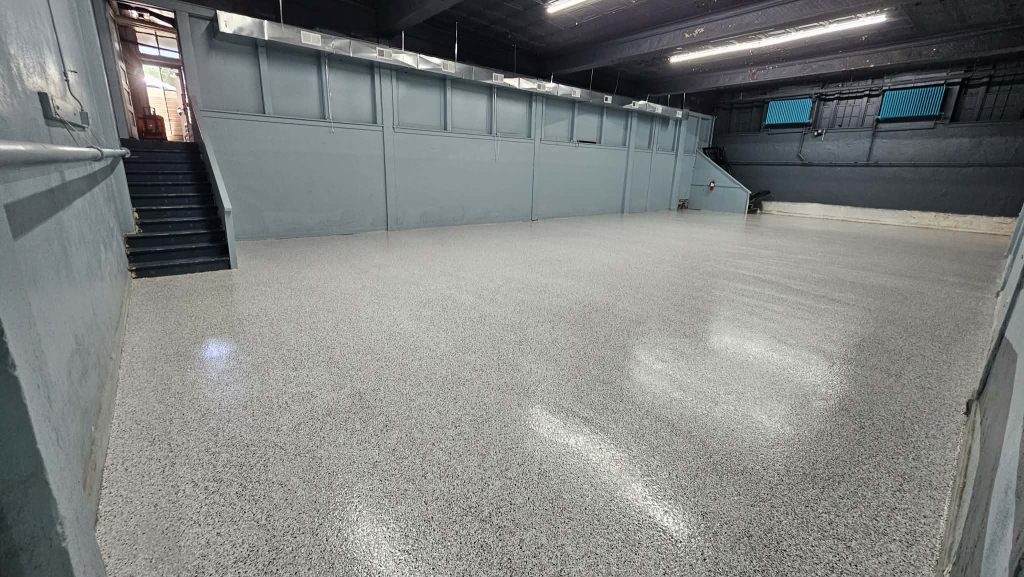
A full-broadcast flake system suits it exactly. The chips build thickness, the texture gives grip for a room full of running children, and the blend hides scuffs and dust in a way a solid color never will.
Kitchen and serving area
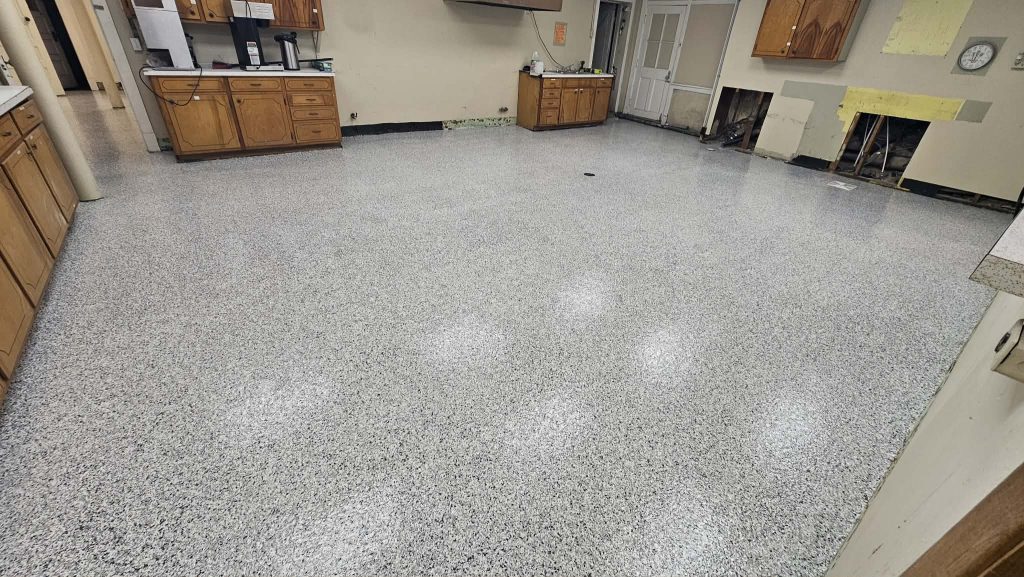
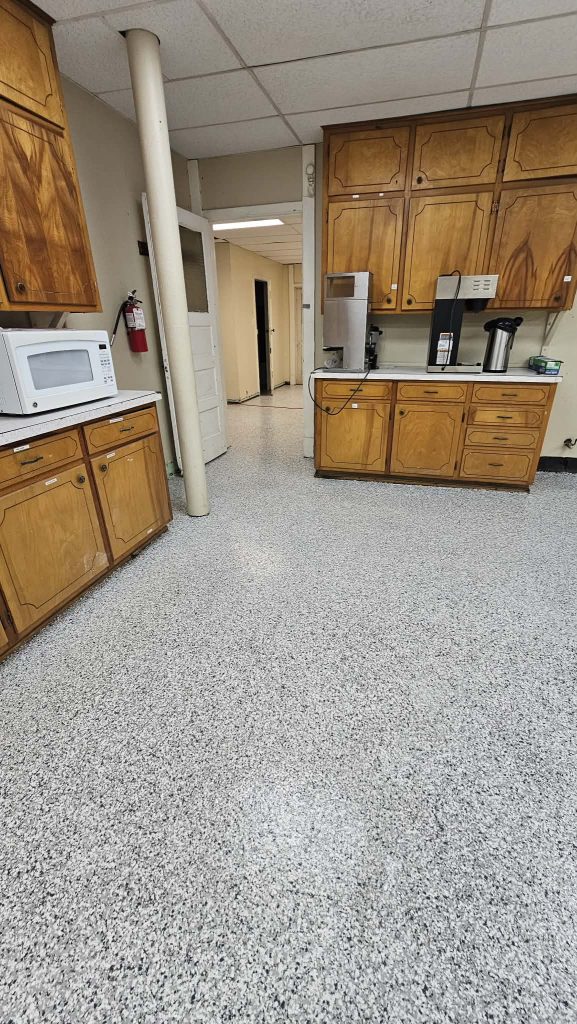
The kitchen is where a coated floor earns its keep against tile. There are no grout lines to hold grease, the coating turns up the wall as an integral coved base so the floor-to-wall joint is sealed rather than caulked, and the finish carries right up to the floor drain. It cleans with a mop and a hose instead of a scrub brush and a prayer. The standards are the same ones that govern commercial kitchen floors.
Working around a live kitchen also means grinding and coating around fixed sinks, cabinets and equipment that is not coming out, which is slower than an open floor and is exactly the kind of detail that separates a facility contractor from a garage contractor.
Corridors and the stair landing
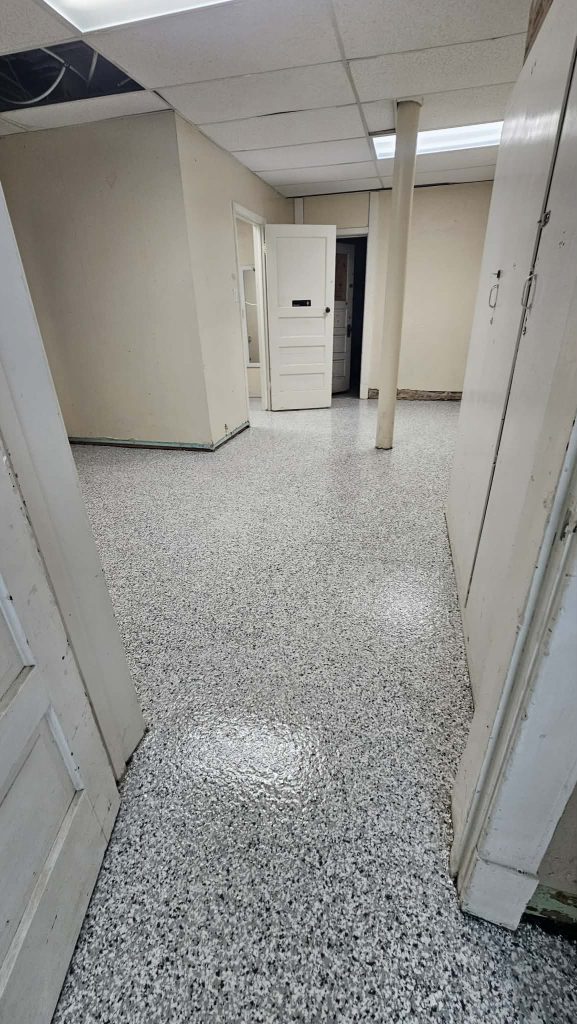
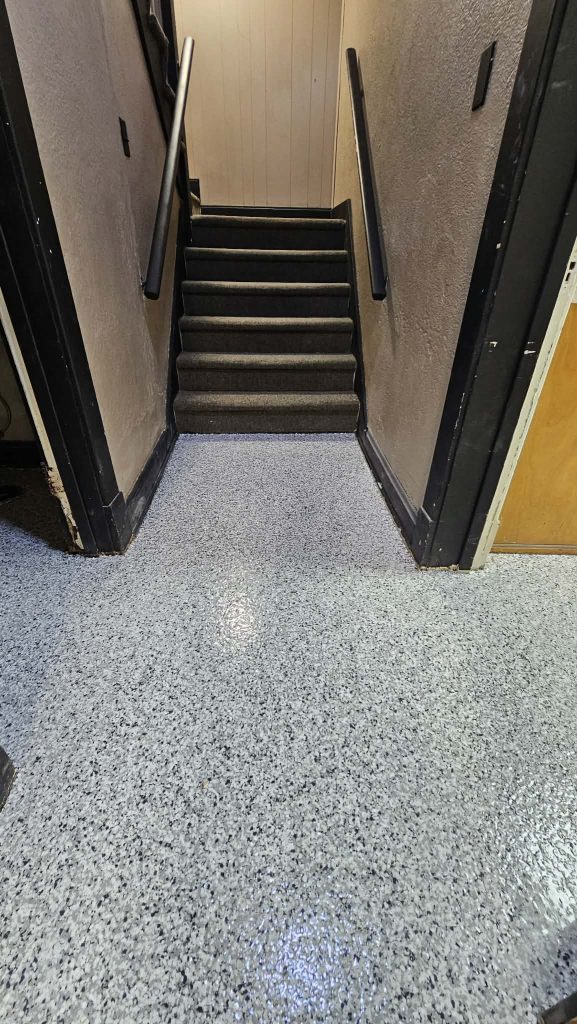
Corridors and landings are the parts that get skipped, and they are the parts everyone walks on. Carrying the same system through the halls and onto the landing means no transition strips, no change in cleaning routine, and no bare concrete at the exact spot where wet shoes arrive from outside.
What a 6,000 sq ft church floor costs in Kansas City
Church campuses are not one flooring environment, so pricing is best read by zone.
| Space | System | Installed cost / sq ft |
|---|---|---|
| Fellowship hall / gymnasium | Full-broadcast flake epoxy | $4 to $8 |
| Commercial kitchen | Quartz broadcast epoxy | $7 to $12 |
| Classrooms and corridors | Flake epoxy or grind and seal | $4 to $7 |
| Lobby / entrance | Polished concrete or metallic epoxy | $5 to $10 |
| Sanctuary | Polished concrete or dye polish | $5 to $9 |
At 6,000 square feet, a flake system across mixed spaces generally lands between $24,000 and $48,000, and scale works in your favor: mobilization, setup and equipment costs are largely fixed, so cost per square foot drops meaningfully as a project grows. Our commercial cost guide breaks the scaling down further. What moves a church project within that range is almost always the same three things.
- Removal. Existing tile, carpet, adhesive or a failed coating has to come off, and adhesive is slow. This is usually the largest single variable.
- Slab repair. Cracks, spalls and moisture issues are priced after the floor is exposed, which is why a good contractor sets an allowance rather than a guess.
- Access and scheduling. Night and weekend work, phasing around services, and protecting occupied areas all carry cost. They also protect your ministry calendar, which is usually worth paying for.
What maintenance looks like afterward
This is the part to bring back to the board, because it is the part that changes how the building runs.
- Dust mop, then damp mop or auto-scrub with a neutral cleaner.
- No wax. No stripping. No annual refinishing contract.
- Spills, including kitchen grease and coffee, wipe up rather than soak in.
- Winter salt and slush rinse off instead of attacking the concrete.
- A volunteer can maintain it correctly without training, which is not true of a waxed floor.
Frequently asked questions
How much does a church floor coating cost in Kansas City?
Broadcast flake systems for fellowship halls, gyms and multipurpose rooms run $4 to $8 per square foot installed, so a 6,000 square foot project generally lands between $24,000 and $48,000. Commercial kitchens run higher at $7 to $12 per square foot because of the quartz systems used there. Removal of existing flooring and slab repair are the main variables.
Can the church stay open during installation?
Yes. Work is broken into zones and sequenced around the church calendar so spaces come back into service in stages. Foot traffic returns to a finished area in about 24 hours and heavier use after about 72. The important step is agreeing which rooms are out of service on which days before work starts.
Do you have to remove the old tile first?
Yes. Tile and its adhesive both have to come off, and the adhesive is ground off rather than pulled up. Coating over old resilient flooring does not work, because the coating can only be as sound as what it is bonded to.
What about asbestos in old church flooring?
Resilient flooring and adhesive in older buildings should be tested before removal begins. It is a standard planning step for any renovation in a building of that era, and it belongs in the project budget from the start rather than being discovered mid-project.
Will the cracks come back?
A slab that moves will keep moving; no coating changes that. Proper crack repair transfers load across the crack, stops the edges from breaking down, and gives the coating a continuous surface to bond over, which is what keeps the finished floor reading as one floor.
Is a flake floor slippery for children and older members?
The flake broadcast creates texture, so it grips better than polished concrete, sealed tile or a waxed floor. For kitchens, entries and any area that regularly gets wet, an anti-slip additive can be added to the topcoat.
How does a coated floor compare to VCT over ten years?
VCT carries a permanent strip-and-wax program, typically 2 to 4 times a year, plus ongoing tile replacement. A coated floor has no wax cycle at all and lasts 15 to 20 years in a commercial setting. For most churches the recurring maintenance on tile passes the cost of coating within a few years.
Can a coating be installed in a commercial kitchen?
Yes, and it is one of the strongest arguments for it. A seamless coating with an integral coved base removes the grout lines and the floor-to-wall joint where grease collects, and it can be finished around floor drains for proper cleaning and drainage.
How long does a 6,000 sq ft project take?
Timeline depends far more on removal and repair than on the coating itself. Tile and adhesive removal, crack repair and grinding across a facility this size take several days before the first coat goes down, and phased scheduling around services extends the calendar even though it does not add labor.
Do you work with churches outside Kansas City proper?
Yes. High Stakes Epoxy LLC is based in Cleveland, MO and serves the whole Kansas City metro on both sides of the state line, including churches, schools, community centers and municipal buildings.
Planning a floor for your church or facility
If your fellowship hall is on its third round of wax this year, or the kitchen floor has a grout problem the health inspector keeps mentioning, the conversation worth having is not about product. It is about what is under your existing floor, what it will take to get to sound concrete, and how the work gets sequenced so the building keeps running.
Call (816) 820-8193, Monday through Saturday, 7:00am to 6:00pm, or request a free quote online. High Stakes Epoxy LLC is a locally owned, licensed and insured commercial concrete coating contractor serving the Kansas City metro.
More for facility decision-makers: our guide to church and house of worship flooring, concrete flooring for churches and community centers, and finished work in the project gallery.