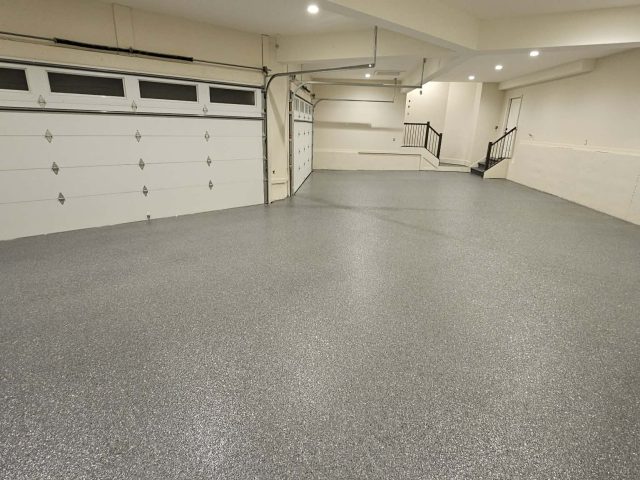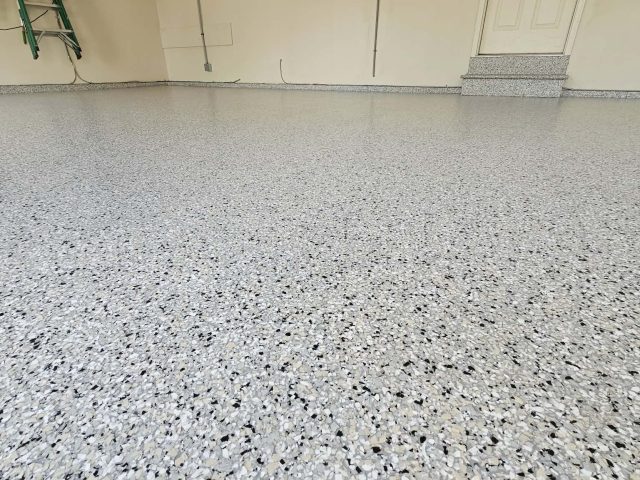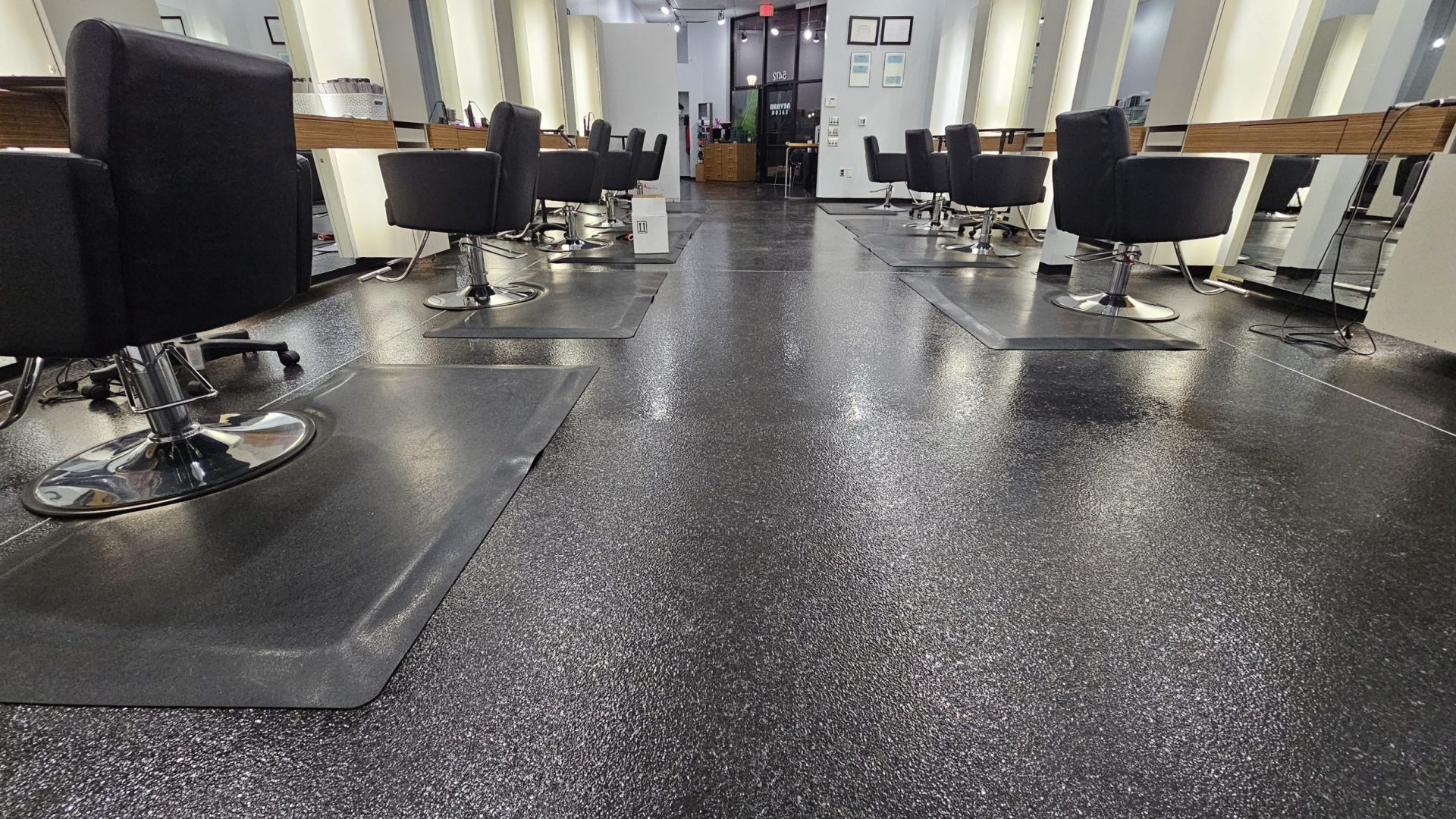
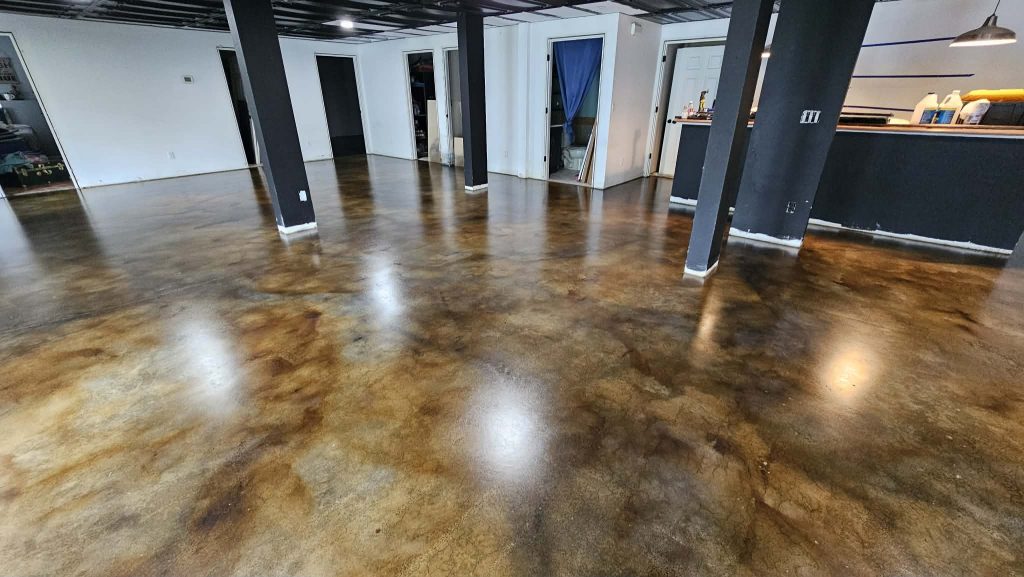
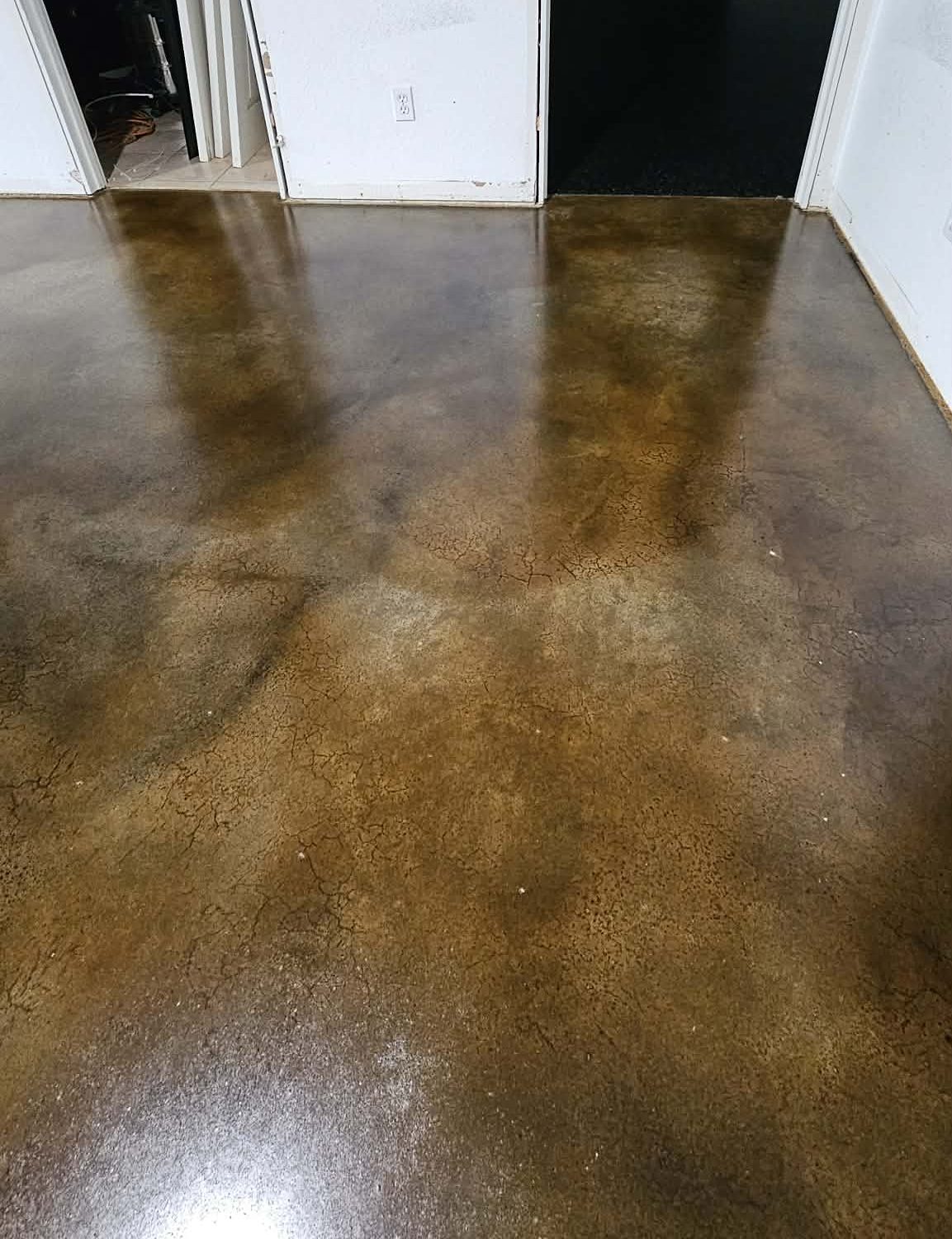
A 1,500 square foot basement in La Cygne, Kansas spent years as bare gray concrete with the glue lines of whatever came before still printed on it. It is now a stained and sealed concrete floor, and it is the best-looking room in the house. No carpet, no subfloor, no laminate waiting to buckle the first time the slab gets damp. Here is what the job involved, why stained concrete suits a basement better than almost anything else, and the one thing you need to be honest with yourself about before you choose it.
Project snapshot
| Location | La Cygne, KS (Linn County, south of the Kansas City metro) |
|---|---|
| Space | Residential finished basement, approximately 1,500 sq ft |
| Existing floor | Bare slab with old flooring adhesive, glue lines and staining |
| Prep | Full-floor diamond grinding with HEPA dust collection, adhesive removal, clean and rinse |
| System | Concrete stain in warm browns and ambers, protective clear sealer |
| Character | Variegated, marbled color with the slab’s own history visible in the finish |
| Rooms | Main open living area, adjoining rooms and hallway, coated continuously |
What was on the floor before
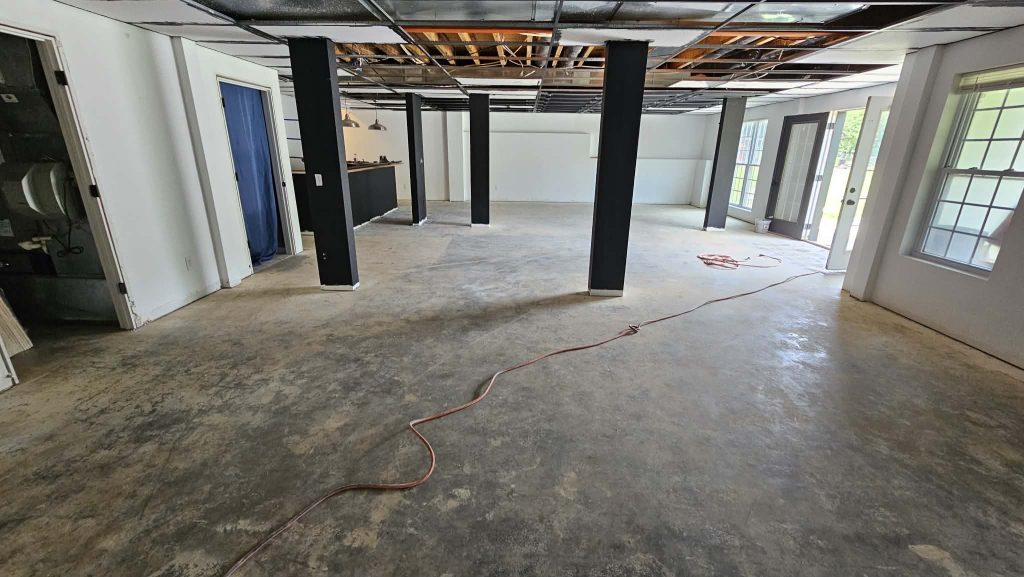
The starting point was a slab that had been under something else for a long time. In the doorway you could still read the trowel notches of the adhesive that held down the last flooring, in perfect squares, exactly where each tile had been.
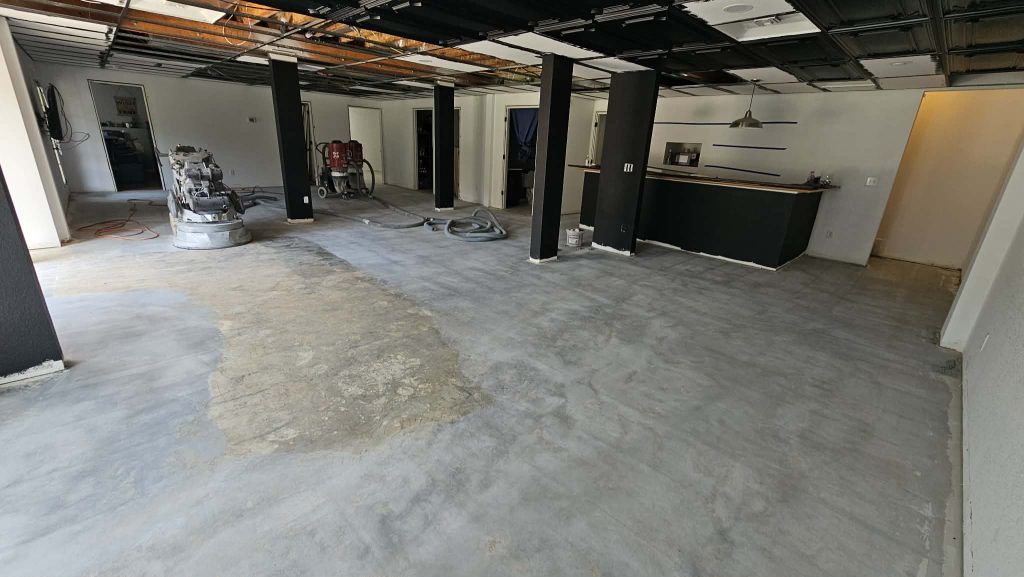
That pattern is the reason the prep on a basement job is never quick. Adhesive does not scrape off. It gets ground off, and until it is completely gone the stain cannot reach the concrete underneath it. Anywhere adhesive is left behind, the stain simply will not take there, and you find out after the color goes down.
Why a basement is a different problem
Basement floors fail for one reason more than all the others combined: moisture. A basement slab sits in the ground, and ground holds water. Vapor moves up through concrete continuously, and anything you lay on top of that slab has to survive it.
That is what ruins basement flooring. Carpet on a damp slab grows mold in the pad where nobody sees it. Laminate and engineered wood swell and cup at the seams. Glue-down vinyl releases. Even a well-installed floating floor turns a moisture problem into a smell problem, because the humidity ends up trapped underneath.
Stained concrete does not sit on top of the slab. The color penetrates into the concrete itself and becomes part of it, and the sealer over the top is a thin protective layer rather than a floor. There is nothing to trap water against, nothing to grow mold in, and nothing to lift.
That said, moisture still matters, and any contractor who does not raise it on a basement job is skipping a step. Slab moisture should be checked before a sealer goes down, because a slab pushing heavy vapor can cloud or lift a sealer the same way it would ruin any other floor. On a basement quote, ask how moisture is being evaluated and what happens if the reading comes back high.
The prep, which is most of the work
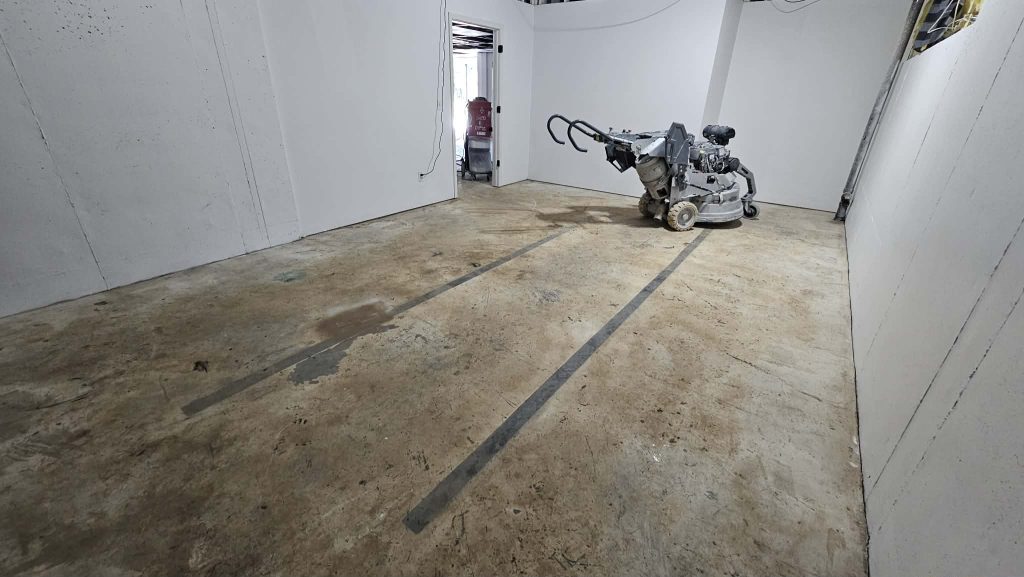
Every square foot of this floor was diamond ground, not just the areas with visible adhesive. Grinding does three things at once: it removes the adhesive and old residue, it opens the concrete’s pores so the stain can penetrate evenly, and it exposes a consistent surface so the color lands the same way across the whole room.
In the smaller rooms, the old glue lines ran in long stripes where the previous flooring had been bonded down. Those get ground out too. All of it runs through HEPA dust collection, which matters more in a basement than anywhere else in a house, because a basement is a closed box connected to the return air of the whole building.
After grinding, the floor is cleaned and rinsed until nothing is left on the surface. Stain reacts with what it touches. Anything still on the slab becomes part of the finished color, permanently. Heavier removal work like this falls under concrete prep and removal.
Stain and seal, step by step
- Grind and clean. Adhesive, sealers and residue removed, the slab opened up and rinsed.
- Apply the stain. Color goes on and penetrates the concrete rather than coating it. Depth and movement come from how the slab itself takes the color.
- Neutralize and rinse. Residue is removed and the floor is brought back to a neutral surface so the sealer bonds properly. Skipping this is a common cause of sealer failure.
- Dry completely. A sealer applied over a slab that has not dried traps moisture and clouds. In a basement this step takes patience rather than skill.
- Seal. Clear protective coats lock the color in, bring out the depth, and give the floor its sheen and its cleanability.
The honest part: stained concrete shows you the slab you have
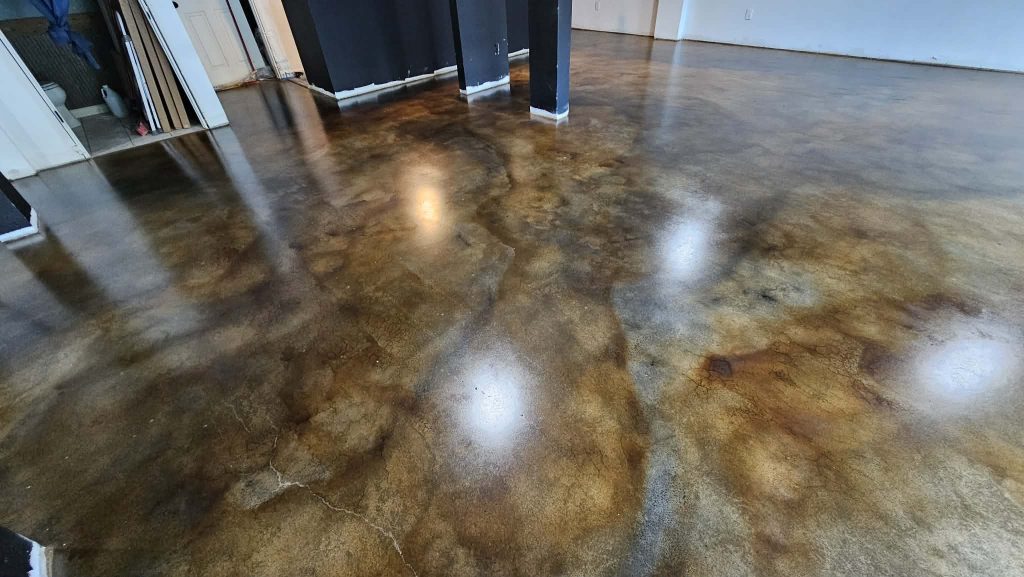
This is the section most contractors leave out, and it is the one that decides whether you will love your floor.
Stain is not paint. It colors the concrete by working into it, so the finished floor is a record of that specific slab: where it cured faster, where it was troweled harder, where something spilled in 1994, where a patch was made. That is exactly what produces the depth and the marbled movement in these photos. It is also why no two floors are the same and why nobody can show you a sample that will match your basement, because the sample is a different piece of concrete.
Cracks stay visible. Look at the photo above and you can see a fine line running across the floor. A stained floor does not hide cracks, patches or old repairs. It highlights them, because they take color differently than the surrounding slab.
Whether that is a flaw or a feature is a personal call, and it is the single most useful question to answer before you commit:
- If you want the character of the concrete, including its history, stain and seal is the right choice, and the variation is the point.
- If you want a uniform floor that hides everything, a full-broadcast flake system is the better fit. The chips build a consistent surface that covers repairs and variation completely.
- If the slab is badly cracked or spalled and you still want a decorative finish, a concrete overlay resurfaces it first and gives the stain a fresh, consistent surface to work with.
We would rather have that conversation before the stain goes down than after.
What it replaced, and why homeowners choose it
For a basement specifically, stained concrete solves several problems at once.
- Nothing to remove. The slab is already there. You are finishing it, not covering it, which means no subfloor build-up and no lost ceiling height in a room that usually has none to spare.
- Water is an inconvenience, not a disaster. A sump failure or a water heater leak on carpet is a demolition job. On sealed concrete it is a wet floor.
- Nothing for allergens to live in. No fibers, no pad, no seams.
- It cleans like a floor should. Dust mop and damp mop. No wax, no grout, no shampooing.
- It looks like a designed room. Compare the photos above to bare gray concrete or builder carpet and the difference is not subtle.
Stain and seal versus the other concrete finishes
Three decorative systems come up for basements, and they solve different problems.
| Stain and seal | Full-broadcast flake | Polished concrete | |
|---|---|---|---|
| Look | Marbled, variegated, natural | Speckled, uniform, consistent | Smooth, reflective, minimal |
| Hides slab defects | No, it highlights them | Yes, completely | No, and it exposes aggregate |
| Texture | Smooth, sealer sheen | Textured, good grip | Smooth, can be slick when wet |
| Adds height | Effectively none | A coating thickness | None, it removes material |
| Basement suitability | Excellent | Excellent | Depends on slab quality |
| Wear layer | Sealer, recoat eventually | Clear topcoat, long life | The concrete itself |
For a finished basement that is going to be lived in rather than worked in, stain and seal usually wins on looks and on cost. For a basement that doubles as a shop, a home gym or storage, flake is tougher and more forgiving. Polished concrete is the third option and depends entirely on what the slab looks like once it is opened up.
What a 1,500 sq ft basement costs
Stain and seal pricing depends on how many colors and how much design work is involved. These are our installed rates applied to this floor’s size.
| System | Installed cost / sq ft | 1,500 sq ft basement |
|---|---|---|
| Single-color acid stain + sealer | $3 to $5 | $4,500 to $7,500 |
| Multi-color acid stain + sealer | $4 to $7 | $6,000 to $10,500 |
| Water-based dye, single color + sealer | $3 to $6 | $4,500 to $9,000 |
| Water-based dye, multi-color or patterns + sealer | $5 to $9 | $7,500 to $13,500 |
| Sawcut pattern + dye + sealer | $6 to $12 | $9,000 to $18,000 |
Two things move a basement quote off those numbers. The first is removal: old adhesive, carpet tack strip, thinset or a failed sealer all have to come off before anything else happens, and adhesive is slow. The second is slab condition, since crack repair and any patching are priced after the floor is exposed and clean.
For comparison, finishing a 1,500 square foot basement in carpet, luxury vinyl plank or tile generally runs from the mid four figures into the low five figures once material and installation are counted, and every one of those options is still sitting on a slab that moves moisture. Stained concrete is usually competitive on price and considerably better suited to being underground.
Living with a stained concrete floor
- Dust mop, then damp mop with a neutral cleaner. No wax, no acidic or abrasive cleaners.
- Felt pads under furniture legs, the same as any hard floor.
- Wipe spills reasonably promptly. The sealer is the protection, and it is a thin layer.
- The color is permanent because it is in the concrete. The sealer is not permanent. It wears, and in a low-traffic finished basement that is a long horizon, but plan on a recoat eventually rather than never.
- A recoat is a clean and re-seal, not a re-do. The color underneath is still there.
Frequently asked questions
How much does a stained concrete basement floor cost in Kansas?
Single-color acid stain with a sealer runs $3 to $5 per square foot installed, so a 1,500 square foot basement lands between roughly $4,500 and $7,500. Multi-color work runs $4 to $7 per square foot and sawcut patterns run higher. Removing old adhesive or flooring is priced on top.
Can you stain a basement floor that has old glue or adhesive on it?
Yes, but the adhesive has to be completely ground off first. Stain penetrates concrete, so anywhere adhesive remains the color will not take. Full-floor diamond grinding is the only reliable way to remove it.
Is stained concrete a good choice for a basement?
It is one of the best. The color is in the slab rather than on top of it, so there is no pad, no seams and no material to trap moisture, warp or grow mold. It also adds no height, which matters in a basement with limited headroom.
What about moisture coming up through the slab?
Slab moisture should be evaluated before sealing. Concrete moves water vapor continuously, and a slab pushing heavy vapor can cloud or lift a sealer. On any basement quote, ask how moisture is being checked and what the plan is if the reading is high.
Will the stain hide cracks in my basement floor?
No. Stained concrete highlights the character of the slab, including cracks, patches and old repairs, because those areas take color differently. If you want a uniform floor that hides everything, a full-broadcast flake system is the better choice. If the slab is badly damaged, an overlay can resurface it before staining.
Can you match a color sample exactly?
Not exactly, and no honest contractor will promise it. Stain colors the concrete by working into it, so the result depends on that specific slab. Samples show the palette and the general character, not the finished floor.
Is a stained concrete floor cold or hard underfoot?
It is concrete, so it is firm, and a basement slab sits at ground temperature. Area rugs handle both in the spots where you actually stand or sit, and the floor takes radiant heat well if that is part of the plan.
How long does it take?
Prep is what drives the schedule. Grinding adhesive off 1,500 square feet takes real time, and the floor has to be fully dry before sealing, which cannot be rushed in a basement. Plan on a multi-day project rather than a one-day install.
Does the sealer need to be reapplied?
Eventually. The stain itself is permanent because it is part of the concrete, but the sealer is a wear layer. In a low-traffic finished basement that horizon is long. A recoat is a clean and re-seal rather than starting over.
Do you work in La Cygne and the rest of Linn County?
Yes. High Stakes Epoxy LLC is based in Cleveland, MO, a short drive from La Cygne, and we cover Linn County and the surrounding communities on both sides of the state line.
Thinking about your own basement?
If you have a bare slab, old glue lines, or carpet you do not trust, the useful first step is not choosing a color. It is finding out what is on your concrete, what condition it is in, and whether you want a floor that shows its character or one that hides it.
Call (816) 820-8193, Monday through Saturday, 7:00am to 6:00pm, or request a free quote online. High Stakes Epoxy LLC is a locally owned, licensed and insured concrete coating company based in Cleveland, MO, serving La Cygne, Linn Valley, Louisburg, Ottawa, Fort Scott and the wider Kansas City metro.
More reading: our stain and seal concrete service page, the full guide to stain and seal colors, costs and character, dye polishing if you want color without a topcoat, and finished work in the project gallery.