Is your concrete floor cracked, pitted, stained, or just plain ugly? A concrete overlay may be the most cost-effective solution available. Rather than tearing out your existing slab — an expensive, time-consuming process — a concrete overlay lets you apply a fresh, new surface directly over your existing concrete, creating a beautiful, durable floor at a fraction of the replacement cost. High Stakes Epoxy LLC provides professional concrete overlay services throughout Kansas City, KS, and the greater metro area, including Overland Park, Olathe, Lenexa, Shawnee, Gardner, and Merriam.

What Is a Concrete Overlay?
A concrete overlay (also called a micro-topping, skim coat, or resurfacer) is a thin layer of polymer-modified cementitious or epoxy-based material applied over an existing concrete substrate. Overlays range in thickness from 1/16 inch (micro-topping) to 1/4 inch or more (self-leveling overlay). They bond chemically and mechanically to the existing concrete, creating a new, fresh surface that can be colored, textured, stenciled, stamped, or sealed to achieve virtually any aesthetic.
When Is a Concrete Overlay the Right Choice?
Concrete overlays are the ideal solution when:
- The existing concrete slab is structurally sound but cosmetically damaged (pitting, spalling, staining, minor cracking)
- The floor level cannot be raised significantly (overlay adds minimal height — ideal for doorways, transitions)
- Budget does not support full slab replacement
- The goal is to achieve a new aesthetic (color, texture, pattern) without the cost of demolition
- The project timeline does not allow for the cure time required with new concrete pours
- Environmentally, you want to avoid the waste and carbon impact of demolition and new concrete
Types of Concrete Overlays We Install in Kansas City
Micro-Topping (Skim Coat Overlay)
Micro-toppings are ultra-thin (1/16 to 1/8 inch) polymer-modified cementitious overlays that create a smooth, trowel-applied finish perfect for interior residential and commercial spaces. Available in dozens of integral colors and can be stained, dyed, or sealed after application. Ideal for Kansas City homes, retail stores, restaurants, and offices. Cost: $4–$8 per sq ft.
Self-Leveling Overlay
Self-leveling overlays are poured and spread across the floor surface, seeking their own level and creating an extremely flat, smooth finish. Excellent for correcting uneven or wavy concrete surfaces before a final decorative treatment. Thickness: 1/8 to 1/4 inch. Cost: $3–$6 per sq ft.
Stampable Overlay
Stampable overlays are thick-bodied polymer overlays that can be stamped with texture mats to replicate the look of brick, slate, stone, wood, or custom patterns. Popular for interior floors, covered patios, and pool decks in Kansas City and Johnson County. Cost: $5–$10 per sq ft.
Spray Texture Overlay
A spray-applied decorative overlay that creates a light orange-peel or knock-down texture. Popular for pool decks, exterior surfaces, and commercial kitchens requiring slip resistance. Cost: $2–$4 per sq ft.
Concrete Overlay Cost in Kansas City, KS
| Overlay Type | Thickness | Cost Per Sq Ft | Best Application |
| Micro-Topping | 1/16″–1/8″ | $4 – $8 | Interior Residential/Commercial |
| Self-Leveling | 1/8″–1/4″ | $3 – $6 | Floor Leveling, Base Coat |
| Stampable Overlay | 3/16″–1/4″ | $5 – $10 | Patios, Decorative Interior |
| Spray Texture | 1/16″–1/8″ | $2 – $4 | Pool Decks, Exterior |
| Epoxy Overlay | 30–100 mils | $4 – $9 | Industrial, Commercial |
The Concrete Overlay Installation Process
Surface Preparation
No overlay can succeed without proper surface preparation. We diamond grind or shot blast the existing concrete to remove any existing coatings, laitance, or contamination, and to open the surface profile for bonding. Cracks are routed and filled. For self-leveling overlays, we install perimeter edge forms to contain the material.
Primer Application
A bonding primer or slurry coat is applied to the prepared concrete. This is a critical step that ensures the overlay bonds firmly to the existing substrate without delamination.
Overlay Application
The overlay material is mixed to manufacturer specifications and applied using the appropriate tools: a gauge rake and spiked roller for self-leveling overlays; a skip trowel or pool trowel for micro-toppings; stamp mats for stampable overlays. Multiple thin coats are superior to a single thick coat for micro-toppings.
Color, Stain, or Dye Application
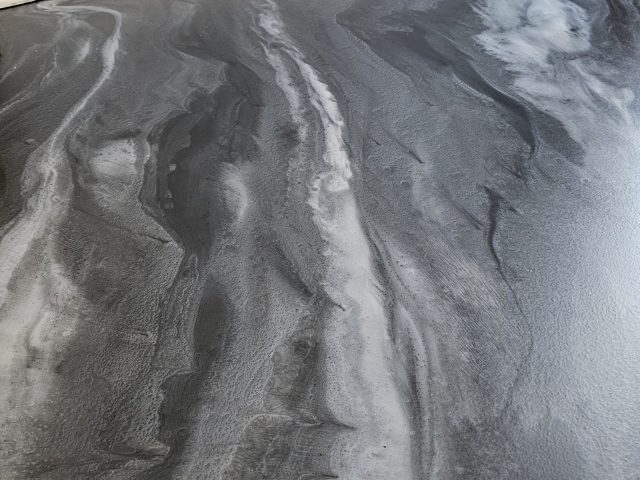
For colored overlays, integral pigments are mixed into the overlay material. For post-applied color, acid stains, water-based dyes, or concrete dyes are applied after the overlay has cured. Multiple colors can be applied for custom patterns and designs.
Sealing & Topcoat
All overlay systems require a sealer or topcoat to protect the decorative surface. We use polyurethane, polyaspartic, or epoxy topcoats depending on the application, traffic level, and desired sheen.
Project Showcase: Concrete Overlay Projects in Kansas City
Merriam Commercial Kitchen — Self-Leveling Overlay
A restaurant in Merriam had an existing concrete floor that had been poorly maintained, leaving a highly uneven surface that posed tripping hazards and failed health department inspections. We installed a 3/16 inch self-leveling cementitious overlay to level the floor, then applied a polyurethane topcoat rated for food service environments. The project was completed over a two-day restaurant closure, saving the owner the cost and time of full slab replacement.
Overland Park Residential Basement — Micro-Topping with Dye
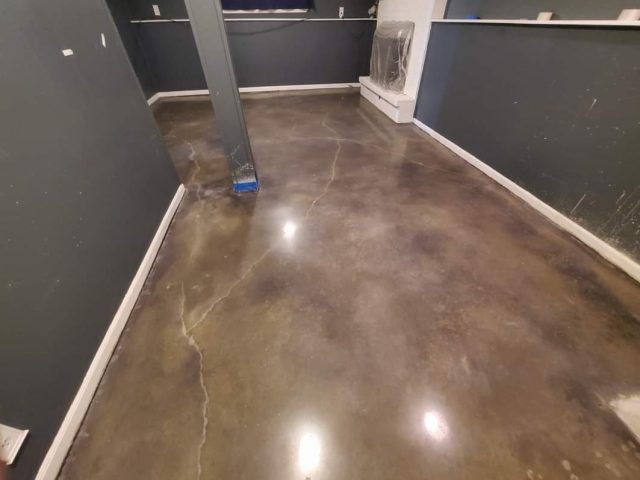
A homeowner in Overland Park was finishing their basement and wanted a polished, seamless floor without the cost of new tile. We applied a two-coat micro-topping system over the existing slab, then applied a charcoal water-based dye and burnished the surface to a satin sheen. Total cost was approximately 40% less than comparable tile installation, with a faster timeline and a more unique aesthetic.
Concrete Overlay vs. Full Slab Replacement
| Factor | Concrete Overlay | Slab Replacement |
| Cost | 30–60% less expensive | Full demo + new pour |
| Timeline | 1–5 days | 2–4 weeks minimum |
| Disruption | Minimal | High — major construction |
| Height Added | Minimal (1/16″–1/4″) | Full slab height |
| Sustainability | No demolition waste | High material/labor waste |
| Best When | Slab is structurally sound | Slab is structurally failed |
Concrete Overlay Maintenance
- Sweep daily to remove grit and abrasive particles
- Mop weekly with a pH-neutral cleaner
- Reapply sealer every 3–5 years in residential settings; annually in high-traffic commercial areas
- Avoid harsh chemicals, bleach, and dragging heavy furniture
- Use felt pads under furniture legs to prevent scratching the overlay surface
| 🔨 Resurface Your Kansas City Floor with a Professional Concrete Overlay — Call High Stakes Epoxy LLC for a Free Estimate! |
FAQs — Concrete Overlay Kansas City
Q: Can a concrete overlay fix cracks in my Kansas City floor?
A: Overlays can address cosmetic hairline cracks and minor surface damage. Structural cracks (moving, wide, or deep) must be properly repaired before overlay installation. If structural cracks are present, we route and fill them with semi-rigid polyurea before applying the overlay.
Q: How thick is a concrete overlay?
A: Depending on the system, overlays range from as thin as 1/16 inch (micro-topping) to 1/4 inch or more (self-leveling or stampable). Most overlays add minimal height, making them ideal for situations where floor-level transitions must be maintained.
Q: How long does a concrete overlay last in Kansas City?
A: With proper surface preparation, installation, and maintenance, a concrete overlay in a Kansas City home or business can last 10–20+ years. Sealer re-application is the primary maintenance task that extends overlay life.