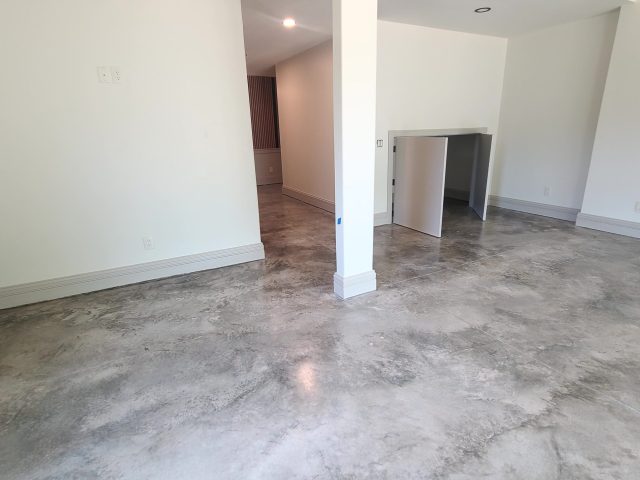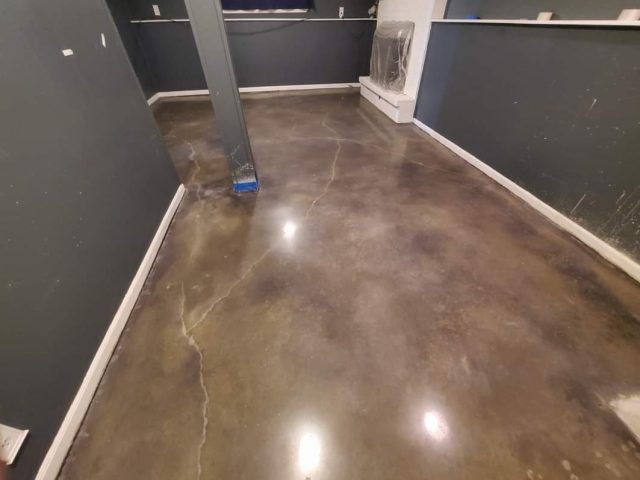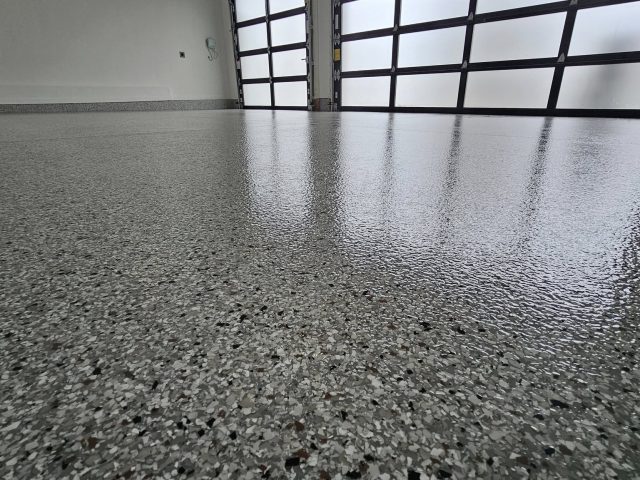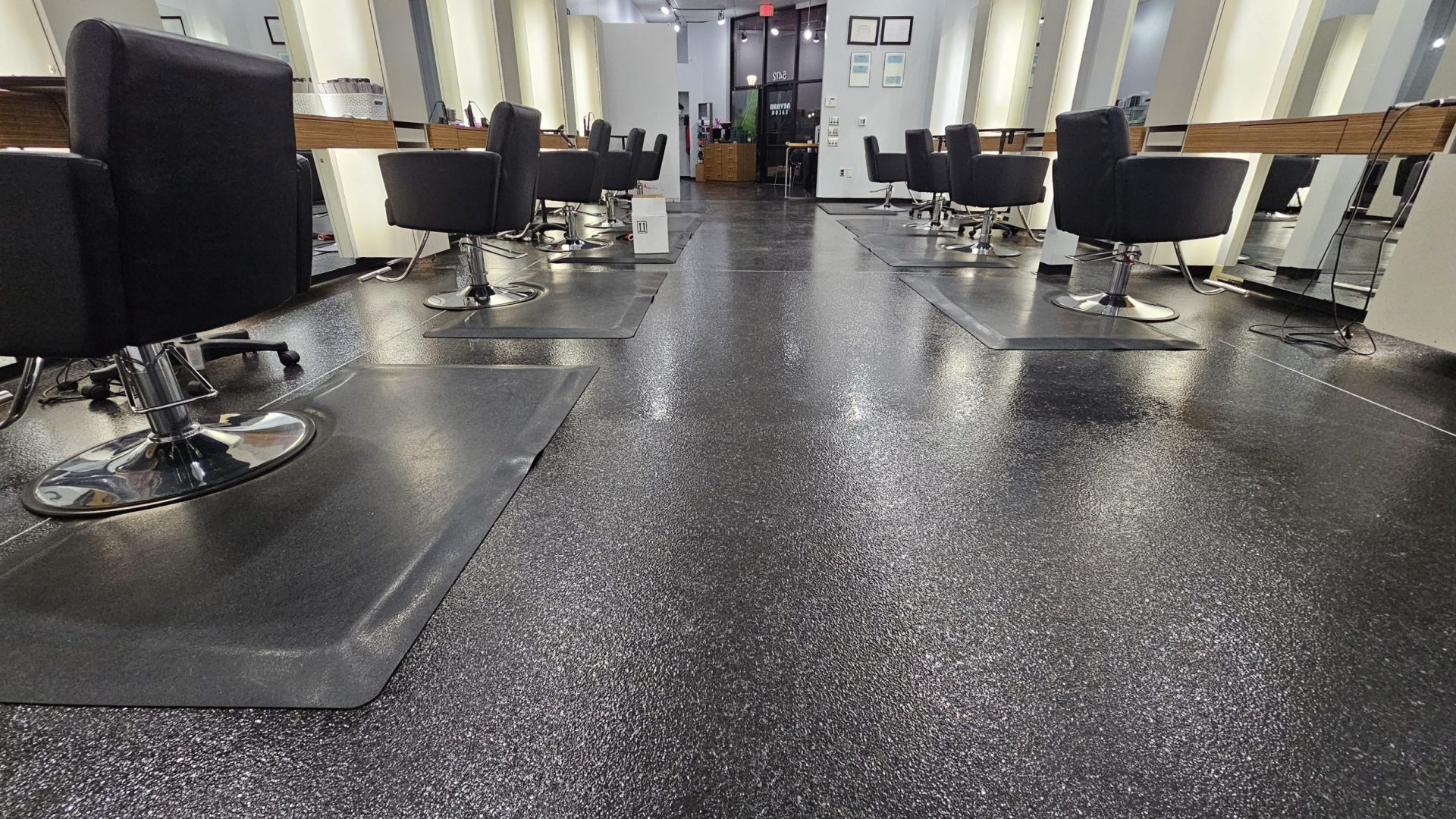
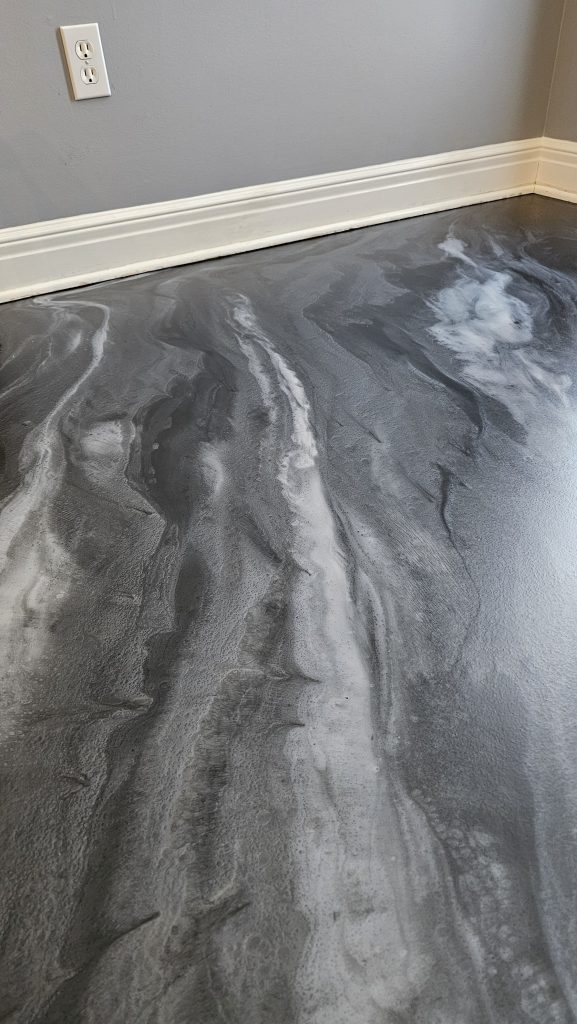
Metallic epoxy flooring is the most visually dramatic and customizable flooring surface available today. If you’ve ever walked into an upscale showroom, boutique hotel lobby, or luxury home in the Kansas City area and found yourself staring at the floor — you’ve likely seen a metallic epoxy system. High Stakes Epoxy LLC specializes in custom metallic epoxy installations throughout Kansas City, KS, Overland Park, Leawood, Lenexa, and the surrounding metro area.
In this comprehensive guide, we’ll cover everything you need to know about metallic epoxy flooring: how it’s made, what makes it unique, the installation process, costs in the Kansas City market, and real project examples from our portfolio.
What Is Metallic Epoxy Flooring?
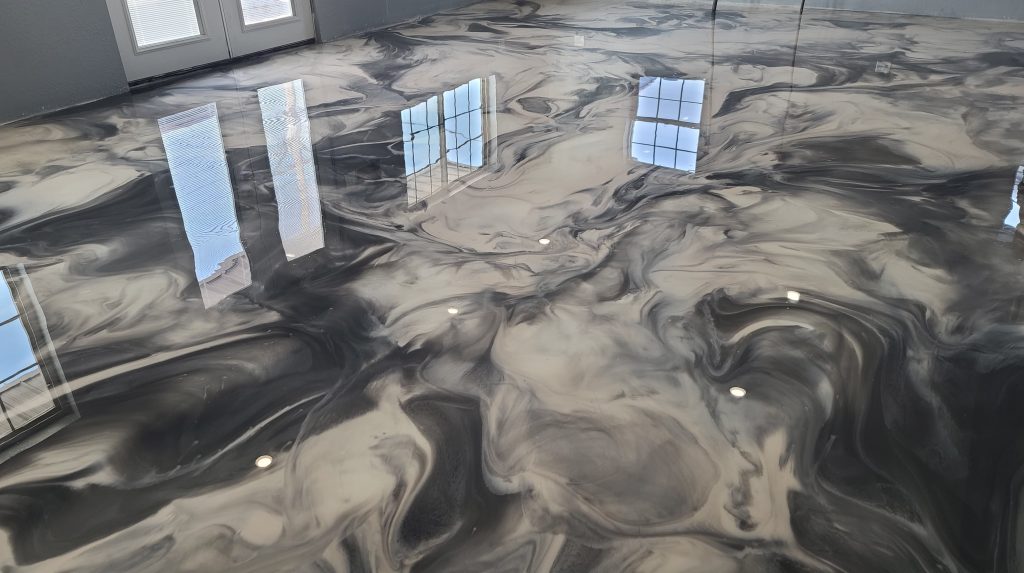
Metallic epoxy flooring is a two-component decorative floor coating system that uses pearlescent metallic pigments suspended in a clear or tinted epoxy resin. When applied, the pigments react with the wet epoxy, creating swirling, three-dimensional effects that cannot be replicated by any other flooring system. The final result resembles polished marble, flowing lava, deep ocean water, molten metal, or galaxies — depending on the color palette and application technique used by the installer.
Unlike mass-produced flooring products, metallic epoxy is entirely hand-crafted. Every floor is a one-of-a-kind piece of functional art. Two rooms with the same color palette and technique will still look different from each other — making metallic epoxy the ultimate expression of personalized flooring design.
Why Kansas City Property Owners Choose Metallic Epoxy
- Unmatched aesthetic impact — jaw-dropping 3D visual depth
- Seamless, grout-free surface that’s easy to clean
- Extremely durable — resists scratches, chemicals, and heavy traffic
- UV-stable topcoats prevent yellowing or fading
- Suitable for residential, commercial, and hospitality applications
- Increases perceived property value significantly
- Customizable colors to match any brand palette or interior design scheme
- Anti-slip finishes available for safety compliance
Metallic Epoxy Design Options in Kansas City
Color Palettes
We offer hundreds of metallic pigment colors and can blend custom shades to match any interior design vision. Popular metallic epoxy color schemes we’ve installed across Kansas City and Johnson County include:
- Midnight Black & Silver Galaxy — popular for luxury garages and man caves
- Ocean Blue & Pearl White — chosen for hotel lobbies and spa facilities
- Copper & Gold Fusion — a favorite for upscale restaurant dining areas
- Champagne & Bronze — elegant choice for retail boutiques in Leawood
- Emerald Green & Silver — striking for commercial showrooms in Overland Park
- Lava Red & Charcoal — popular for Kansas City BBQ restaurants and entertainment venues
Application Techniques
Our master installers use multiple techniques to create different metallic effects:
- Flow coat technique: creates soft, organic flowing patterns
- Marble veining: replicates the look of Italian Carrara marble
- Galaxy swirl: deep, cosmic three-dimensional effect
- Cracked earth: dramatic fissure patterns with contrasting colors
- Ombre gradient: smooth transition between two or more colors
Metallic Epoxy Flooring Cost in Kansas City
Metallic epoxy is the premium option in the epoxy flooring category, reflecting the skill, time, and materials required to achieve its distinctive look. Here’s what Kansas City property owners can expect to pay:
| Project Type | Size Range | Estimated Cost | Timeline |
| Residential Garage | 400–800 sq ft | $2,400–$9,600 | 1–2 days |
| Home Interior (Basement) | 500–2,000 sq ft | $3,000–$24,000 | 2–4 days |
| Retail / Boutique | 500–3,000 sq ft | $3,000–$36,000 | 2–5 days |
| Restaurant / Bar | 1,000–5,000 sq ft | $6,000–$60,000 | 3–7 days |
| Auto Dealership Showroom | 5,000–20,000 sq ft | $30,000–$240,000 | 5–14 days |
| Hotel Lobby / Corridor | 2,000–10,000 sq ft | $12,000–$120,000 | 4–10 days |
Factors that influence metallic epoxy pricing in Kansas City include: number of colors, design complexity, concrete preparation required, location and accessibility, and topcoat specifications (standard polyurethane vs. premium polyaspartic).
The Metallic Epoxy Installation Process
Phase 1: Concrete Evaluation & Moisture Testing
All metallic epoxy projects begin with a comprehensive concrete assessment. We perform calcium chloride moisture emission tests and relative humidity probe testing per ASTM F1869 and F2170 standards. Kansas City’s variable climate means moisture vapor transmission is a real concern, particularly in basements and slabs-on-grade. If moisture levels exceed manufacturer specifications, we apply a moisture vapor barrier epoxy primer before proceeding.
Phase 2: Diamond Grinding & Surface Profile
We grind the concrete to a CSP (Concrete Surface Profile) 2–3 using professional planetary diamond grinding machines. This opens the concrete’s pores, removes any existing sealers or coatings, and creates a mechanical anchor for the epoxy system to bond to. Cracks and control joints are repaired with semi-rigid polyurea caulk.
Phase 3: Epoxy Primer Coat
A 100% solids epoxy primer is applied at approximately 10–15 mils wet film thickness. This coat penetrates deep into the concrete, prevents outgassing bubbles in the metallic coat, and creates a smooth, consistent base for the decorative layer.
Phase 4: Metallic Base Coat Application
The metallic epoxy base coat is mixed with custom pigments and applied using a combination of tools: notched squeegees for even distribution, followed by spiked rollers to release air, and hand manipulation techniques unique to each installer to create the desired artistic effect. Multiple pigment colors may be worked simultaneously while the epoxy remains open and workable.
Phase 5: UV-Stable Clear Topcoat
Once the metallic layer has cured, we apply two coats of a UV-stable, aliphatic polyurethane or polyaspartic topcoat. This protects the metallic pigments from UV yellowing, adds chemical and abrasion resistance, and achieves the final sheen level — from satin to ultra-high gloss. For commercial applications requiring fast return to service, polyaspartic topcoats cure hard in 2–4 hours.
Project Showcase: Kansas City Metallic Epoxy Installations
Leawood Luxury Home — Master Bathroom Metallic Epoxy
A Leawood homeowner wanted to elevate their master bathroom renovation with a flooring statement piece. We installed a custom pearl white and gold metallic epoxy system to complement the home’s Italian marble vanity tops. The seamless surface eliminated grout lines, making daily cleaning effortless. The homeowner described it as ‘looking like a five-star hotel bathroom.’
Overland Park Auto Salon — Midnight Galaxy Showroom
An Overland Park luxury car detailing and storage facility commissioned a 4,200 sq ft metallic epoxy installation featuring deep midnight black with silver and blue metallic pigments. The floor became a central design element of the business, regularly photographed by customers and featured in local business spotlights.
Kansas City Restaurant & Bar — Copper Lava Design
A popular restaurant in the Kansas City Power & Light District selected a copper and charcoal metallic epoxy for their bar area and private dining room. The dramatic, warm tones complement the industrial-chic décor and have been a consistent conversation piece for diners. The project was completed over two consecutive weekends to avoid disrupting service.
Metallic Epoxy vs. Other Decorative Flooring Options
| Flooring Type | Visual Impact | Durability | Maintenance | Cost/Sq Ft |
| Metallic Epoxy | Exceptional — 3D Art | Very High | Very Low | $6–$12 |
| Luxury Vinyl Plank | Good | Medium | Low | $4–$10 |
| Marble Tile | Excellent | High | Medium-High | $15–$50 |
| Polished Concrete | Good — Industrial | Very High | Very Low | $4–$8 |
| Hardwood | Classic Warmth | Medium | High | $8–$25 |
| Stained Concrete | Good | High | Low-Medium | $3–$8 |
Metallic Epoxy Lifespan & ROI
When professionally installed by High Stakes Epoxy LLC, metallic epoxy flooring in Kansas City typically lasts 15–20+ years in residential settings and 10–15+ years in commercial environments with proper maintenance. The UV-stable topcoat prevents the color degradation and yellowing seen in older, solvent-based epoxy systems.
From an ROI perspective, metallic epoxy delivers exceptional value:
- Residential: Increases perceived home value; a finished, designer-quality floor adds appeal to luxury listings in Leawood, Overland Park, and Mission Hills
- Commercial: Creates a memorable brand environment that drives customer engagement and supports premium pricing
- Hospitality: Reduces long-term flooring replacement costs compared to tile or carpet
- Automotive: Transforms a dealership or shop floor into a high-end customer experience
Metallic Epoxy Maintenance Guide
Maintaining metallic epoxy floors is simple and requires minimal products:
- Daily: Sweep or dust mop to remove grit that can scratch the topcoat
- Weekly: Mop with warm water and a mild pH-neutral cleaner (avoid ammonia, bleach, or citrus-based cleaners)
- Monthly: Apply a compatible floor polish/maintainer to restore sheen on high-traffic areas
- Annually: Inspect topcoat for wear zones in high-traffic paths; schedule a professional recoat consultation if needed
- Avoid: Dragging sharp or heavy objects; prolonged standing water near expansion joints
| ✨ Transform Your Kansas City Space with Custom Metallic Epoxy — Request Your FREE Design Consultation Today! |
Frequently Asked Questions — Metallic Epoxy Flooring Kansas City
Q: Can metallic epoxy be installed in Kansas City basements?
A: Yes, but moisture management is critical. Kansas City basements, especially in older homes, can have elevated moisture vapor transmission from the slab. We perform ASTM-standard moisture testing before every basement project and apply a vapor-barrier primer when needed. With proper prep, metallic epoxy performs excellently in Kansas City basements.
Q: How long does metallic epoxy take to cure before we can walk on it?
A: Light foot traffic is typically possible within 24 hours. Full cure for vehicle or heavy commercial traffic requires 5–7 days with standard polyurethane topcoats, or as little as 24–48 hours with polyaspartic topcoat systems.
Q: Can metallic epoxy be applied over existing tile or old epoxy?
A: In some cases, yes — but it depends on the adhesion and condition of the existing surface. We always prefer to diamond grind down to bare concrete for maximum long-term adhesion. We’ll assess your existing floor during the free consultation.
Q: Does metallic epoxy work outdoors in Kansas City?
A: Standard metallic epoxy is not recommended for outdoor use due to UV exposure and moisture concerns. We offer UV-stable exterior coating systems and polished concrete alternatives for patios, driveways, and exterior commercial surfaces in the Kansas City area.
ARTICLE 3 OF 10
| Meta Title | Polished Concrete Floors Kansas City KS | High Stakes Epoxy |
| Meta Desc | Professional polished concrete floors in Kansas City, KS. Low maintenance, long-lasting, and stunning. Commercial & residential. Free estimates available. |
Polished Concrete Floors in Kansas City, KS: The Complete Commercial & Residential Guide
Polished concrete flooring has become one of the most popular flooring choices for Kansas City commercial buildings, retail spaces, offices, schools, and upscale homes. It combines unbeatable durability, minimal maintenance requirements, and a sleek, high-end aesthetic that works in virtually any design environment. High Stakes Epoxy LLC is Kansas City’s trusted polished concrete contractor, serving businesses and homeowners across the metro — from the Kansas City downtown core to Overland Park, Shawnee, Olathe, Gardner, and beyond.
What Is Polished Concrete?
Polished concrete is a mechanical finishing process that uses diamond-impregnated tooling — progressing from coarse grits (40–80 grit) to fine grits (800–3000 grit) — to grind, hone, and polish a concrete slab to the desired level of sheen. A chemical hardener/densifier is applied during the process to increase surface hardness and reduce porosity. Unlike epoxy or coating systems, polished concrete does not use a topcoat — the finish is entirely within the concrete itself, making it immune to peeling, chipping, or delamination.
The final result is a floor that ranges from matte (low sheen, 400 grit finish) to high gloss (mirror-like, 3000 grit finish). Aggregate exposure levels can also be customized: cream finish (no aggregate exposed), salt & pepper (light aggregate exposure), full aggregate (large stones visible).
Why Kansas City Businesses Choose Polished Concrete
Cost Savings Over the Lifetime of the Floor
Polished concrete has a higher upfront cost than VCT or carpet but delivers dramatically lower lifetime costs. There’s no waxing, no stripping, no replacement cycles. A polished concrete floor installed in a Kansas City warehouse or retail space can last the life of the building with proper care.
LEED and Sustainability Credits
Polished concrete utilizes the existing concrete slab, eliminating the need for new flooring materials. For Kansas City commercial projects pursuing LEED certification — particularly in the growing Lenexa and Overland Park commercial corridors — polished concrete can contribute credits in the Materials & Resources and Indoor Environmental Quality categories.
Improved Lighting Efficiency
High-gloss polished concrete reflects light, reducing the lumen output required to achieve target illuminance levels. Kansas City warehouse and retail operators often report 20–30% reductions in lighting energy costs after switching from dark, matte VCT to polished concrete.
Exceptional Durability for Kansas City’s Industrial and Retail Market
Polished concrete is ideal for forklift traffic, heavy racking loads, retail foot traffic, and food service environments. The densified surface is harder than unpolished concrete and resists abrasion far better than VCT, carpet, or standard epoxy coatings.
Polished Concrete Gloss Levels
| Grit Level | Appearance | Best Application |
| 400 Grit | Matte / Low Sheen | Industrial Warehouses, Back-of-House |
| 800 Grit | Satin / Semi-Gloss | Retail Stores, Schools, Offices |
| 1500 Grit | High Gloss | Showrooms, Hotels, Upscale Retail |
| 3000 Grit | Mirror / Ultra Gloss | Luxury Residential, Art Galleries |
Polished Concrete Cost in Kansas City, KS
Polished concrete pricing in Kansas City depends on the starting condition of the concrete, the number of diamond tooling passes required, the level of aggregate exposure desired, and the final grit level specified:
| Service Level | Description | Cost Per Sq Ft |
| Level 1 — Grind & 400 Grit Hone | Flat matte, minimal gloss | $2.50 – $4.00 |
| Level 2 — 800 Grit Polish | Semi-gloss, satin finish | $3.50 – $5.50 |
| Level 3 — 1500 Grit Polish | High gloss, reflective | $4.50 – $7.00 |
| Level 4 — 3000 Grit Polish | Mirror finish, maximum reflection | $6.00 – $9.00 |
| Dye + Polish (Custom Color) | Color added during polishing | Add $1.00 – $2.00/sq ft |
| Crack Repair / Prep Work | Per linear foot or area | $1.00 – $3.00/sq ft |
Polished Concrete Installation Process
Step 1: Concrete Assessment
We evaluate slab flatness, condition, existing coatings, hardness (using Mohs hardness test), and moisture levels. This determines the starting grit and process sequence.
Step 2: Coarse Grinding (Removal Phase)
Metal-bonded diamond segments at 30–80 grit are used to remove existing coatings, high spots, and surface laitance. This is the most aggressive and dusty phase — we use HEPA-filtered dust containment systems to maintain a clean job site throughout the Kansas City metro area.
Step 3: Medium Grinding (Transition Phase)
Progressive diamond tooling at 100–400 grit begins to refine the surface. Scratch patterns from previous grits are systematically removed. A chemical hardener/densifier (sodium, lithium, or potassium silicate) is applied during this phase to react with the calcium hydroxide in the concrete, forming additional calcium silicate hydrate — permanently hardening the surface.
Step 4: Honing & Polishing
Resin-bonded diamond pads at 800, 1500, and 3000 grit are used to progressively refine the scratch pattern until the desired sheen level is achieved. Each grit pass removes the scratches left by the previous pass. This is where the floor transforms from a matte grind to a glossy, reflective surface.
Step 5: Guard/Stain Protector Application
A penetrating silane or siloxane-based concrete guard is applied to reduce surface porosity, improve stain resistance, and ease daily maintenance. This is not a topcoat — it penetrates into the concrete and does not peel or chip.
Project Showcase: Polished Concrete in Kansas City
Olathe Retail Center — 18,000 Sq Ft 800 Grit Polish
A major retail tenant in an Olathe strip center required a cost-effective, durable flooring solution that could withstand heavy shopping cart traffic. We delivered an 18,000 sq ft 800 grit polished concrete installation in five days, with a lithium densifier and guard treatment. Three years later, the floor still looks outstanding with only regular mopping maintenance.
Shawnee Office Park — 1500 Grit with Dye Accent Bands
A corporate office campus in Shawnee selected polished concrete with custom charcoal dye accent bands for their main lobby and common corridors. The high-gloss finish reflects the building’s natural light, reducing lighting costs by an estimated 22%. The dye accent bands guide foot traffic and reinforce the company’s brand colors.
Kansas City Craft Brewery — Salt & Pepper Full Aggregate Expose
A popular craft brewery in the West Bottoms district selected a full aggregate exposure polish to complement their industrial warehouse aesthetic. We exposed the large river aggregate in the original 1940s slab, creating a unique connection to the building’s history. The floor is resistant to keg drops, spills, and heavy foot traffic from weekend events.
Polished Concrete vs. Epoxy: Which Is Right for Your Kansas City Project?
| Factor | Polished Concrete | Epoxy Coating |
| Topcoat Required | No — mechanical finish | Yes — coating applied |
| Peeling Risk | None | Possible if prep is poor |
| Repair Process | Re-polish damaged area | Re-coat or patch |
| Color Options | Natural + dyes | Unlimited colors/patterns |
| UV Resistance | Excellent | Depends on topcoat |
| Slip Resistance | Achievable with additives | Achievable with additives |
| Best For | Retail, warehouses, offices | Garages, showrooms, basements |
| Cost Per Sq Ft | $3 – $9 | $3 – $12 |
Maintenance Guide for Polished Concrete Floors
- Daily: Dust mop to remove abrasive particulates — the #1 enemy of polished concrete
- Weekly: Wet mop with a neutral pH cleaner specifically formulated for polished concrete
- Monthly: Apply a compatible burnishing compound if floor burnisher is available
- Annually: Professional maintenance visit to assess guard re-application needs
- Avoid: Acidic cleaners, bleach, high-pH alkaline cleaners, and dragging abrasive loads
- Use: Entrance mats at all exterior doors to capture grit before it reaches the polished surface
Polished Concrete Lifespan in Kansas City
Polished concrete is genuinely one of the most durable flooring surfaces available. With a well-prepared and properly polished slab, Kansas City commercial operators can expect a service life of 20–40 years with routine maintenance. The floor does not peel, crack (under normal loads), or need replacement. Periodic re-polishing or guard re-application may be needed every 5–10 years in heavy-traffic areas.
| 🏢 Upgrade Your Kansas City Commercial Floor with Professional Polished Concrete — Contact High Stakes Epoxy LLC Today! |
FAQs — Polished Concrete Kansas City
Q: Can polished concrete be installed in existing Kansas City buildings?
A: Yes. Polished concrete works with the existing slab — there’s nothing to tear out or replace (in most cases). We assess the concrete’s condition, repair significant damage, and begin the polishing process. Even 50–70 year-old concrete slabs in Kansas City’s older commercial buildings can often be polished successfully.
Q: Is polished concrete slippery?
A: Properly polished and guarded concrete has a slip resistance (DCOF) comparable to or better than most commercial tile. For wet areas, we recommend adding a fine grit anti-slip aggregate to the guard coat. We test and document DCOF values on all commercial projects.
Q: How long does polished concrete installation take?
A: A 10,000 sq ft commercial project typically takes 3–5 days. Larger spaces are divided into phases. Most polished concrete is walkable the same day the final polish pass is completed.