Facility managers responsible for large commercial or industrial spaces in Kansas City face a consistent tension: the floor needs to be clean, durable, and presentable, but the capital and maintenance budget does not always support a full polished concrete or epoxy system. Grind and seal concrete is the answer that High Stakes Epoxy most often recommends in this scenario — a professional, cost-effective system that transforms rough or worn concrete into a clean, sealed, easy-to-maintain surface at the best cost-per-square-foot available in the market. This guide explains exactly what grind and seal is, what it is not, who it is right for, and how to evaluate it against competing options for Kansas City commercial facilities.

What Is Grind & Seal Concrete?
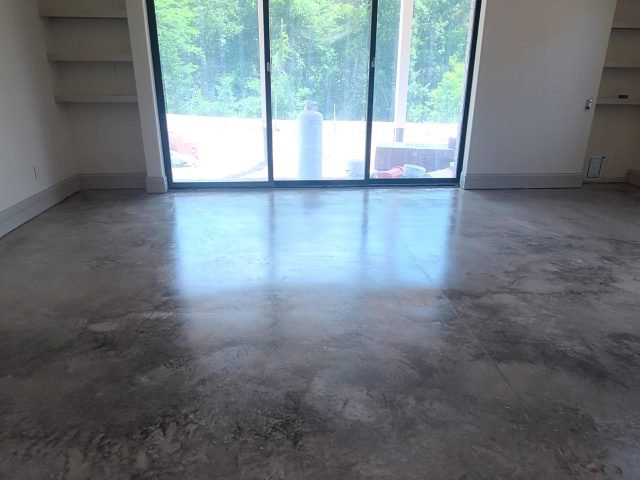
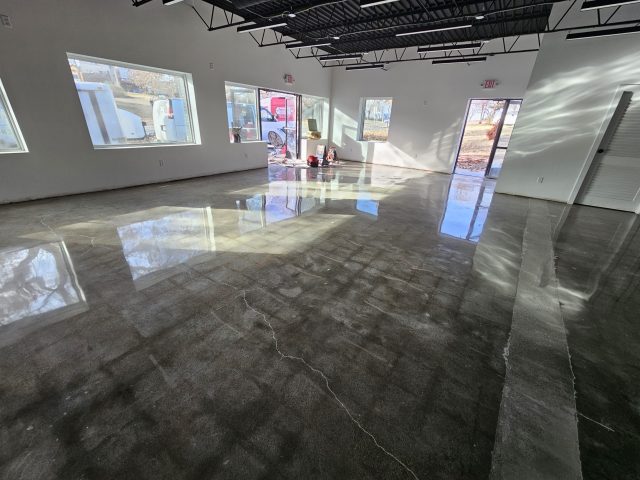
Grind and seal is a two-stage process. First, the concrete surface is mechanically ground with industrial diamond tooling to a consistent profile — removing surface laitance, minor high spots, and surface contamination while opening the concrete’s pores. Second, a penetrating or film-forming sealer is applied to protect the ground surface from moisture, oil, dust, and chemical penetration. The result is a clean, uniform, lightly sheen surface that looks professional, resists staining, and is dramatically easier to maintain than bare unprotected concrete.
The critical distinction between grind and seal and polished concrete is the final surface hardness and reflectivity. Polished concrete involves a multi-step grit sequence that progressively refines the surface to a high gloss with a densifier treatment that chemically hardens the concrete. Grind and seal stops after the initial grind, before the refinement stages, and applies a sealer rather than achieving optical clarity through mechanical polishing. The result is a matte to low-sheen surface that is durable and clean but does not have the light-reflective properties or the extreme hardness of a polished system.
Grind & Seal vs. Competing Systems for Kansas City Facilities
| System | Cost / sq ft | Gloss | Hardness | Reseal Frequency | Best Application | Lifespan |
|---|---|---|---|---|---|---|
| Grind & Seal | $2 – $4 | Low to medium | Moderate | Every 3–5 years | Warehouses, storage, secondary spaces | 5 – 10 years |
| Polished Concrete | $3 – $6 | High | Very high | Annual burnish only | Retail, showrooms, offices, schools | 20+ years |
| Epoxy Coating | $4 – $9 | Medium to high | High | N/A (replace system) | Chemical environments, food processing | 7 – 15 years |
| Bare Concrete (untreated) | $0 | None | Low | N/A | Not recommended | Degrades continuously |
The Real Cost of Grind & Seal in Kansas City
On a 50,000 sq ft warehouse or distribution center in the Kansas City metro, grind and seal runs approximately $100,000–$200,000 installed — roughly 40 to 60 percent of the cost of a full polished concrete system. The trade-off is the 3-to-5-year reseal cycle: a 50,000 sq ft reseal at $0.75–$1.50 per square foot runs $37,500–$75,000 per cycle. Over 15 years, a grind-and-seal system (installation plus two reseal cycles) totals approximately $175,000–$350,000 for a 50,000 sq ft floor. A polished concrete system over the same 15 years (installation plus minimal maintenance) totals approximately $150,000–$300,000 — slightly less, with no reseal disruption.
Where grind and seal clearly wins is in shorter-term scenarios: lease terms of 5–7 years, transitional facilities awaiting redevelopment, and spaces where the tenant or owner wants a clean, functional floor without a long-term capital commitment. In these contexts, grind and seal delivers the best value available.
Why Kansas City Facility Managers Specify Grind & Seal
Facility managers at distribution centers, flex industrial buildings, secondary warehouses, and institutional storage facilities in Johnson County, KCMO, and the I-70 industrial corridor consistently cite three reasons for choosing grind and seal: speed of installation, cost, and the dramatic improvement in dust generation. Bare concrete in a warehouse is a perpetual dust-generation machine; unprotected concrete sheds fine particulate with every forklift pass, coating products, racking, and equipment. A sealed surface stops this process entirely, reducing HVAC filter replacement frequency and improving the cleanliness of stored products. For food distribution and pharmaceutical storage operations, dust control is not aesthetic — it is a compliance requirement.
Maintenance Requirements for Grind & Seal Floors
Daily sweeping or auto-scrubbing. Weekly wet mopping with a pH-neutral cleaner. Reseal every 3–5 years depending on traffic intensity and sealer type. High Stakes Epoxy uses penetrating silane-siloxane sealers for industrial applications (more durable but lower sheen) and acrylic or polyurethane film-forming sealers for environments where a higher gloss or enhanced chemical resistance is needed. The reseal process itself takes 1–2 days for most commercial floor footprints and does not require surface grinding at reapplication — just light mechanical scuffing and cleaning before the new sealer coat.
Frequently Asked Questions: Grind & Seal in Kansas City
What is the difference between grind and seal and polished concrete in Kansas City?
Grind and seal grinds the surface to a consistent profile and applies a sealer; it delivers a matte to low-sheen finish with moderate durability at the lowest cost point. Polished concrete involves multiple progressive grinding and refinement stages with a chemical densifier, delivering a high-gloss, extremely hard surface with a 20+ year lifespan but at a higher initial cost.
How long does grind and seal last on a Kansas City warehouse floor?
A properly installed grind and seal system on a warehouse floor lasts 5–10 years before the sealer needs full replacement, with a reseal topcoat recommended every 3–5 years. Traffic intensity, wheel type (hard rubber vs. cushion tire), and maintenance discipline all affect this timeline.
Can you polish over grind and seal concrete later?
Yes. Grind and seal is a reversible starting point. If your use case or budget evolves, High Stakes Epoxy can strip the sealer and continue the polishing sequence to achieve a full polished concrete finish. The initial grind work is not wasted; it is simply the first step of the polishing sequence, done before the refinement stages.
How much does grind and seal cost in Kansas City?
Grind and seal in the Kansas City market runs $2–$4 per square foot installed depending on the condition of the existing concrete, the type of sealer specified, and the square footage. Projects over 20,000 sq ft typically fall in the $2–$3 range; smaller projects or those with significant surface repair needs are at the higher end.
Is grind and seal appropriate for a food-grade facility in Kansas City?
Grind and seal with a food-safe polyurethane sealer can be used in dry food storage areas and secondary processing zones. For active kitchen, production, and wet processing areas, urethane cement or a dedicated food-grade epoxy system is the appropriate specification. High Stakes Epoxy distinguishes between dry and wet food facility zones when specifying the correct system.
See more of our work on the High Stakes Epoxy website.